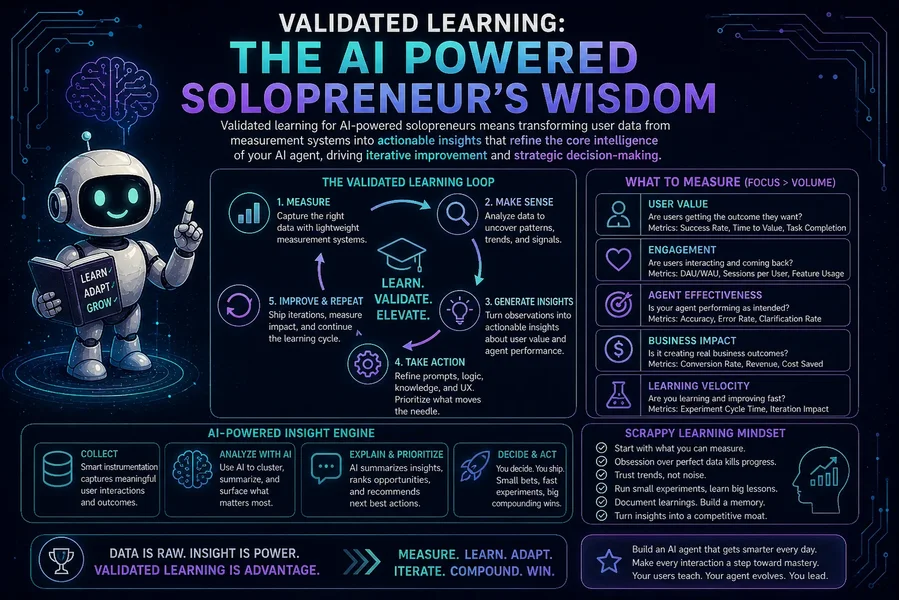
You have successfully moved past the "Build" stage by breaking down your agent's tasks. You've set up a "Measurement" system to track every signal from your early users. Now, you face the most crucial point for any startup: the Learn phase. This is where data turns into understanding, and where you, as a solopreneur, truly become a founder. In the typical software world, learning means fixing bugs and adding features. But for AI agents, learning is about improving the very core "thinking" and reasoning of your product.
Learning is the main goal of the Lean Startup cycle. We don't build things just to build them, and we don't count things just to count them. We do these actions to reach a moment of clear understanding. As Eric Ries explains, the only thing that truly matters in a new startup is Validated Learning. This is the process of proving, with evidence, that a team has found reliable truths about a business's potential. For someone building an AI agent, this means showing that your agent's "reasoning loop" actually offers value that users will keep paying for over time.
"Validated learning is not a way to explain things after the fact or a good story to hide failure. It's a precise method to show progress when facing extreme uncertainty."
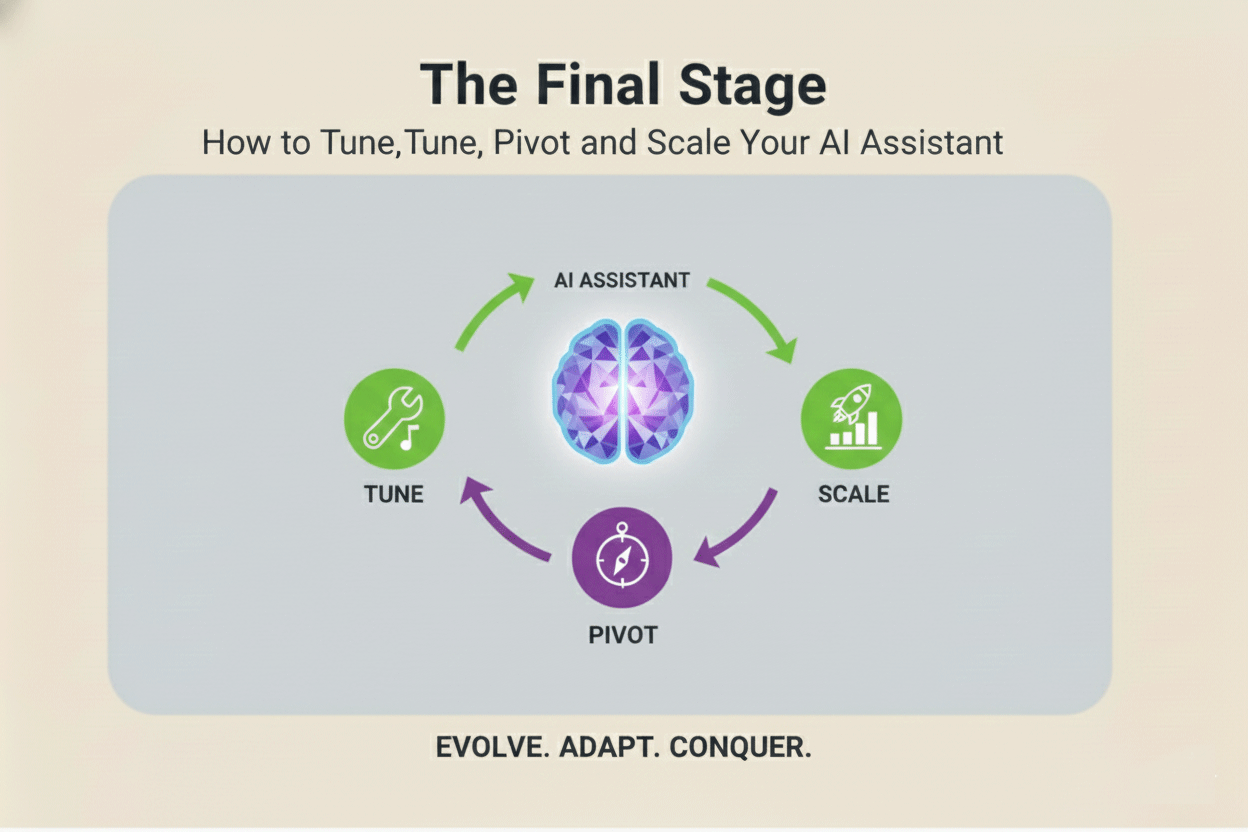
In this final part of our challenge, we'll look at how to understand the signals you've collected. We'll also cover how to make the tough choice between changing your direction or sticking with it. Finally, we'll explore how to improve your agent's intelligence smartly, without getting stuck in endless prompt tweaking.
Interpreting the AI Signal: Distinguishing Wisdom from Noise
AI agents generate a special kind of data. Unlike a simple click on a button in a regular app, an agent's interaction is less clear-cut. A user might get exactly what they wanted but still give the agent a "thumbs down" because they disliked the tone. On the other hand, a user might be thrilled by a mistake (a hallucination) that sounds believable.
Your first task in the Learn phase is to tell the difference between the Signal and the Noise. The Signal is the behavior that shows your product is a good fit for the market. The Noise includes unusual events and variations in how the AI model works.
To do this, you need to look at your measurement data by considering User Intent. Ask yourself: "Did the agent fail because of a technical issue with the model itself, or because the user's expectations were completely different from the task we designed it for?"
There are three main areas where you can learn from your AI agent's performance. These types of learning help you pinpoint the exact problem and find the right solution. Understanding these distinctions is key to refining your agent and ensuring it truly meets user needs.
Structural Learning: This happens when you discover that your access to data wasn't good enough. For instance, if your inventory agent missed a stockout because the system updating the API was too slow, that's a structural lesson. You've learned that real-time information is not just a convenience, but a necessity. This understanding guides you to improve the underlying data systems that your agent relies on, ensuring it has the most up-to-date information to make accurate decisions.
Reasoning Learning: This occurs when the agent had the correct data but made a poor decision. Imagine the agent marked an item as "low stock" when it was actually a seasonal product that shouldn't be reordered. This is a lesson about Context. You've learned that your agent needs to understand "Seasonality Rules" to be perceived as intelligent. This type of learning points to the need for your agent to have a more sophisticated understanding of the data it's processing, going beyond simple facts to grasp nuances and implications.
Value Learning: This is the most critical type of learning. If users are completing tasks but never come back, you've learned that while your solution might technically "work," the problem it solves isn't significant enough for users to build a new habit around it. You've confirmed a lack of strong need or urgency. This insight is vital because it addresses whether your product solves a truly painful problem for users, one they are willing to invest time and effort into repeatedly.
The Moment of Truth: Pivot or Persevere?
Steve Blank often says that a startup is a temporary team built to find a business model that can be repeated and grown. The "Learn" phase marks the end of this search. Based on your key numbers—how strongly users feel about the problem, how often they use your product, and how well tasks are completed—you must now decide if your current direction is working.
For a solopreneur, changing direction (a Pivot) is not a failure. It's a smart move made because you have evidence. Because you've used a lean approach, changing course at this stage doesn't cost much. You haven't built a huge, complicated system; you've created a specific task-focused agent. Here are the most common ways AI agents might pivot:
The Zoom-In Pivot: Your agent might have been designed to handle several tasks, like managing inventory, setting prices, and sending emails. You discover through user feedback that people are only really interested in the Pricing task. In this case, you "zoom in" and make the Pricing agent your entire product. This focuses your efforts on the most valuable part of your original idea.
The Customer Segment Pivot: You might have built an inventory agent for small sellers on platforms like Etsy. However, your data shows that only users who sell a lot on Shopify are using it frequently enough to show repeat usage. You then shift your marketing and product features to better serve these high-volume Shopify users. This involves understanding who your most engaged users are and tailoring your product to their specific needs.
The Platform Pivot: You could have developed the agent as a web application. But, your conversations with users reveal that they dislike having to leave their familiar Slack or Discord environments to use your agent. You then decide to move the core functionality of your agent so it works within the platforms where users already spend their time. This makes your agent more convenient and integrated into their daily workflow.
Persevering is the opposite of pivoting. It means your key metrics are improving, and you have confirmed your main ideas about the business are correct. If you decide to persevere, your learning focus shifts to improving what you have. You are no longer questioning the fundamental "Why"; you are working on perfecting the "How."
💡 Pro Tip: The "Five Whys" of Agent Failure. When your agent fails to complete a task, don't just tweak the instructions you give it. Ask "Why?" five times. 1. Why did it fail? (It made up a price). 2. Why? (It didn't have the latest price list). 3. Why? (The step to get the data took too long). 4. Why? (The database query was too complicated). 5. Why? (We are storing data in a way the AI model can't easily understand). After asking five times, you'll likely find a core problem with how data is stored, something simply changing the prompt wouldn't fix.
Strategic Iteration: Refining the Agentic Brain
Once you decide to keep going with your current direction, you enter a phase of careful improvement. As a solopreneur, you can't afford to chase every new AI model or technique. You must improve your agent based on the Intervention Rate, which we discussed earlier. This rate shows how often you, the human in charge, have to step in and help the agent.
If you are still intervening 40% of the time, your goal is to reduce that to 5%. You do this through specific "Learning Interventions." These are targeted actions to make your agent more independent and accurate.
Level 1: Prompt Engineering (The Easy Fixes). Look through your agent's activity logs to find where its decisions differed from what the user wanted. Often, a simple example provided to the agent, known as "Few-Shot" learning (giving it 3 examples of a correct answer), can fix 80% of reasoning errors. This is the quickest way to "teach" your agent during the Learn phase.
Level 2: RAG Optimization (Adding Context). If your learning shows the agent is often "guessing" facts, you need to improve your Retrieval-Augmented Generation (RAG) system. RAG helps the AI access and use relevant information. Learning in this area might involve realizing your agent needs to see the last 10 sales, not just the last 2, to give a smart suggestion. You are essentially improving the agent's ability to "remember" and use relevant information.
Level 3: Fine-Tuning (Building Specific Skills). This is a later stage of improvement. If you have gathered 1,000 examples of "perfect" interactions, and your agent still struggles with a certain tone or a complex way of presenting information, you might learn that the basic AI model isn't capable enough. By training a smaller, less expensive model on your collection of "correct" examples (your "Backlog of Truth"), you can often create an agent that is faster and more reliable than using the most expensive, general-purpose models.
The Founder’s Intuition vs. Data
In a lean startup, we rely heavily on data, but we don't dismiss the founder's gut feeling. Measurement tells you What is happening, but conversations with users explain Why. If your numbers are dropping, but your talks with users are incredibly enthusiastic, you might be looking at the wrong indicators.
Conversely, if your numbers are good, but users seem uninterested or "bored" when you interview them, your customer retention will likely suffer later. This indicates a superficial engagement that won't last.
Validated learning happens at the meeting point of these two forces. It's the moment you realize, "The data shows X, the users are saying Y, therefore the actual truth must be Z." For a solopreneur, this clarity is your "Aha! Moment." It's the point where the challenge of building shifts from a constant struggle to a clear, focused mission. You're no longer just guessing; you're acting on a plan that has been proven to work.
"The goal of the Learn phase is to reach a state where you can predict the outcome of your changes before you make them."
Conclusion: Completing the Loop
The Solopreneur’s AI Agent Build Challenge isn't a one-time event. It's a continuous cycle. After you learn and make improvements, you go back to Build. But this time, you're not building a basic version (MVP); you're building Version 1.1. You build with the confidence that every piece of code is supported by proof. Your data is more reliable, your safety checks are stronger, and your measurements are more exact.
By following this lean approach—Build (Atomized), Measure (North Star), and Learn (Validated)—you have protected your most precious resources. You've avoided the common fate of over-built AI projects that no one actually wants. You have created an agent that doesn't just converse; it performs tasks. You have built a startup that doesn't just exist; it learns and improves.
The age of AI belongs to those who are disciplined enough to build lean. Go back to your activity logs, talk to your testers, and find your next "Why." The loop never truly ends; it's just the start of your growth. Happy building.
✅ Final Pro Tip: Celebrate the "Negative Validation." Learning that a feature isn't useful is just as valuable as learning that it's great. Every feature you remove lightens your load and clarifies the path toward the features that truly matter. In a lean startup, a "No" from the market means a "Yes" for your focus.



No comments yet
Be the first to share your thoughts on this article!