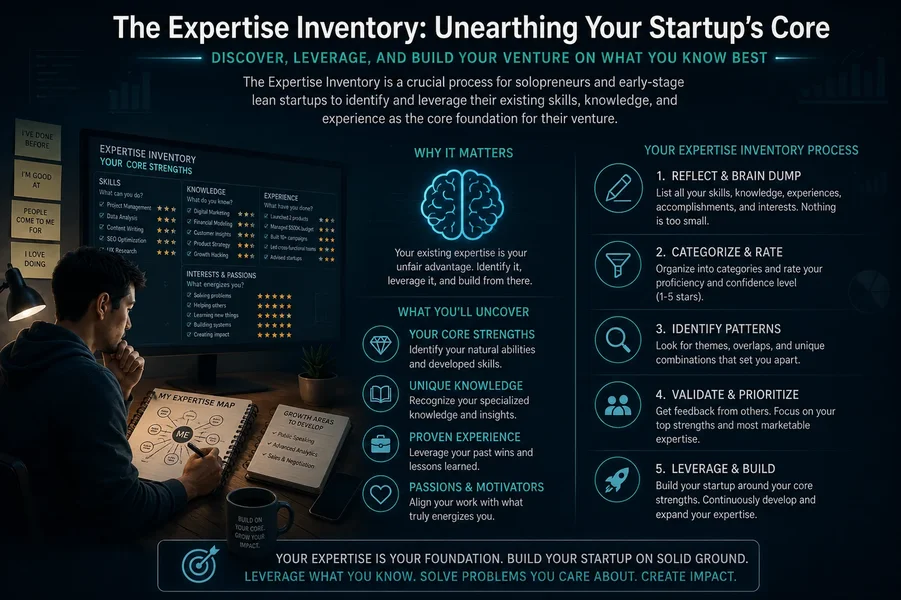
So, you've found yourself at a crossroads. Perhaps a sudden layoff disrupted your path, an industry-wide economic shift altered your career trajectory, or a persistent, deep-seated desire to build something on your own terms finally won out. Whatever catalyst brought you to this point, you are embarking on an entirely new journey: launching your first startup, either as a solo operator or alongside a lean co-founding team. The good news? You are not starting from scratch. You are starting with a deep well of accumulated experience, refined skills, and hard-earned knowledge. This unique expertise is your starting capital. Understanding how to unlock, analyze, and package it is the critical first step in the "Learn" phase of the Lean Startup cycle, popularized by Eric Ries.
Many first-time founders mistakenly believe they must immediately master complex business terminology, draft fifty-page marketing plans, or acquire advanced technical credentials before launching. While these components have their place, overfocusing on them early on leads to procrastination and diverts your focus from your ultimate competitive advantage: what you already know better than anyone else. Think of this process not as a superficial resume-building exercise, but as a forensic audit of the real-world, highly specialized capabilities you have cultivated over years of professional and personal life. Your expertise inventory is your raw asset. It represents your initial hypothesis of the value you can introduce to the market. In lean startup methodology, it is far more efficient to build on your existing strengths than to spend precious runway trying to master a completely foreign domain from scratch. By anchoring your venture in your core strengths, you establish a resilient, authenticated starting point for market validation.
The Psychology of the Transition: Overcoming the "Curse of Knowledge"
Before putting pen to paper, it is essential to address the psychological friction that often stops founders from accurately identifying their value. The most common hurdle is what cognitive psychologists call the Curse of Knowledge. When you are highly skilled at something, that skill becomes second nature to you. You begin to assume that because a task, workflow, or concept is easy for *you*, it must be simple and obvious to everyone else. This cognitive bias causes founders to systematically overlook their most valuable, and highly monetizable, skills.
To understand this phenomenon, we must look at the psychological model of the Four Stages of Competence:
- Unconscious Incompetence: You don't know what you don't know.
- Conscious Incompetence: You know what you don't know, and you realize you have a skill gap.
- Conscious Competence: You can perform the skill, but doing so requires heavy focus and mental processing.
- Unconscious Competence: The skill is so deeply ingrained that it has become second nature; you execute it effortlessly, often without thinking.
The trap for founders is that your most profitable skills live almost entirely in stage four: Unconscious Competence. Because you no longer have to exert conscious effort to do them, you write them off as "common sense."
For example, a veteran operations manager might think, "Everyone knows how to streamline a fulfillment process; it's just common sense." In reality, to a fast-growing e-commerce startup owner drowning in backorders, those "obvious" processes are an opaque, stressful bottleneck they would gladly pay thousands of dollars to solve. To combat this bias, you must look at your background through the eyes of an outsider. What feels like "basic common sense" to you is often a highly sought-after superpower to someone operating in a different sphere. Your target customer is typically struggling in Stage 1 or Stage 2, and they are desperately searching for someone who operates at Stage 4.
Mapping Your Skills to Market Needs: The Five-Category Audit
To construct an honest, comprehensive "Expertise Inventory," you must look beyond corporate job titles and dive deep into your behavioral history. Grab a notebook or open a blank document and begin cataloging your assets across five distinct dimensions, free from self-censorship or immediate judgment. This self-awareness exercise directly aligns with customer development pioneer Steve Blank’s model: you must know your own capabilities before you can hope to understand how they fit into a customer's workflow.
- 1. Technical Skills (The "How-To" Mechanics): These represent the concrete, practical abilities you have acquired. This category includes software proficiencies (e.g., advanced Excel modeling, Figma design, database administration), coding languages (e.g., Python, Javascript, SQL), technical writing, or specialized equipment operation. These are the functional mechanics that allow you to build, configure, edit, or repair assets. For instance, a founder with a command of Python and data visualization tools like Tableau can construct custom data pipelines for small firms, while an illustrator skilled in vector graphics can visually translate abstract tech concepts. These skills allow you to produce high-quality, tangible deliverables immediately without hiring external help.
- 2. Soft Skills (The Human Operating System): These are your interpersonal dynamics, character traits, and cognitive styles. They govern how you build relationships, resolve friction, and direct projects. Key examples include persuasive communication, creative problem-solving, structured negotiation, high-empathy active listening, and strategic project coordination. As Ash Maurya notes in Running Lean, soft skills are the lifeblood of startup agility. A founder who can communicate with extreme clarity can distill a complex product vision into a compelling pitch for early adopters, while a founder with exceptional problem-solving skills can navigate the inevitable operational roadblocks of early company building. These human skills are what turn raw technical output into a trusted business relationship.
- 3. Industry Knowledge (The Landscape Map): This is your systemic understanding of a specific macro-market. It includes knowing who the dominant players are, the typical distribution channels, regulatory compliances (e.g., HIPAA, GDPR), and the highly specific jargon or cultural norms of that sector. This insider perspective gives you an immediate competitive moat. If you have spent a decade in healthcare administration, you understand the regulatory minefields, the procurement cycles of hospital networks, and the precise daily frustrations of clinical staff. This depth of understanding prevents you from building solutions that violate compliance laws or require unrealistic behavioral changes from your end users.
- 4. Domain Expertise (The Functional Specialty): This refers to your deep, specialized mastery of a specific functional role within an organization, independent of the industry itself. You might have domain expertise in supply chain logistics, performance marketing, high-volume recruiting, corporate tax planning, or developer relations. This focused knowledge allows you to solve highly precise pain points. For example, an expert copywriter knows the exact psychological triggers required to optimize email open rates. This domain mastery positions you not as a general service provider, but as a specialized expert capable of driving immediate business results.
- 5. Life Experiences (The Untapped Capital): Do not discount the invaluable lessons, networks, and resilience gained from personal endeavors, hobbies, or life challenges. Managing a massive volunteer-led charity event, executing a complex home renovation project, navigating a difficult immigration process, or even training for a marathon all forge valuable entrepreneurial traits. Organizing a local community drive refines budgeting, volunteer management, and localized marketing. Navigating a complex immigration process builds extreme persistence and systematic document management. These unconventional avenues of experience often yield highly creative startup concepts and a unique capacity to endure early-stage ambiguity.
Once you have compiled this comprehensive inventory, your next task is to translate these raw personal assets into market-facing solutions. This is the bridge to achieving "Problem-Solution Fit"—a core milestone in lean thinking. You do not look for a job description that matches your skills; instead, you look for a specific friction point in the real world that your skills are uniquely equipped to eliminate.
For every major skill on your list, push past the feature or the title and write down the corresponding human pain point. Use this template to draft your early market hypotheses:
"I believe that [Specific Target Customer Segment] experiences recurring friction with [Observed Pain Point], and I can leverage my [Unique Inventory Skill] to resolve this by [Proposed MVP Solution]."
Write down at least three distinct variations of this formula. This exercise forces you to transition from introspective self-analysis to market-oriented hypothesis generation.
Evaluating Your Hypotheses: The Feasibility vs. Pain Scorecard
Once you have generated three or more variations of your opportunity hypothesis, how do you decide which one to validate first? You must score them systematically based on two crucial axes: Customer Pain Severity and Founder Feasibility. Use this simple scoring model to rank your opportunities:
- Pain Severity (Score 1-5): Is this problem a "paper cut" or a "gaping wound"? A score of 1 means it is a minor annoyance that people complain about but won't pay to solve. A score of 5 means the problem actively costs them significant money, wastes critical hours, or threatens their job security.
- Founder Feasibility (Score 1-5): How easily can you deliver the solution using only your current skills and tools? A score of 1 means you need to learn to code or hire a large team to build it. A score of 5 means you can deliver the core value using simple spreadsheets, existing nocode apps, or direct consulting.
Multiply these two scores together to get a total validation score out of 25. Prioritize the hypothesis with the highest score. Your goal is to find the sweet spot: high pain, high feasibility.
The Skill-to-Problem Translation Matrix
To help visualize this translation process, study the matrix below to see how standard, everyday skills map directly to urgent commercial opportunities:
| My Raw Skill Asset | The Hidden "Curse of Knowledge" Trap | The Real-World Market Friction | The Commercial Opportunity |
|---|---|---|---|
| Advanced Spreadsheet Modeling | "Anyone can set up a Pivot Table, it's basic math." | Local service business owners manage inventory on paper and lose track of margins. | Custom inventory dashboard creation and monthly financial optimization as a service. |
| Event Logistics & Coordination | "Planning schedules and ordering food isn't a business." | Remote companies struggle to coordinate productive, engaging annual in-person retreats. | Turnkey corporate retreat planning specializing in remote team alignment. |
| Technical Copywriting | "I just write emails and update blog posts; it's easy." | B2B software founders build incredible tools but struggle to explain what they do clearly. | Landing page messaging audits and conversion copywriting for early-stage SaaS. |
The Power of the Feedback Loop: Listening to Your Market
A startup is almost never a linear march from a brilliant initial idea to market dominance. Rather, it is an iterative, evolutionary process of scientific discovery. The "Learn" stage of the Lean Startup cycle is where this reality becomes clear. The foundational currency of this stage is qualitative feedback. As a bootstrapped solopreneur, you do not have millions of dollars to spend on massive quantitative focus groups; instead, your primary competitive edge is your capacity to engage in deep, unvarnished, one-on-one conversations with potential buyers. This is the exact core of Steve Blank’s Customer Development methodology: "Getting Out of the Building."
Your expertise inventory provides you with a starting baseline—your internal hypothesis. Customer Discovery is the process of testing that hypothesis against the hard reality of human behavior. When conducting discovery, you are not pitching your solution. In fact, if you mention your product idea in the first 20 minutes of a customer interview, you have compromised the data. Your objective is simply to understand the customer's daily workflows, frustrations, and priorities.
Mastering the Rules of "The Mom Test"
To ensure your customer discovery interviews yield pure, uncorrupted data, you must follow the principles outlined in Rob Fitzpatrick’s seminal book, The Mom Test. The core premise is that you should never ask anyone if your business idea is good. If you ask your friends, family, or even potential customers, "Would you buy a product that does X?", they will say "yes" out of politeness. This is false positive data that can lead you to build a product nobody actually wants.
Instead, your conversations must adhere to these three golden rules:
- Rule 1: Talk about their life, not your idea. Keep the focus entirely on the customer’s actual experiences, routines, and workflows.
- Rule 2: Ask about specifics in the past, never generics about the future. Do not ask, "Would you use an app that manages your schedules?" Instead, ask, "How did you manage your schedule last Tuesday? Walk me through what went wrong."
- Rule 3: Talk less, listen more. Your job is to facilitate, take notes, and let them vent. Silence is your friend; it invites the customer to fill the gap with raw, emotional details about their struggles.
Case Study: Sarah’s Transition from Corporate HR to Entrepreneurship
To see this in action, let us look at Sarah. After spending 15 years in corporate human resources, specializing in employee training, structural development, and onboarding, she stepped away to build her own venture. Her expertise inventory highlights a deep mastery of instructional design, organizational behavior, and soft skills training. Her initial startup hypothesis was that small, fast-growing tech startups (10 to 50 employees) struggle to onboard new staff efficiently and would readily buy an extensive, high-ticket online onboarding training program.
Instead of locking herself away to build the curriculum, Sarah initiated a Customer Discovery campaign. She reached out to founders and operations managers at small tech firms on LinkedIn. Her outreach was simple: she was not selling anything; she was an HR researcher trying to understand how fast-growing teams handle early cultural alignment. She secured 15 interviews. During these conversations, Sarah avoided showing templates or discussing her curriculum. Instead, she used a highly diagnostic line of inquiry:
- "Walk me through the exact day a new employee joins your team. What happens first?"
Why this is asked: This open-ended question forces the interviewee to recount historical actions rather than speaking in vague, idealized generalities. It exposes raw operational reality.
- "What was the single most frustrating part of onboarding your last hire?"
Why this is asked: This isolates immediate pain. It reveals whether the frustration is administrative (e.g., setting up email accounts, signing contracts) or developmental (e.g., learning the product, aligning with cultural values).
- "How do you currently measure if a new hire is successful after 30 days?"
Why this is asked: This uncovers their internal definition of value and success metrics. If they do not track this, she knows they lack formal systems and may need a highly structured, simple framework.
- "What tools or methods have you tried to make this process easier, and what did you dislike about them?"
Why this is asked: This is a critical validation check. If the company has never spent money, time, or spreadsheet space trying to solve the problem, the pain is not severe enough for them to buy a new solution.
Through this deliberate, systematic process of active listening, Sarah avoided a major pitfall. She discovered that while startups did suffer from onboarding friction, their main headache was not "training modules" or "cultural history lessons"—it was the immense administrative overhead of the first week (e.g., provisioning software, sending contracts, setting up standard tasks). They did not want to buy an expensive, time-consuming course. They wanted a plug-and-play toolkit of checklists, legal templates, and sequence guides that they could immediately hand to an office manager to execute in an afternoon.
Use the prompt below to generate your own customized list of diagnostic customer discovery questions based on your specific skills:
"I am launching a lean startup and want to run customer discovery. My core expertise is in [Your Key Skill from Inventory]. My primary hypothesis is that [Target Customer Segment] struggles with [Observed Pain Point]. Help me draft 5 open-ended, non-leading diagnostic interview questions that focus on uncovering their historical behaviors, current workflows, and actual financial or time costs, without sounding like a sales pitch."
Iteration and Adaptation: Refining Your Offering
As you collect feedback from your discovery interviews, you will inevitably begin to see clear patterns. These trends are your data points. They will highlight where your initial assumptions were correct, where you were slightly off, and where you were completely wrong. In the lean model, you do not view incorrect assumptions as failures. They are simply successful invalidations that narrow your focus toward what the market actually wants. This leads directly to the practice of iteration: making systematic, incremental improvements to your product, service, or business model based on verified customer feedback.
Let's return to Sarah's journey. Armed with the discovery data showing that comprehensive courses were a poor match for small, fast-moving startups, she iterated. She abandoned the idea of building a multi-module video course. Instead, she designed a highly practical, low-friction solution: "The First-Week Onboarding Blueprint." This was a package of pre-configured Notion templates, customizable Google Doc checklist templates, and automated email sequences designed to get a new hire fully operational in five days.
This revised offering represented a true Minimum Viable Product (MVP). As defined by Eric Ries, an MVP is not merely a cheaper, stripped-down version of a final product; it is a structured mechanism designed to maximize validated learning with the absolute minimum amount of effort and resources. An MVP is a test of your value proposition. By releasing a clean, functional toolkit built on basic software tools, Sarah was able to instantly test whether founders would actually pay for administrative relief, without spending months coding a custom software platform.
Three Types of Lean MVPs for Solopreneurs
As a bootstrapped founder, you have three primary architectural pathways to build and test your MVP without writing a line of code or exhausting your life savings:
- The Concierge MVP: You deliver the service manually to the customer, but package it to look like a polished product. The customer knows it is human-powered, but they get the exact benefit. For example, before building an automated scheduling algorithm, you personally match calendars via email. This allows you to experience every operational bottleneck firsthand.
- The Wizard of Oz MVP: On the front end, it looks like a highly sophisticated, fully automated software application. On the back end, however, *you* are manually pulling the levers and performing the work. To the customer, the process is seamless and magical; to you, it is an intense manual process that proves whether they value the output before you spend $20,000 on software development.
- The Smoke Test (Landing Page) MVP: You create a highly polished marketing page detailing your product's core features, pricing tiers, and benefits. Instead of a checkout, you place a high-intent button like "Get Early Access" or "Buy Now." When clicked, you display a polite message saying the product is at capacity, and you invite them to join the waitlist. This tests actual commercial demand and transaction intent before a single line of product exists.
If you are a solopreneur offering expertise, the fastest, cheapest way to test your MVP is through Concierge Service Delivery. Do not build software or complex portals yet. Perform the service manually for your first three clients. If you want to build an automated scheduling app, act as the manual scheduler behind the scenes via email first. This hands-on execution teaches you every single nuance of the user's workflow, ensures your solution works, and funds your development with actual customer revenue.
Pivot vs. Persevere: The Art of Strategic Decision-Making
After launching your MVP and collecting early engagement data, you will arrive at the most critical juncture of the "Learn" phase: the Pivot-or-Persevere decision point. This is where founders must strip away emotion and make a highly strategic choice about the future of their venture based on objective data.
- When to Persevere: You choose to persevere when your core hypotheses are consistently validated by high-intent actions. If your MVP is seeing organic engagement, low churn, and customers are successfully achieving their "Aha!" moment without constant hands-on troubleshooting from you, your core model is sound. Your primary focus should now shift to micro-optimizing your workflows, expanding customer acquisition channels, and scaling delivery.
- When to Pivot: A pivot is a structured, strategic course correction designed to test a new hypothesis about your product, business model, customer segment, or engine of growth. It is not an admission of defeat; it is a calculated redirection of your intellectual capital based on market feedback. If your target market repeatedly expresses interest in your space but consistently refuses to pay, or if users sign up for your MVP but abandon it after one session, you must pivot.
Establishing Quantitative Pivot Triggers
To remove emotional bias from the pivot-or-persevere choice, establish "trigger thresholds" before running your MVP tests. Write down your targets in advance. For example:
- The Ad/Landing Page Test: If our cost-per-click (CPC) is under $1.50 and the landing page conversion rate is above 8% after 500 visitors, we persevere. If conversion falls below 3%, we pivot our messaging or target segment.
- The Free-to-Paid Trial Test: If at least 15% of our active trial users upgrade to a paid tier at the end of 14 days, we persevere. If the upgrade rate is under 5%, we pivot our pricing structure, onboarding loop, or targeted features.
Having these predefined thresholds protects you from the sunk cost fallacy—the urge to keep pouring hours into a failing model just because you have already invested so much time into it.
The Six Most Common Startup Pivots
If the market signals that a change is required, you will generally execute one of these classic pivot types:
- The Zoom-In Pivot: This occurs when a single, specific feature or service within your broader MVP becomes the only thing customers actually care about. You strip away all other features to focus entirely on making this single element a standalone offering. (e.g., Sarah shifting from a broad consulting practice to focusing exclusively on onboarding templates).
- The Zoom-Out Pivot: The reverse of the Zoom-In. Sometimes, your single feature is not enough to solve the customer’s entire problem. You must expand your offering to include a broader suite of integrated services to deliver full value.
- The Customer Segment Pivot: Your product successfully solves a real problem, but your initial target customer segment turns out to be the wrong audience (e.g., they lack the budget, are too difficult to acquire, or have too much internal bureaucracy). You take the exact same solution and apply it to a completely different customer profile (e.g., shifting from cash-strapped solo freelancers to well-funded small agency owners).
- The Customer Need Pivot: Through deep customer intimacy, you discover that the problem you initially set out to solve is a minor inconvenience, but a related, much larger problem exists nearby. You shift your solution to target this newly discovered, highly urgent pain point.
- The Platform Pivot: A transition from delivering a service directly to building a platform that allows others to deliver that same service themselves, or vice versa (e.g., moving from high-ticket custom SEO consulting to building a self-service SEO auditing tool).
- The Channel Pivot: A shift in how you deliver your product or service to your customers, such as changing from an enterprise-sales model to a self-serve, direct-to-consumer online subscription model.
For Sarah, if her target demographic of small tech startups had loved her onboarding templates but ultimately lacked the budget to purchase them at her target price point, she would not have closed her business. Instead, she could have executed a Customer Segment Pivot. She might have taken the exact same onboarding templates and retargeted them at mid-sized consulting firms or franchise operations, where the cost of staff turnover is exceptionally high and budgets for internal operational tools are pre-allocated. By maintaining complete emotional objectivity and treating your venture as an ongoing experiment, you preserve your energy, protect your capital, and continually move closer toward true Product-Market Fit.
Conclusion: Your Expertise as a Learning Machine
Transitioning into entrepreneurship is a profound personal and professional evolution. Yet, success in this landscape is not determined by the size of your initial funding round, the complexity of your software code, or the elegance of your initial business plan. It is determined by the speed and efficiency with which you can execute the Build-Measure-Learn feedback loop.
Your unique expertise is the foundation of this process, but the market is the ultimate architect. By conducting a systematic inventory of your skills, translating those skills into high-value hypotheses, actively listening to customers through discovery, and adapting based on data, you turn your startup into an incredibly agile learning machine. Embrace the feedback, respect the data, and view every pivot as an exciting step closer to building a business that delivers profound, lasting value to your market.



No comments yet
Be the first to share your thoughts on this article!