

The journey from a disrupted career to a thriving startup is less about starting from zero and more about leveraging the immense, battle-tested toolkit you already possess. As a solopreneur or early-stage founder facing the monumental task of building something from scratch, it’s easy to feel overwhelmed. You might have navigated the "Build" phase by launching an MVP using simple no-code tools, but now you face an even greater challenge: proving your creation has actual legs. How do you know if you are on the right track before you pour all of your limited time, capital, and emotional energy into a concept that might not resonate? This is where the MEASURE phase of the Lean Startup cycle becomes your most critical operational anchor. It is about converting vague assumptions into concrete evidence, transforming your daily hustle into actionable, decision-driving data.
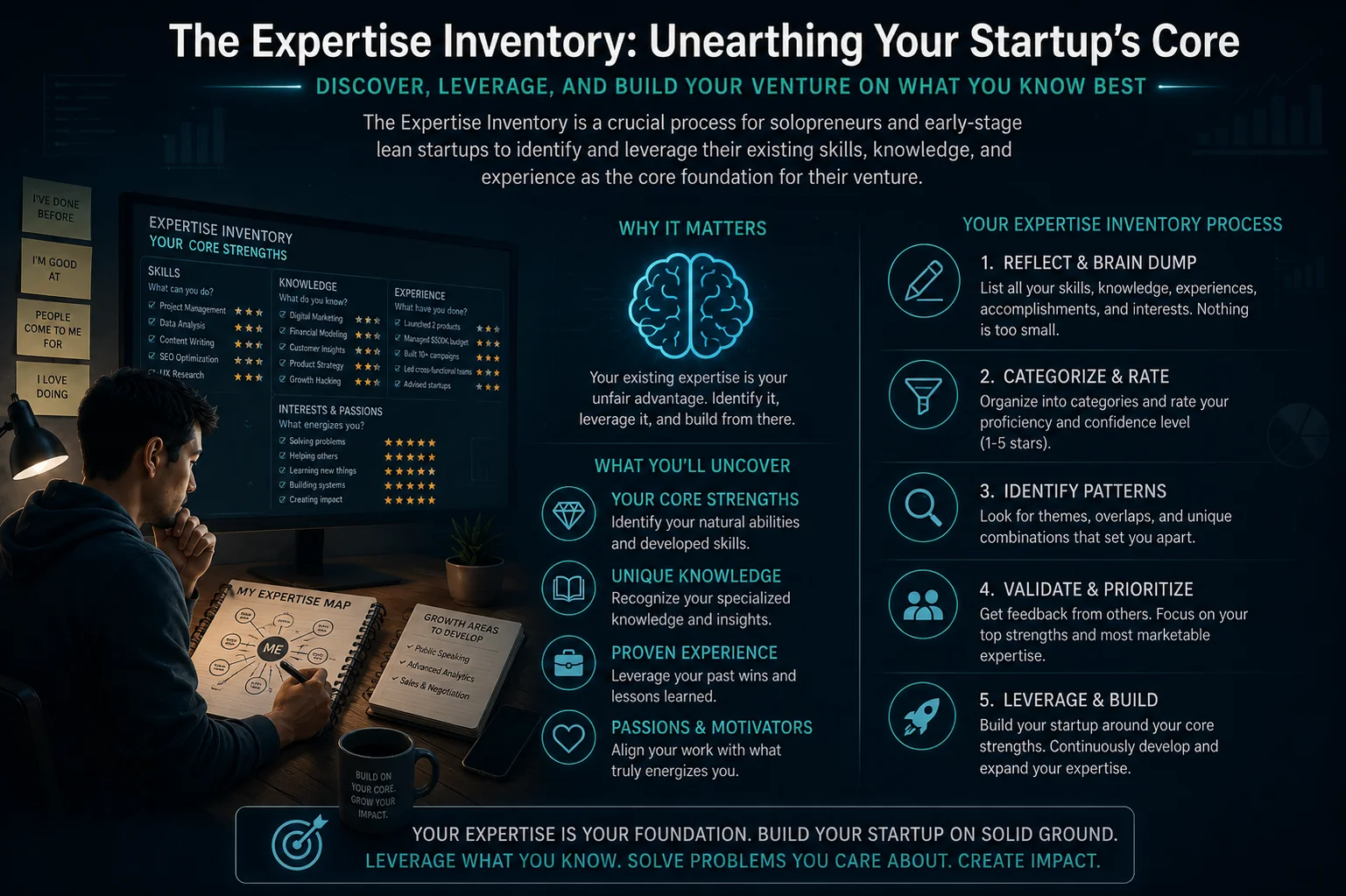
Think of it this way: your expertise inventory—the sum of everything you know and can execute—is your foundation. But to build a sustainable, recurring revenue model, you must constantly check the structural integrity of your business as it grows. Measurement is not a corporate bureaucratic exercise designed to slow you down, nor is it a luxury reserved for venture-backed teams with dedicated data science departments. For a bootstrapped founder, measurement is your steering wheel. Without it, you are stepping on the gas pedal in a dark room, hoping you don't hit a wall.
The Psychology of Measurement: Moving Past the Hope Strategy
Before diving into KPIs and dashboard architectures, we must confront a hard truth: many bootstrappers actively resist measurement because of a psychological phenomenon called the Confirmation Bias of the Creator. When you build something yourself, you are emotionally invested. You want your assumptions to be correct. Consequently, it is incredibly easy to treat "hope" as a business strategy—convinced that if you just keep posting on social media, or if you wait another month, customers will magically discover you.
Measuring your business forces you to confront objective reality. It strips away the comfort of vague excuses ("We just need more exposure!") and replaces them with cold, hard facts ("Only 1% of visitors are clicking the signup button"). Shifting your perspective means realizing that a poor metric is not a personal failure. It is simply a diagnostic reading. Just as a doctor uses a thermometer to identify an infection rather than to punish the patient, you must use metrics to pinpoint precisely where your startup's growth engine is losing pressure.
The Bootstrapper's Metric Taxonomy: Tracking What Matters
When you are in the early stages, trying to track every metric recommended by modern marketing blogs is a fast track to analysis paralysis. As a solopreneur or a lean team, you do not need fifty data points; you need the right five. These are your business's vital signs, reflecting customer engagement, validation, and unit economics.
- 1. Customer Acquisition Cost (CAC) – The Sweat Equity Edition:
In traditional startups, CAC is calculated as your total marketing spend divided by your acquired customers. But when bootstrapping, your primary marketing spend isn't cash—it is your time. To calculate your true bootstrapped CAC, you must calculate your "sweat equity" value alongside your software subscriptions and ad spend:
Bootstrapped CAC = [ (Hours Expended × Hourly Target Rate) + Direct Marketing Costs ] / Total Customers Acquired
If you spend 20 hours writing LinkedIn content and managing direct outreach to acquire 2 clients, and you value your time at $50/hour, your true CAC is $500 per client. If those clients only buy a $50 digital product from you, your acquisition model is deeply broken. Tracking this metric prevents you from wasting hundreds of hours on low-yield promotional tactics.
- 2. Customer Lifetime Value (CLTV) – The Early-Stage Proxy:
CLTV measures the total revenue you expect to generate from a single customer over their entire relationship with your business. For a new venture with only three months of operational data, projecting long-term CLTV can feel like guesswork. To solve this, focus on a simple early-stage proxy calculation:
CLTV Proxy = Average Order Value × Average Number of Purchases per Customer
Your goal is to ensure your CLTV is significantly higher than your CAC. In a healthy business, you should aim for an LTV to CAC ratio of at least 3:1:
CLTV / CAC ≥ 3If this ratio is below 3, you are either spending too much effort/money to acquire customers (high CAC) or your product pricing and retention mechanisms are too weak (low CLTV).
- 3. Conversion Rate (The Funnel Analyzer):
Conversion rate is the percentage of users who take a desired action out of the total population that had the opportunity to do so. To diagnose issues effectively, break this down into micro-conversions (e.g., landing page visitors who sign up for a newsletter) and macro-conversions (e.g., trial signups who convert to paid users).
Conversion Rate = ( Conversions / Total Visitors ) × 100
A low macro-conversion rate tells you that your value proposition, product onboarding, or pricing strategy is failing to convert interest into financial transaction.
- 4. Engagement Rate (The Retention Engine): For any software, service, or productized consulting model, engagement is the ultimate precursor to retention. You must define what "active engagement" means for your business. It is not just logging in; it is performing the core action that delivers value. For an automated invoicing tool, it could be the percentage of users who send at least one invoice per week. For a consulting cohort, it is the percentage of participants who complete their weekly homework modules. Track how many of your signups actually reach this "active" state.
- 5. Churn Rate (The Silent Killer):
Churn is the percentage of customers who cancel their subscription or stop using your service over a given period. It is the single most dangerous threat to a bootstrapped business. If you acquire 10 new clients a month but lose 10 existing clients, your net growth is zero, and you are wasting your precious acquisition runway.
Churn Rate = ( Customers Lost During Period / Total Customers at Start of Period ) × 100
If your monthly churn rate is above 8%, your product or customer experience is failing to deliver long-term value, and you must pivot your attention from marketing to retention immediately.
The Clarity vs. Vanity Spectrum
As you build your measurement framework, you must ruthlessly filter out metrics that flatter your ego but do not influence your bank account. Review this comparison matrix to align your focus:
| The Vanity Metric (Ignore) | The Hidden Trap | The Clarity Metric (Track Instead) |
|---|---|---|
| Page Views / Website Hits | High traffic without action is just an expensive server bill. | Form Conversion Rate & Lead Capture % |
| Social Media Followers / Likes | Likes cannot pay for your software subscriptions or your rent. | Email Newsletter Click-Through & Reply Rate |
| Cumulative Registered Accounts | Masks dead accounts, bots, and churned trial signups. | Daily/Weekly Active Core Feature Usage |
| Gross Transaction Volume | Ignores refunds, processing fees, discounts, and CAC. | Net Profit Margin & Customer Contribution Margin |
Actionable Tip: Pick Your One Metric That Matters (OMTM)
Do not try to optimize five metrics simultaneously. At any given stage of your bootstrap journey, identify the single metric that best reflects your current bottleneck. If you have under 100 visitors a day, your OMTM is traffic generation. If you have traffic but no sales, your OMTM is landing page conversion. Focus your daily activities on moving this single number.
Building Your Measurement Framework: The Bootstrapper's No-Cost Stack
You do not need to sign up for expensive Enterprise Business Intelligence suites to measure your business effectively. In fact, a highly advanced measurement framework can be assembled using free, accessible tools. The key is configuring them correctly to talk to one another.
1. Quantitative Web Analytics: Google Analytics 4 (GA4) or Simple Alternatives
If you use Google Analytics, stop looking at the standard default overview page. Instead, navigate to your settings and set up custom Conversion Events. Define a conversion as a high-intent user behavior: completing a sign-up form, clicking a payment link, or spending more than 2 minutes reading a case study.
If GA4's interface feels overly complicated, switch to privacy-first, lightweight tools like Plausible or Fathom. They offer a clean, single-screen view of your conversion paths, traffic sources, and page-level engagement without the complex cookie configurations or administrative overhead.
2. Operational & Financial Tracking: The Weekly Cohort Sheet
For early-stage operations, a custom spreadsheet is far more flexible and educational than any CRM software. You should build a simple **Weekly Cohort Tracking Dashboard** inside Google Sheets or Airtable to monitor user behavior over time. Here is an example layout you can copy-paste and configure:
| Cohort Start Date | New Signups | Active Week 1 (%) | Active Week 2 (%) | Active Week 3 (%) | Active Week 4 (%) | Net Churn Rate (%) |
|---|---|---|---|---|---|---|
| Oct 5, 2026 | 45 | 88% | 72% | 54% | 30% | 70% |
| Oct 12, 2026 | 52 | 90% | 78% | 65% | 48% | 52% |
This tracking framework quickly exposes user retention patterns. If your active retention plunges from 90% in Week 1 to 30% in Week 4 (as shown in the first cohort), you have a severe retention leak. By monitoring this weekly, you can directly trace whether a change you made in your onboarding process (like the updates in the second cohort) successfully improved user longevity.
3. Qualitative Feedback Integrations: Typeform, Tally, or Google Forms
Quantitative metrics show you *what* is happening, but qualitative data explains *why* it is happening. Pair your numbers with short, transactional forms. Set up automations (using tools like Zapier or Make) to trigger simple survey questions based on specific events:
- The Churn Survey: When a user cancels their subscription or stops scheduling consulting calls, immediately trigger an automated single-question email: "What was the main reason you decided to cancel today?" Keep the responses categorized in your spreadsheet to monitor recurring themes.
- The Customer Delight Check: Send a quick check-in form 14 days after purchase, asking: "What is one feature or aspect of our service that exceeded your expectations, and what is one thing that has been frustrating?" This reveals hidden operational bugs before they turn into churned accounts.
Data-Driven Action Protocols: Steering Your Bootstrapped Ship
Collecting charts and filling spreadsheets is useless unless you use that data to drive concrete business iterations. In the Lean Startup loop, data is your strategic advisor. It tells you when to double down, when to adjust your messaging, and when to execute a complete structural pivot.
Diagnostic Protocols for Low-Traffic Environments
As a bootstrapper, you do not have the volume of web traffic required to run traditional A/B tests with statistical confidence. If your page gets 100 visitors a week, running a split test between a blue button and a green button is a waste of valuable runway. Instead, use these heuristic diagnostics to make major strategic iterations:
- The Diagnostic Matrix: High Traffic + Low Signups
The Diagnosis: Your promotional channels (social media, SEO, or direct outreach) are successfully driving traffic, but your landing page is failing to clearly explain your value proposition, build credibility, or establish an obvious call to action.
The Action: Rewrite your main headline to focus on the customer's *outcome* rather than your *features*. Implement session recording software (like Microsoft Clarity or Hotjar) to ensure users aren't running into page load bugs or layout navigation issues.
- The Diagnostic Matrix: High Signups + Low Core Engagement
The Diagnosis: Your copywriting and offer are incredibly compelling, but your actual product, onboarding flow, or service setup is too confusing, complicated, or slow to deliver value. Your users are bouncing before reaching their "Aha!" milestone.
The Action: Simplify your signup onboarding. Remove complex registration screens, provide a step-by-step interactive onboarding template, or manually guide your first 10 users through their first setup (using the Concierge model) to see exactly where they get confused.
- The Diagnostic Matrix: High Active Engagement + Low Financial Conversion
The Diagnosis: Users love your free value, templates, or resources, but they do not perceive your premium paid offering as valuable enough to justify parting with their hard-earned capital. This is a monetization alignment failure.
The Action: Run a survey to evaluate your pricing model. Test shifting your paywall closer to the core value-delivery step, bundle additional high-value resources (like templates or direct support) into your paid tier, or transition from a low-ticket transactional product to a highly structured productized service.
Data is Your Compass, Not Your Critic
Do not treat your dashboard as a weekly report card on your personal ability as a founder. Treat it as a navigational tool. If a metric plunges, it is not a signal that your business is a failure; it is your dashboard telling you exactly where to focus your product development efforts. Let evidence dictate your priorities, and ignore the surrounding noise.
Conclusion: The Resilient, Informed Startup
The transition from a corporate career to building your own venture is a profound evolution. It requires moving from a culture of execution to a culture of constant validation. By implementing a lightweight, highly focused measurement framework from day one, you strip away the fog of uncertainty and arm yourself with real market validation.
Measurement is your ultimate insurance policy against building something that nobody wants. By tracking the metrics that matter, ignoring the vanity traps, setting up high-impact tracking spreadsheet layouts, and translating qualitative feedback into immediate product iterations, you ensure your business is built on a rock-solid foundation. Step out of the dark, trust your compass, and let the data lead you toward sustained growth, profitability, and independence.





No comments yet
Be the first to share your thoughts on this article!