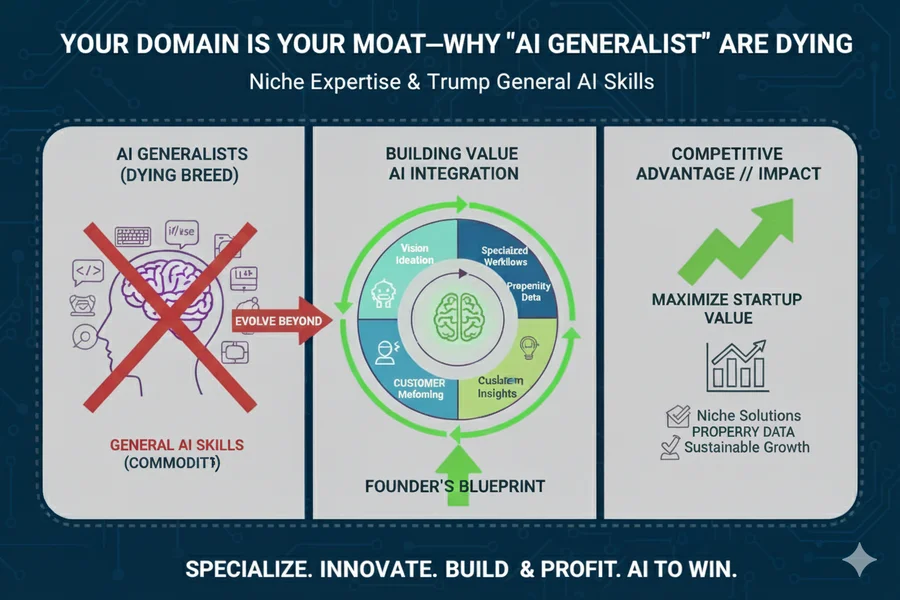
The Problem with AI Generalism: The "Sherlocking" Risk
The "AI Generalist" builds tools for everyone. They build "The Ultimate AI Assistant," "The All-in-One CRM," or "The Best Content Generator for Small Business." While these ideas sound lucrative because of their massive Total Addressable Market (TAM), they are strategically suicidal for a lean solopreneur for two-fold reasons:
1. The Horizontal Giants
You are competing directly with OpenAI, Microsoft, Google, and Adobe. These giants are playing a "horizontal" game. They are integrating AI directly into the operating systems and productivity suites we use every day. If you build a general writing tool, you aren't just fighting other startups; you are fighting Microsoft Word’s "Copilot." If your feature can be replicated by a generic prompt inside ChatGPT, it will be "Sherlocked" within a quarter. You cannot out-scale or out-feature the companies that own the models.
2. The Lack of "Tacit Knowledge"
Generalists build for surface-level problems. They solve the things people say they need—the explicit pain points that appear on the first page of a Google search (e.g., "I need to write emails faster"). But they fail to solve the systemic, structural frictions that actually cost businesses real money. They miss the "Dark Matter" of the industry.
What is Tacit Knowledge? The "Dark Matter" of Industry
Tacit knowledge is the "hidden" information of an industry. It is the information that isn't written down in textbooks, blogs, or Reddit threads because it is learned through years of scars, trial, and error. Because LLMs are trained on the public internet, they are world-class experts in Explicit Knowledge—the stuff that is documented. They are not experts in the messy, unwritten, specialized workflows of a high-compliance industry.
- In Real Estate: A generalist builds a "Listing Description Generator." A domain expert knows that a real estate agent cares less about the description and more about the speed of generating a "Disclosure Packet" that complies with local municipal laws—a process that usually involves chasing three different departments and a notary.
- In Medical Billing: A generalist builds an "AI Scribe." A domain expert knows the bottleneck isn't the typing; it’s the specific, idiosyncratic "rejection codes" from insurance companies that change every six months and vary by state.
Your moat is built from these nuances. If your AI understands the "unspoken rules" of your industry, it becomes indispensable. If it only understands the "written rules," it is a commodity.
The Skills-Opportunity Matrix: Finding Your Sweet Spot
To find your AI business, you shouldn't look at "trending AI news" or Product Hunt. You should look at your own resume. At the AI Solopreneur's Launchpad, we use the Skills-Opportunity Matrix to audit your past.
Draw a four-quadrant grid based on two axes:
- Complexity: How much specialized, non-Googleable knowledge is required to do the task?
- Repetition: How often does this task happen in a given week for a typical professional?
The Four Quadrants:
- Low Complexity / High Repetition: (e.g., generic email replies, basic social media captions). Status: Dead Zone. These are already being automated by the big players for free.
- Low Complexity / Low Repetition: (e.g., setting up a new office printer). Status: Irrelevant. Not enough volume to build a business.
- High Complexity / Low Repetition: (e.g., quarterly strategic planning, M&A due diligence). Status: Consultant Zone. This is still the realm of high-priced human experts. The data is too sparse for AI to handle the "edge cases" reliably.
- High Complexity / High Repetition: (e.g., specialized legal document review, architectural compliance checking, medical coding audits). Status: The Golden Niche.
The Golden Niche is where the money is. These tasks are too specific for Google or OpenAI to build a native feature for, but they are frequent enough to be a massive, recurring pain point for professionals. If you can automate a task that is "hard" but happens "often," you have a high-margin business.
The Golden Niche is where the money is. These tasks are too specific for Google or OpenAI to build a native feature for, but they are frequent enough to be a massive, recurring pain point for professionals. If you can automate a task that is "hard" but happens "often," you have a high-margin business.
Applying the Skills-Opportunity Matrix
To use the matrix effectively, follow these three steps:
List out the five to ten most time-consuming, frustrating, or complex tasks you had to perform regularly in your past three professional roles. Focus on tasks that were mandatory but felt like a "tax" on your time.
- Example: If you were a financial controller, a task might be "Reconciling inter-company transfers across 15 subsidiaries quarterly."
- Example: If you were a marketing manager, a task might be "Customizing the master presentation deck for each regional sales team every month."
For each task on your list, score it against the two criteria:
- Complexity (High/Low): Can a new hire figure this out with a quick Google search, or does it require five years of specialized experience, familiarity with obscure industry regulations, or institutional knowledge?
- Repetition (High/Low): Did you (or a typical professional in that role) do this weekly or monthly (High), or was it a one-off or quarterly event (Low)?
The tasks that fall into the High Complexity / High Repetition quadrant are your candidates for a successful AI business. These are the problems that:
- Have a High Willingness to Pay: Companies are already paying high salaries or expensive consulting fees to solve this recurring problem.
- Possess a Natural Moat: The "non-Googleable" specialized knowledge creates a data barrier that generic AI models can't easily cross, giving your niche solution a distinct advantage.
- Ensure Recurring Revenue: The high repetition ensures that the solution becomes a necessary, embedded utility rather than a one-time purchase.
Focus your AI solution on automating the specialized, recurring processes you already know inside and out. This insider knowledge is your greatest asset in finding and dominating a Golden Niche.
|
Quadrant |
Description (Complexity / Repetition) |
Status |
Rationale |
|---|---|---|---|
|
Dead Zone |
Low / High |
Dead Zone |
Already automated (often for free) by major tech companies (e.g., generic emails, basic social media posts). |
|
Irrelevant |
Low / Low |
Irrelevant |
Insufficient volume to justify building a profitable business (e.g., setting up a new office printer). |
|
Consultant Zone |
High / Low |
Consultant Zone |
Remains the domain of expensive human experts. The data is too sparse for AI to reliably handle unique "edge cases" (e.g., M&A due diligence, quarterly strategic planning). |
|
The Golden Niche |
High / High |
The Golden Niche |
This is the source of high-margin business. The tasks are too specific for Google or OpenAI to incorporate as a native feature, but they occur frequently enough to be a massive, recurring pain point (e.g., specialized legal document review, medical coding audits, architectural compliance checks). |
The Golden Niche represents the sweet spot for revenue. By automating a task that is both "hard" and happens "often," you secure a high-margin, recurring business model.
The "Five Whys" of AI Problem Discovery
Once you’ve identified a domain, you need to find the "Point of Friction." Most entrepreneurs stop at the first "Why." To build a moat, you must go five layers deep to find the "Boring" problem.
Let’s look at an example from the Construction Industry:
- Surface Problem: "Construction managers are stressed and overworked."
- Why? (1): "They spend four hours a day on paperwork."
- Why? (2): "They have to compile daily progress reports for the property owners."
- Why? (3): "They have to manually gather updates from six different subcontractors (plumbers, electricians, etc.)."
- Why? (4): "The subcontractors don't use the management software; they just send texts or leave voicemails because they're on a ladder with gloves on."
- Why? (5): "The current software is too 'high-friction.' The manager has to manually translate 'human speech' and 'messy photos' into 'BIM (Building Information Modeling) database entries.'"
The AI Moat Defined by the "Boring" Solution
The true innovation is not a better dashboard (Surface Problem) but a solution to the "Why? (5)" translation problem.
- The Moat: The AI product must accept the messy inputs (voicemails, photo OCR, messy text slang) and automatically process, structure, and categorize them directly into the BIM/ERP system.
- The Data Flywheel: Every new text, every translated voicemail, and every successfully processed photo adds a new, proprietary data point that teaches the system to better understand and translate construction-specific, messy, on-site communication. This data is unique, continuous, and proprietary, making the product better with every new user and harder for a competitor to replicate.
- The Result: The construction manager's four hours of daily stress are reduced to minutes. The product solves a time-cost problem, not just a stress problem, leading to high ROI, sticky adoption, and a defensible position built not on a complex algorithm, but on solving the deepest layer of human and system friction.
The Three Hallmarks of a "Boring" AI Moat Problem
Identifying the "Boring Problem" through the Five Whys analysis allows a founder to validate three critical characteristics that guarantee a powerful AI moat:
- High-Frequency, Low-Value Labor: The task is performed constantly (daily/hourly) by the user, but the user views it as necessary drudgery. The cumulative time sink is immense, but the individual task is so small and repetitive that it's overlooked by high-level software vendors.
- Messy, Proprietary Data Source: The root cause of friction is the existence of unstructured, domain-specific data that is difficult to standardize (e.g., medical scribbles, construction slang, financial analyst commentary). Competitors cannot easily scrape this data; it must be collected via a unique, low-friction input channel, which becomes the basis for the moat.
- Human-in-the-Loop as Translator: The current solution relies on an expensive, skilled human to manually bridge the gap between the messy data source (Why 4) and the structured system of record (Why 5). This translation step is the single biggest bottleneck and the most direct target for automation.
The AI Opportunity: You shouldn't build a "Construction Management AI." You should build an "SMS-to-BIM Bridge." An agent that lets a plumber text a photo of a pipe and a 5-second voice note, which the AI then parses, verifies against the project blueprint, checks for compliance, and automatically updates the formal report.
The Generalist would have built a "Report Writer." The Domain Expert builds a "Communication Bridge." One is a tool; the other is a vital organ in the business.
Validating Without the "AI" Buzzword: The Mom Test
One of the biggest mistakes AI solopreneurs make is leading with the technology. They say, "I have an AI-powered solution for lawyers." This is a mistake.
The professional doesn't care about AI. In many high-stakes industries (legal, healthcare, finance), "AI" is actually a dirty word that implies risk, hallucinations, and privacy leaks. What they care about is the Outcome.
In his book The Mom Test, Rob Fitzpatrick argues that you should never ask people if your idea is good. They will lie to be nice. Instead, you should ask about their past behavior.
The AI Solopreneur’s Version of the Mom Test:
- The Wrong Way: "Would you pay for an AI that writes your legal briefs?" (Hypothetical question = Useless answer).
- The Right Way: "Walk me through the last time you had to draft a brief. Which part took the longest? What did you do while you were waiting for that part to finish? How much did you pay the junior associate or the paralegal to help you with that? When was the last time a deadline for a brief caused you to stay in the office past 8 PM?"
If you find a problem that people are already spending money or "unpaid overtime" to solve (even if they are solving it poorly with humans or spreadsheets), you have found a market. Your AI is simply the "mechanism" that solves it faster and cheaper.
Case Study: The "Boring" Business Win
Compare two hypothetical solopreneurs in the recruitment space:
Founder A (The Techie): Builds an AI "Image Generator for Social Media Recruiters."
- The Moat: None.
- The Competition: Canva, Midjourney, and every other image generator.
- The Outcome: High churn, constant price wars, and eventually getting "Sherlocked" when LinkedIn adds an image generator directly into the post box.
Founder B (The Former Recruiter): Builds an AI "Technical Interview Auditor."
- The Moat: They know that "Technical Recruiters" are often non-technical. They spend all day on Zoom calls with developers and can't actually tell if a candidate is "hallucinating" their Python skills or if they are truly an expert.
- The Solution: An AI agent that joins the Zoom call, listens to the candidate's technical explanation, and gives the recruiter a "Truth Score" and three "Deep-Dive Questions" to ask next, based on real-world coding standards.
- The Outcome: High-ticket B2B sales. The tool is indispensable because it solves a specific, expensive problem: hiring the wrong developer costs a company $100k+.
Your Action Plan: The Domain Audit
Before moving forward to Module 2, "The Idea Engine," you must first meticulously complete your Personal Opportunity Audit. This foundational exercise is designed to unearth the unique, high-friction, and high-value problems within your specific professional domain—the fertile ground from which your specialized AI solution will grow.
Here is the expanded, two-part process for the Audit:
This is more than just listing achievements; it's an archaeological dig into the repetitive, frustrating, and non-obvious work that makes up your career. This step defines the borders of your "moat"—the industry knowledge that an "AI Generalist" cannot easily replicate.
- List Every Role and Duration: Start with a simple chronology of every paid position you've ever held.
- The "Stupid" Task Inventory: For each role, list at least five tasks that you considered mind-numbingly boring, overly manual, or beneath your pay grade. These are often the tasks you have subconsciously optimized for speed and repetition, making them perfect candidates for AI automation.
- Example: "Manually cross-referencing vendor contract dates in a spreadsheet against the quarterly budget reconciliation."
- The Hate Log: What specific activities made you dread a Monday morning? What processes caused the most friction, delay, or internal conflict? The emotional energy attached to these items often signals a high-value opportunity for a solution.
- Domain Jargon Capture: Identify and list the acronyms, industry-specific buzzwords, and technical phrases that an outsider (or a general-purpose AI) would not understand. This "insider language" is the natural barrier to entry that your specialized AI must master.
- Example: Terms like "T-minus," "LTV," "CAC," "MSA," "EBITDA," or "Dark Funnel."
Your internal frustrations are a starting point, but the true opportunity lies in shared, widespread pain. This step validates your findings against the experiences of your peers, ensuring you are solving a problem that the market is willing to pay to eliminate.
- The Peer Outreach Protocol: Identify three former colleagues who are still active in the field and whose opinions you respect.
- The Unbiased Interview: Do NOT mention that you are building an AI tool. Frame the conversation as a casual check-in or market research. The goal is to elicit raw, unfiltered complaints.
- The Core Question: Ask them: "What is the single, most frustrating task, process, or deliverable in your job that makes you want to quit and walk out the door on a Tuesday afternoon?"
- The Follow-up: Listen for the time they spend on the task, the cost of an error, and the emotional toll. Log these complaints verbatim, noting the specific context of the role and industry segment.
The High-Value Task Filter: Isolating the AI-Solvable Pain
Once you have your comprehensive list of internal and external complaints, you must apply the final filter to pinpoint the problems that an AI can solve better, faster, or cheaper than a human.
- The Triad Test: Review every single complaint and check if it involves one or more of the following actions:
- Processing Information at Scale: Does the task require reading, synthesizing, or organizing large volumes of unstructured data (emails, documents, PDFs, meeting transcripts)?
- Summarizing and Pattern Recognition: Does the task require extracting the "signal" from the "noise"—i.e., identifying trends, anomalies, or key takeaways from a sea of metrics or reports?
- Making Decisions Based on a Set of Rules: Does the task involve a complex decision tree, a compliance checklist, or a series of conditional actions that a human must painstakingly follow?
Conclusion: The problems that pass the Triad Test are your AI Targets. They represent the intersection of your unique professional domain knowledge (your moat) and a common, high-friction activity that is ripe for automation. These are the specific, narrow-scope solutions that form the core of your "AI Specialist" business.
The Practitioner-Architect: Your New Role
In the age of AI, we are seeing the rise of a new type of founder: The Practitioner-Architect. This is someone who doesn't necessarily write the code, but they understand the logic of the problem so deeply that they can architect the solution.
Because AI can handle the "execution" (the code), the value shifts to the "diagnosis" (the problem). Your "boring" background is not a distraction from your tech career—it is the foundation of it.
The "AI Revolution" is not a technical revolution; it is an Application Revolution. The big labs are building the "Electricity." Your job is not to build a better power plant. Your job is to build the "AI-powered Toaster," the "AI-powered Washing Machine," and the "AI-powered Industrial Lathe" for specific industries that Silicon Valley has forgotten.
Stop trying to be a generalist. Embrace your niche. Your expertise is the only thing the AI can't replace—it can only amplify it.
What’s Next?
Now that you’ve found your moat, how do you actually come up with the product idea? In Post 3: Structured Creativity, we will look at the SCAMPER framework and how to use "Forced Relationships" to turn your domain knowledge into a portfolio of viable business concepts.
Your background isn't a distraction. It's your edge. Use it.

No comments yet
Be the first to share your thoughts on this article!