In the high-stakes, hyper-competitive world of the solopreneur, every decision is a leverage point. You are the product manager, the developer, the marketing team, and the coffee runner. Your scarcest, most precious resource is not capital—it is time.
This reality fundamentally changes how you must approach technical decisions. Design patterns that seem purely academic or overly complex in a large organization become survival tools for the solo founder. This is especially true when it comes to the Application Programming Interface (API), the often-neglected digital backbone of every modern product.
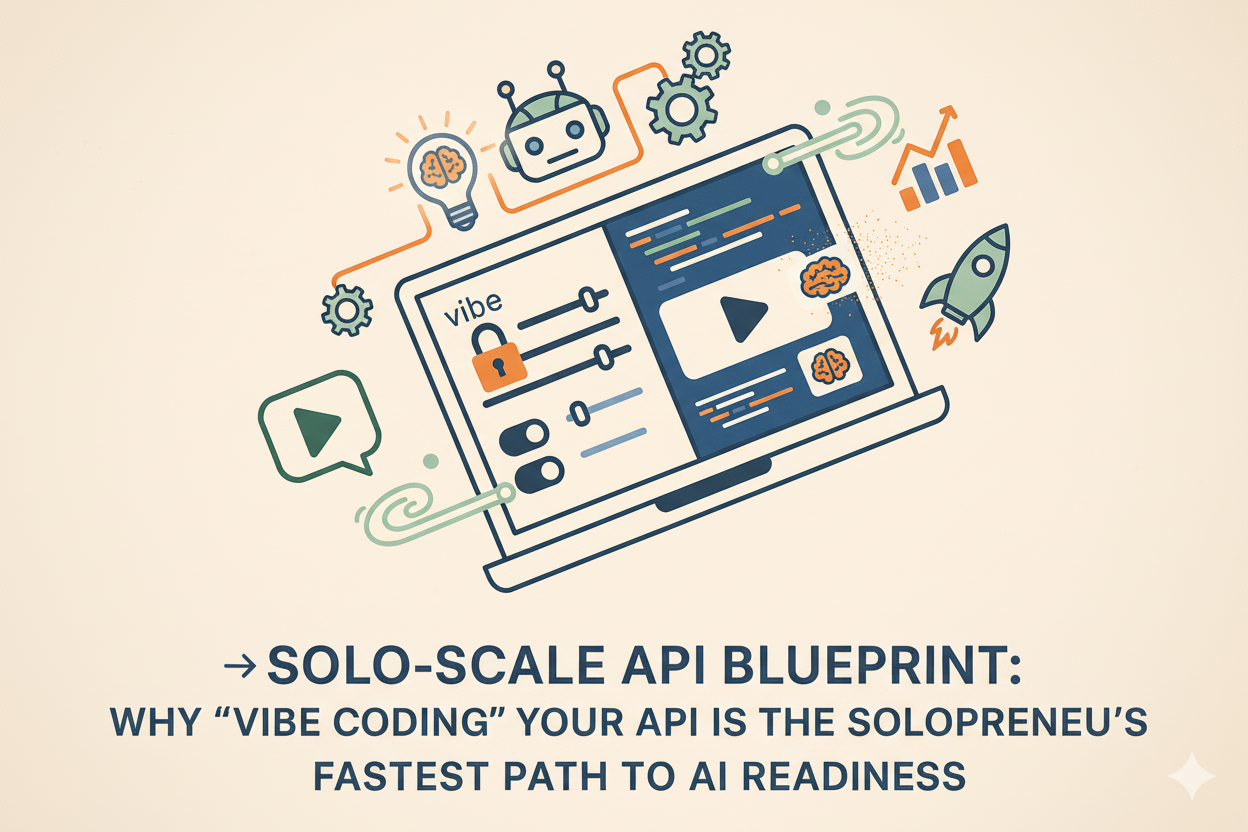
API design is frequently dismissed as a purely technical, back-end chore. We treat it as data plumbing. But that perspective is dangerously short-sighted. The core philosophy of Vibe Coding posits that a truly well-designed API is not a technical specification; it is a product built with profound empathy for its client.
Whether that client is a frazzled human developer integrating your service, a slick new user interface (UI) you just built, or, increasingly, an autonomous Artificial Intelligence (AI) agent, the quality of their experience—their "vibe"—is directly proportional to the clarity and thoughtfulness of your API's design.
Section 1: Vibe Coding — API Design as Radical Empathy
What is Vibe Coding in practical terms? It’s designing an API that minimizes cognitive load and anticipates failure.
The goal is to create an API that is discoverable, predictable, and resilient.
Imagine a new developer—perhaps a contractor, or even your future self six months from now—sitting down to integrate your service. If the URI paths are confusing (/get-user-data), the error messages are opaque (500 Internal Error), or the required input fields are undocumented, that developer's productivity instantly drops to zero. That is anti-empathy; that is poor Vibe.
A Vibe-Coded API, conversely, communicates intent clearly and consistently. It uses standard HTTP methods correctly, employs clear, plural nouns for resources, and provides detailed, actionable error messages. It transforms integration from a painful interpretation task into a smooth, self-service operation. It’s a direct tool for accelerating the Lean startup's most critical cycle: Build-Measure-Learn. You accelerate the "Build" phase by making integration seamless, and you accelerate the "Learn" phase by providing clean, contextual data.
Section 2: Beyond the MVP: The Minimum Adaptive Product (MAP)
The concept of the Minimum Viable Product (MVP) has long governed the lean startup methodology: launch fast, learn faster. But the modern, AI-accelerated market demands more. The goal is now the Minimum Adaptive Product (MAP)—a product that delivers a "lovable, adaptive experience immediately."
"The term 'viable' is no longer enough. AI has radically accelerated the 'Build' stage; you can prototype features faster than ever before. But this initial speed gain is instantly nullified if the underlying architecture is fragile."
If your API is a brittle, monolithic structure of hardcoded endpoints, every minor market pivot, feature update, or technology upgrade turns into a client-breaking architectural rewrite. This is where architectural ambiguity becomes the new development waste, constantly pulling you away from innovation and forcing you into maintenance debt.
Section 3: The 3 Cs for Autonomous Agents
This shift toward adaptivity is amplified by the rise of Agentic AI. Autonomous agents and Large Language Models (LLMs) are moving beyond being simple consumers of data; they are becoming intelligent, decision-making clients that use APIs as tools to complete complex, multi-step goals.
An AI agent doesn't just need data; it needs knowledge and understanding to function autonomously. To bridge this gap, APIs designed for Agentic AI must provide the 3 Cs: Clarity, Context, and Semantic Consistency.
1. Clarity: The Foundation of Trust
Clarity means resource names, methods, and parameters must be unambiguous. The agent should be able to reason about the service purely by reading the endpoint path and its associated documentation (which should be automatically generated, but more on that in Blog Post 3).
Bad Clarity: /api/v1/stuff/process?id=123
Good Clarity (Vibe Coded): /api/v1/orders/ORD-1234/payment
An LLM interpreting your API schema needs to instantly map your service functions to the world model it is constructing. Obfuscation is fatal to agent integration.
2. Context: Exposing Business Intent
Context is the crucial element that differentiates a simple data gateway from an intelligence tool. Autonomous agents assess situations, understand goals, and make informed decisions. They cannot do this if your API only returns raw data.
The API needs to expose the business intent alongside the data.
Error Context: Instead of a generic 400 Bad Request, provide a detailed error body that specifies why the request failed.
{
"errorCode": "INSUFFICIENT_FUNDS",
"message": "The transaction amount ($45.00) exceeds the available balance ($32.50).",
"actionableStep": "Suggest card change or check balance endpoint."
}
An AI agent can read this and instantly know the next action: prompt the user for a new card, rather than retrying the same failed request. This dramatically reduces the need for human intervention.Status Context: Resource statuses should be meaningful strings (status: "processing_review") rather than cryptic codes (status_id: 3).
3. Semantic Consistency: Moving Beyond CRUD
Traditional REST design often focuses on fine-grained CRUD (Create, Read, Update, Delete) operations. This works well for databases and UIs, but it creates cognitive overhead for an AI trying to achieve a higher-level task.
Semantic Consistency dictates that the interface should be task-centric and goal-oriented.
Instead of forcing a client to:
GET /cart/C123
POST /payments with cart data
DELETE /cart/C123 on success
... the Vibe-Coded approach uses a single, goal-oriented endpoint:
Goal-Oriented Endpoint: POST /checkout
The client only needs to state its intent, and the server orchestrates the complex logic. The output should be semantically enriched knowledge—a confirmation object with a link to the order status—not just a raw JSON record of what was created in the database. This pattern simplifies agent workflow, reduces round trips, and ensures business logic is encapsulated safely on the server.
Section 4: The Ultimate Decoupling: HATEOAS for Velocity
To truly achieve the "Adaptive" part of the MAP, the API must be dynamically responsive to state changes. This is the domain of Hypermedia As The Engine Of Application State (HATEOAS).
HATEOAS is arguably the most powerful yet least-used principle of REST architecture, and it is a solopreneur's secret weapon for velocity.
In a traditional API, the client hardcodes the URL paths for all actions. If a developer decides that the URI for canceling an order should change from /orders/{id}/cancel to /orders/{id}/void, every single client relying on that old path breaks instantly. Development velocity grinds to a halt, demanding urgent client updates.
HATEOAS solves this by mandating that every API response includes embedded links (_links) that tell the client what further actions or related resources are currently available from the resource just retrieved.
How HATEOAS Works in Practice
{
"id": "ORD-123",
"status": "pending_payment",
// ... other order data
"_links": {
"self": { "href": "/orders/ORD-123" },
"pay": { "href": "/transactions/process-payment/ORD-123", "method": "POST" }
}
}
{
"id": "ORD-123",
"status": "processing",
// ...
"_links": {
"self": { "href": "/orders/ORD-123" },
"cancel": { "href": "/order-management/void-request/ORD-123", "method": "POST" },
"track": { "href": "/shipping/tracking/ORD-123", "method": "GET" }
}
Notice the pay link is gone (because you can't pay twice), and the cancel and track links appeared. The link to cancel the order also changed its internal path (/order-management/...).
A HATEOAS-enabled client is inherently decoupled from the server's internal URI structure. It is instructed by the server's state to use the new links, enabling seamless, friction-free, and continuous updates on the backend without breaking a single client.
Conclusion: Empathy as Leverage
The "Vibe Coding" philosophy—seeing your API as a primary product—is not a luxury; it is the cornerstone of sustainable, solo-driven growth in the age of AI.
It boils down to choosing leverage over labor.
Leverage: Spending one extra hour perfecting your API design now (Clarity, Context, HATEOAS) to save one thousand hours of debugging, client support, and breaking changes later.
Labor: Writing an expedient, brittle API today that forces you into endless non-scalable operational waste tomorrow.
By designing your API with radical empathy for the client—especially the autonomous AI client—you are building an Empathy Engine. You are creating a Minimum Adaptive Product (MAP) that is instantly ready for agentic consumption and resilient to the inevitable pace of change. This is the fastest, safest, and most professional path to scaling your product without scaling your team.
Start building your API not just to work, but to communicate beautifully. The developer, the UI, and the AI agent on the other side will thank you for the good vibes.


No comments yet
Be the first to share your thoughts on this article!