
For the solopreneur, the journey from idea to a profitable business isn't a race to write the first line of code. It's a strategic game of chess where every move is about solving problems, cutting costs, and delaying technical complexity until it's absolutely necessary. The most critical system design decisions happen long before you build anything.
This blueprint will show you why rigorous, non-technical work is the true foundation of your future success.
The Temptation to Build: A Siren Song
It’s a feeling every founder knows: you have a brilliant product idea. You can practically see the finished application—the sleek design, the seamless user experience, the elegant code you'll write. The temptation to dive in and start building is a siren song, luring you into the single biggest cause of wasted time, money, and emotional energy for solopreneurs.
Why is this so dangerous? Because building a product is a solution. And without first proving that a problem exists, you're a solution in search of one. The most robust technical system in the world is worthless if no one needs it.
That's why system design for the solopreneur is not a technical discipline to be mastered, but rather a strategic mindset to be adopted. The core of this approach is a relentless focus on solving a validated problem, minimizing costs, and delaying technical complexity until it's absolutely necessary for growth. The most critical system design decision occurs long before any component is built. The initial phase of any project must be dedicated to rigorous, non-technical work.
Step 1: Rigorous Validation Over Development
Before you invest a single hour in development, you must first validate that you're building something people genuinely want. This is the ultimate "system design." It involves ensuring that your solution is a response to a validated market need, not a personal fascination.
Here’s your action plan, broken down into key preparatory steps:
Define Your Goals: The "One Feature" Challenge
Every product idea starts as a sprawling list of possibilities. Your first job is to get hyper-specific and brutal with your project objectives. The goal isn't to build everything you can imagine; it's to identify the one or two features that are absolutely essential to your product's core value proposition.
Ask yourself: If I had to launch this product with only a single feature, what would it be? What is the bare minimum that will prove my value?
Stripping away everything else forces you to focus on the core problem you are solving. For example, a project management tool doesn't need a built-in chat function, reporting dashboards, and a robust calendar on day one. It needs a way for a user to manage a task. Everything else is a distraction. The discipline of defining this "one feature" is a form of system design—you are defining the smallest possible system that can still deliver value.
Understand Your Audience: Stop Guessing, Start Listening
You can’t guess what your customers want. Actively gathering data is the only way to build a product that resonates. The "system" you're designing here is a feedback loop.
- Surveys and Interviews: Start with simple, open-ended questions. Don’t ask, "Would you use an app that does X?" Instead, ask, "How do you currently solve problem Y?" or "Walk me through your process for Z." Their answers will reveal pain points and behaviors you never considered.
- Community Research: Listen in on forums, subreddits (like r/indiehackers or r/solopreneur), and social media groups where your target audience hangs out. What problems are they complaining about? What solutions are they searching for? This passive research can reveal powerful market gaps.
These conversations and observations will reveal invaluable information that guides your product's refinement. They are a much more reliable form of "data" than a hunch.
Conduct Competitive Analysis: Finding Your Niche
Examine existing solutions to identify market gaps. This isn't about copying competitors; it’s about understanding where they fall short.
- Look for complexity: If competitors offer platforms that are overly complex, difficult to navigate, or bloated with features, a powerful opportunity exists in creating a more intuitive, user-friendly alternative.
- Analyze pricing: Are all competitors targeting a high-end enterprise market? There might be an opportunity to create a simplified, more affordable version for a different audience.
To consolidate these insights, non-technical founders can use the Business Model Canvas as a simple, one-page tool to map out critical elements like customer segments, value propositions, and revenue streams. This forces you to think holistically about your business, not just the product.
Step 2: Embracing the No-Code Minimum Viable Product (MVP)
Once you've validated a problem, the next step is to build the smallest possible system to test your solution. This is where the Minimum Viable Product (MVP) comes in. An MVP is a stripped-down, "pure" version of the business idea, focused on a single core feature to quickly validate the concept with potential customers.
The strategic choice to use a no-code MVP has profound financial and temporal implications.
|
MVP Type |
Estimated Cost |
Strategic Implication |
|
Custom-Coded MVP |
$10,000 to over $400,000 |
Avoids massive initial financial burden and prolonged development. |
|
No-Code MVP |
$1,000 to $5,000 |
Represents a dramatic reduction in cost and development time, enabling rapid validation. |
This dramatic reduction in cost and development time makes the no-code route a strategic choice, not a compromise. It allows you to get real user feedback in weeks, not months.
To ensure your MVP is successful, you must master feature prioritization. A powerful framework for this is the MoSCoW method (categorizing features into Must-haves, Should-haves, Could-haves, and Won't-haves). This method concentrates your efforts on core functionalities and prevents "scope creep"—the slow, feature-by-feature expansion that kills so many projects before they ever launch.
Step 3: Simplicity as a Competitive Advantage
Case studies of successful solopreneurs ("indie hackers") demonstrate that strategic system simplification can become a powerful competitive advantage.
The Power of Less: The Lean Social Media Tool
Consider the solo developer who succeeded by isolating the core functionalities of a social media cross-posting tool. Instead of building a complex platform with analytics, team collaboration, and a dozen other features, they focused on a single, essential function: posting to multiple social media accounts at once. By offering this simplified tool at a significantly lower price point than established competitors, they cornered a segment of the market that valued a lean, affordable solution over a complex, feature-heavy platform. Their simplicity became their competitive edge.
Building a Lean Business with Existing Tools
Think of a freelance professional who built a successful business on a minimal monthly budget. How? By leveraging a thoughtfully assembled suite of affordable, off-the-shelf tools and services.
This "system" wasn't a single, custom-built application. Instead, it was a lean workflow created by strategically combining simple, existing components. Each tool was chosen to solve a specific business problem—like lead generation, content creation, or task management—at a fraction of the cost of a traditional employee or a custom-built solution.
This example proves that a thoughtfully assembled, lean system can replace entire business infrastructures. The professional's skill wasn't in coding; it was in architecting a resilient, profitable business by using readily available, cost-effective components. It shows that you can solve complex problems by leveraging existing managed services rather than building from scratch.
The Trap of Perfection: The Failure to Launch
Conversely, consider the failure of the founder who spent 20 days building a "crap" product because they were focused on aesthetic and technical perfection, rather than solving a real problem. They were so consumed with elegant code and a beautiful user interface that they ignored the fundamental question: Does anyone need this?
Market need is a greater determinant of success than technical elegance. A simple, even ugly, product that solves a real problem will always outperform a technically perfect product that no one wants.
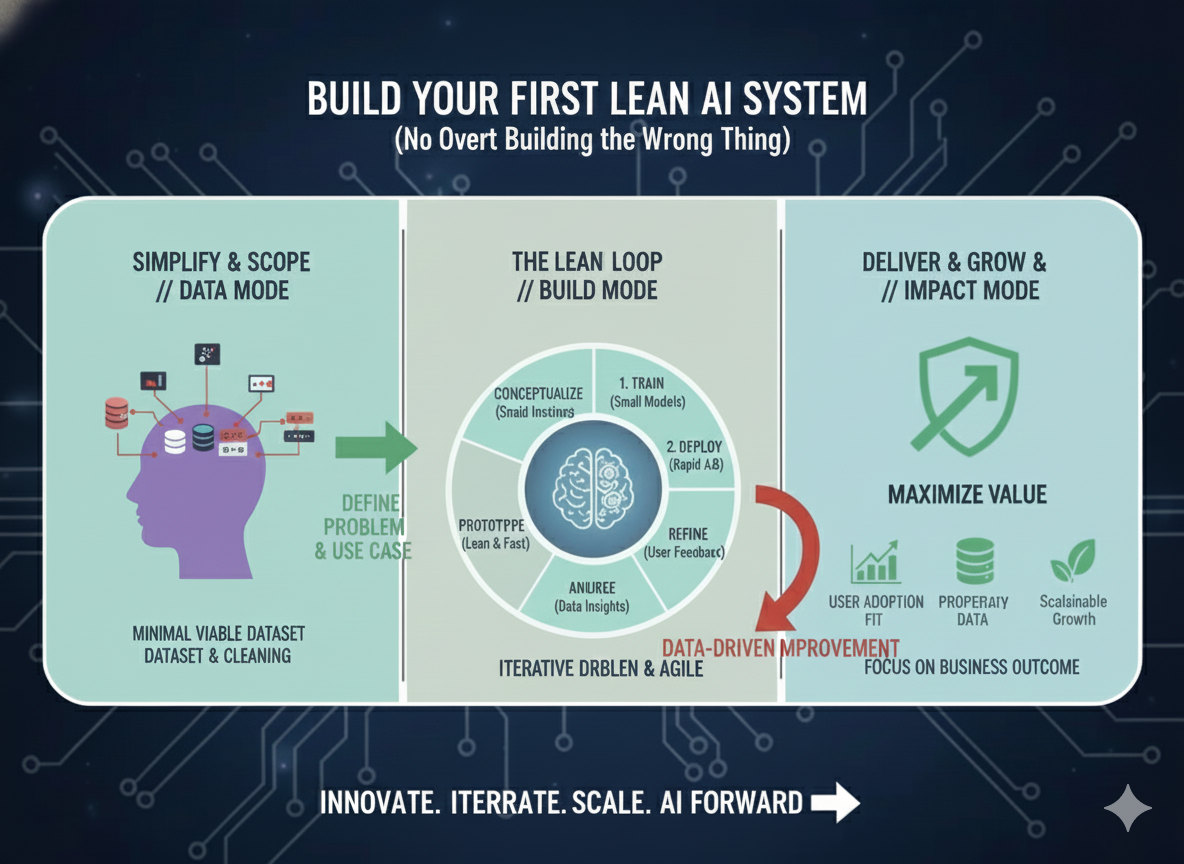
System design for solopreneurs is an iterative process centered on the principle of Validation Over Development. Start simple, validate demand, and use cost-effective solutions before introducing complexity. This is the blueprint for building a resilient, profitable business.

No comments yet
Be the first to share your thoughts on this article!