In the high-stakes world of modern startups, there are two traditional ways to fail. The first is to "build a cathedral"—spending months in a vacuum developing a perfect product that no one actually wants. The second is to drown in "Intelligence Arbitrage," where the collapse of technical barriers to entry means your product is easily replicated by anyone with a generic AI subscription.
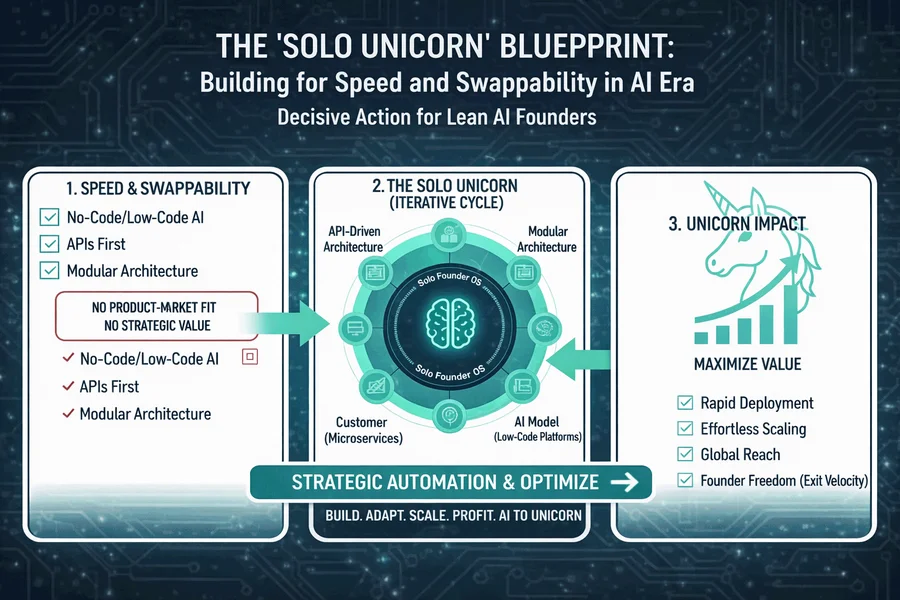
For the modern solopreneur, the building phase is no longer about who can type code the fastest or who has mastered the most obscure framework. In the current landscape, building is an exercise in context over code. By leveraging a specialized technical stack and a composable architecture, you can achieve the feature velocity of a venture-backed team while maintaining the agility to pivot the moment the market demands it.
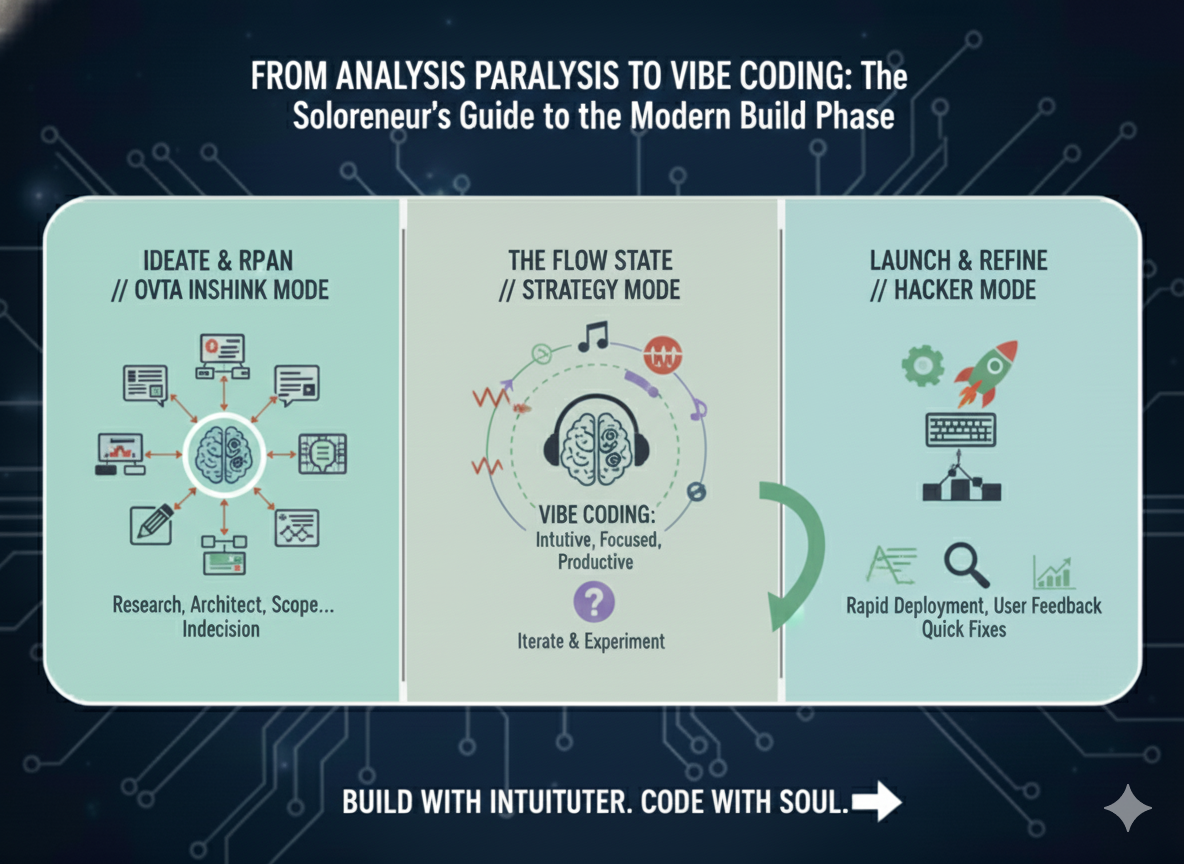
The Vibe Coding Revolution: Antidote to Analysis Paralysis
For decades, the path from idea to product was gated by a massive technical bottleneck. Today, that bottleneck has shifted from syntax to strategy. This has led to the rise of "Vibe Coding"—a lean approach to development that focuses on rapid iteration, essential features, and minimal upfront planning.
By building in vertical slices, you ensure that the speed of your development is grounded in the reality of valid product requirements.
The Composable Architecture: Building with LEGOs, Not Molded Plastic
The greatest threat to a solopreneur is not a lack of features, but technical debt—the ultimate "Pivot Killer." If your architecture is a tangled, rigid web, you cannot change direction when a customer says, "Actually, I need this instead of that."
1. The UI Layer (The Face)
Prioritize goals and structure over visual "vibe." Do not waste days picking hex codes for buttons. Use "Prompt-to-App" tools like Streamlit or Bolt.new to go from a prompt to a deployed, functional interface in minutes.
2. The Orchestration Layer (The Glue)
This is the connective tissue of your app that manages logic flows. Tools like n8n and Gumloop allow you to build complex workflows visually. By keeping your logic here rather than in your UI code, you can pivot your entire business process without touching your frontend.
3. The Models Layer (The Brain)
The AI landscape is volatile. Today’s top-tier model might be tomorrow’s overpriced legacy system. To avoid vendor lock-in, use a unified gateway like LiteLLM or Portkey. These tools provide a single API connecting to hundreds of models, making a switch from one provider to another as simple as changing a single line in your configuration.
4. The Retrieval Layer (The Context)
AI is only as good as the context it can access. Instead of expensive fine-tuning, use Retrieval-Augmented Generation (RAG). Give your AI an "open-book exam" by storing snippets of data in lean vector stores like Pinecone.
5. The Storage Layer (The Memory)
Your data repository should store every experiment log and piece of customer feedback. Platforms like Supabase or Airtable are the gold standards here, providing instant APIs so you can see what’s happening in your system without building a custom admin dashboard.
From Digital Sweatshop to Autonomous Asset
Most solopreneurs start as a "Digital Sweatshop"—a high-tech freelance gig where the founder is a "Human-in-the-Loop" checking every prompt and manually hitting "send" on every deliverable. To scale to significant revenue, you must flip this model into an autonomous asset.
The secret is the Service-to-Product "Flip." You begin by offering a productized service, which effectively pays you to do research and development. While delivering manually, you are secretly building internal tools: the perfect prompt chains, the robust database schemas, and the edge-case handling logic.
Once you’ve validated the process, you move to a "Human-on-the-Loop" model. The AI completes the task autonomously but pauses at a "Quality Gate" where you simply click "Approve" or "Regenerate." Eventually, you use a high-reasoning model as a quality auditor to assign a confidence score to outputs, allowing you to focus only on the small percentage of difficult exceptions.
AI as the Ultimate Waste Reduction Tool
In the traditional build phase, eighty percent of effort is often wasted on features nobody wants. AI serves as your virtual Product Manager and Architect to define the right scope before a single line of code is written.
Use AI to generate a Project Charter—a strategic filter that ensures your MVP is minimal enough to launch fast but viable enough to test your core hypothesis. This AI-driven planning creates the exact behavior code must implement and provides the input for measurement by automatically generating test criteria.
- Explain: Force the AI to articulate its understanding of existing code to ensure alignment.
- Plan: Enforce rigor by defining unit test cases for edge cases before generating code.
- Micro-Pivot: Quickly inject new requirements into the plan, allowing the AI to update its logic without a total restart.
- Implement: Generate the final, runnable code based on the vetted and refined plan.
De-risking the Build: The Illusion of Automation
Before you invest in "automating the plumbing," you must confirm that customers actually value the output. Successful launches often utilize two powerful experimentation techniques to "sell before you build":
The Wizard of Oz MVP
In a Wizard of Oz MVP, users believe they are interacting with a fully automated system, but the backend is manually powered by you. You might build a simple landing page with a "Submit" button, take that input, run it through your prompt library manually in a separate window, and email the results back. This confirms interest without the need for complex API connections or databases.
The Concierge MVP
In a Concierge MVP, you are open about the manual nature of the service. You work directly with a small group of users to deeply understand their pain points and expectations. This high-touch support allows you to collect "brutal feedback" and refine your offer before scaling.
Aspect | Wizard of Oz MVP | Concierge MVP |
|---|---|---|
Transparency | Users believe it's automated | Users know it's a manual service |
Interaction | Mimics software interface | Explicit human-to-human support |
Goal | Validate feature value/UI | Deeply understand user needs |
Best For | Tech-driven SaaS | Personalized services/consulting |
Avoiding the "Pivot Killer": Managing the Build
While speed is a survival requirement, uncritical acceptance of AI-generated code introduces security risks and fragile logic. If the code isn't maintained properly, it becomes a nightmare to update, effectively killing your ability to pivot.
Metrics that Matter for Margins
In the build phase, you must also consider the economic efficiency of your AI. Tracking the following formula ensures you aren't falling into a low-margin trap:
If this ratio is less than 5×, you need to optimize your workflows—perhaps by moving tasks from expensive models to smaller, cheaper versions.
Conclusion: The Solo Unicorn Era
The build phase of the modern era is no longer about who can type the fastest. It is about the "System Conductor" who can translate business problems into rigorous specifications and verify the results with data. By mastering a stack built for performance, security, and data integrity, the solopreneur can finally break the cycle of analysis paralysis.
Building for swappability ensures that your business is a living asset rather than a rigid monument. By focusing on rapid learning loops and evidence-based development, you ensure that every line of code you generate is a step toward a validated, revenue-generating business.

No comments yet
Be the first to share your thoughts on this article!