The modern entrepreneurial battlefield is intensely competitive. For the solo founder, the old rules—relying on massive seed capital, years of development, and a huge team—don't just feel out of reach; they are a recipe for failure.
Your greatest enemy isn't competition; it's wasted resources, especially your limited time and personal savings. For the solopreneur, time spent on the wrong features or chasing the wrong customer can mean the difference between viability and insolvency. Every hour lost to scope creep or an invalidated assumption is an hour you can’t afford.
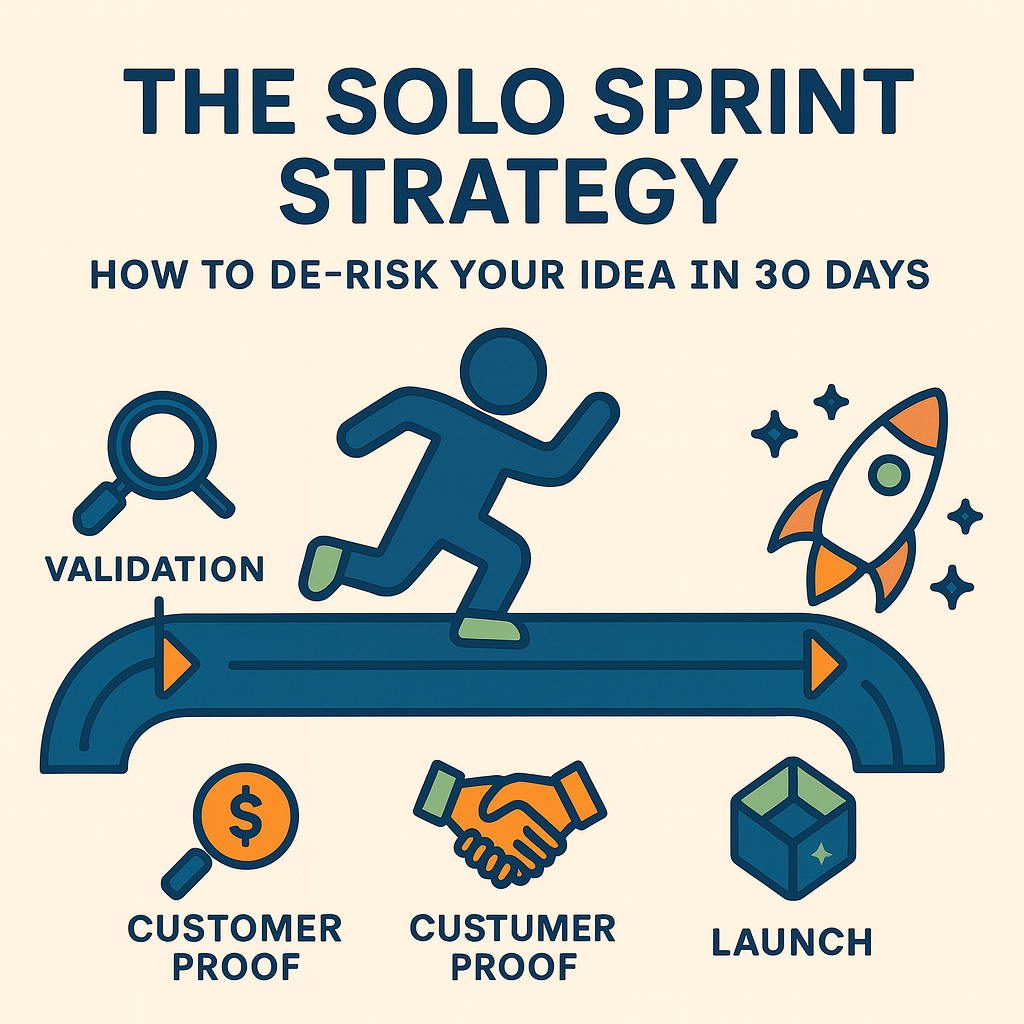
This is why we created the Solo Sprint: a strategic, 30-day blueprint designed specifically for the resource-constrained innovator. It's a disciplined framework that transforms your journey from a risky, months-long gamble into a focused, four-week exercise in validated learning. It’s the ultimate antidote to Founder Overwhelm and the single most powerful strategy for creating a low-burn startup.
Grounded in the rigorous Lean Startup methodology and supercharged by Artificial Intelligence, the Solo Sprint isn't just about launching fast. It's about achieving Product-Market-Fit confidence before you ever run out of runway. You are not bootstrapping a company; you are running a disciplined scientific experiment with your life savings at stake.
The Fundamental Shift: From Vague Idea to Testable Hypothesis
A traditional business starts with a 50-page business plan built on guesswork; a Lean Startup starts with a single, testable hypothesis. This hypothesis is a statement about your business that can be proven or disproven by customer behavior, forcing you to define your assumptions upfront before you build a thing.
A good business hypothesis is structured like an equation, connecting your target, their problem, your solution, and a measurable value.
Example Hypothesis: We believe that non-technical solopreneurs (ICP) who are frustrated with slow, expensive custom development (Problem) will pay $49/month (Metric) for a no-code AI-powered web app builder (Solution) because it allows them to launch a functional MVP in 7 days (Unique Value).
The Solo Sprint is structured to test and validate every component of that hypothesis across four intense, focused weeks. By the end of this sprint, you will have the data—the proof—to know whether to Pivot (change course) or Persevere (scale up).
Week 1: Strategic Validation—Moving from Assumption to Proof
The objective of Week 1 is the most important: to transform your vague idea into a crystal-clear, validated problem. You must achieve absolute certainty that the pain you intend to solve is one that people are actively looking for a solution to, and, crucially, willing to pay to make disappear.
1. Define Your Target: The Narrowly Defined ICP
For a solo founder, a broad audience is a trap. It means diluted marketing, unfocused features, and wasted money. Success hinges on empathy and narrow focus. You need a Narrowly Defined Ideal Customer Profile (ICP). This profile is your strategic compass.
The ICP Deep Dive:
-
Go Beyond Demographics: Forget "Males, 25-45." Drill down. Define their job title, the size of their company (Firmographics), the tools they already use, and the platforms they frequent.
-
Identify Psychographics: What are their aspirations, fears, and values? What does success look like to them? What keeps them up at night? This emotional connection is where the most compelling value propositions are found.
-
The Problem with Vague: If your ICP is "small business owners," which ones? A plumber with two employees has fundamentally different problems and budget constraints than a digital marketing consultant with a virtual team of five. A narrow focus allows you to build a solution that feels bespoke, even if it is scalable.
AI as an ICP Accelerator: The "Audience Pain-Point Sweep"
Instead of spending days manually sifting through online forums, use AI for rapid empathy.
Prompt Example: "I am launching a solution for [Your Narrow ICP, e.g., independent financial advisors with less than 5 employees]. What are their top 10 daily frustrations, their biggest fear related to their business, and what cheap, ineffective hacks are they using right now to cope with that frustration?"
This prompt leverages AI’s knowledge base to instantly surface the language and emotional pain points of your target, giving you a ready-to-test script for the next critical step.
2. The Dual Nature of De-Risking: Quantitative vs. Qualitative
De-risking an idea requires collecting signals from two distinct sources: the market (Quantitative) and the customer's mind (Qualitative). You need both.
A. Quantitative Data: Is There Enough Demand?
This is your market volume check. You need to know if the problem is big enough to support a business.
-
Search Volume Validation: Use keyword research tools (even free versions) to assess the Monthly Search Volume (MSV) for problem-related terms. High MSV for terms like "best way to validate business idea fast" or "affordable web app builder" indicates active demand. If people aren't searching for terms related to your problem, you might be solving a problem nobody knows they have.
-
Competitor Analysis for Validation: Research 3-5 competitors. Don't look at their features yet; look at their pricing pages and their customer reviews.
-
Pricing Tiers: Competitors' pricing confirms the market's willingness to pay for a solution in this space.
-
Customer Reviews (The Gold Mine): What do their users complain about most often? What feature do they desperately wish the competitor had? This is where your future Unique Selling Proposition (USP) is born. Your competitive edge will be found in their flaws, not their features.
-
B. Qualitative Data: What Emotional Pain Am I Solving?
This data is gathered through targeted, unscripted customer interviews (minimum 5-10 people who fit your Narrow ICP). This is the empathy phase.
-
The Crucial Interview Rule: Don't Pitch! The moment you talk about your solution, the customer will be polite and tell you what they think you want to hear. Instead, focus entirely on their past experiences and current behavior.
-
Ask questions like: "Tell me about the last time you had to deal with [the problem]. How did you solve it? How much did it cost you in time/money/stress? How do you feel about the solution you’re currently using?"
-
Listen for the emotional cost. Frustration, anger, resignation—these are the powerful motivators that drive purchases. No emotional pain, no paying customers.
-
3. The Ultimate Validation: Getting Paid
You can get a thousand people to say "I like it" for free. That provides zero validation. For a lean solo founder, the only true validation is the transfer of funds. A paying customer is a validated hypothesis.
-
Pre-Orders: Selling the Vision: Create a very simple landing page describing the future product and offer a steep discount for a small number of "Founding Members" to pre-order access. This separates the truly committed from the merely interested. If they won’t pay $49 now for a product that will cost $99 later, the problem isn’t acute enough.
-
The "Mafia Offer": Named after the idea that it's "an offer you can't refuse," this is a highly compelling, personalized initial service. If your idea is an automated tool, your Mafia Offer is to do that service manually for the first five customers at a slightly discounted price. This provides:
-
Immediate cash flow to fund the sprint.
-
Intimate, one-on-one feedback from a paying user.
-
A chance to perfect the process before you automate it.
-
-
The Paid Pilot Program: Charge a nominal fee ($10-$25) for 30-day access, explicitly setting the expectation that the product is a work-in-progress, or "Beta." This attracts the early adopters who are generally more forgiving of bugs but passionate about the solution.
By the end of Week 1, you must have: a Narrow ICP, a clear list of their emotional pain points, and proof of willingness to pay (either through pre-orders or Mafia Offers). If you don't have this, you have not validated your idea, and you must Pivot back to a new Week 1 hypothesis.
Week 2: Defining Market Position and MVP Scope
With a validated customer and problem, Week 2 shifts to crafting your pitch and planning the absolute Minimum Viable Product (MVP) required to deliver the core value. This phase is all about maximizing your scarce resources through extreme focus.
1. Craft Your Magnetic Message: The Value Proposition
Your value proposition is the single, clear promise of a specific benefit your customer will receive. It is the core of your marketing and sales pitch.
-
The Simplicity Test: A confusing value proposition is a killer. It must be specific, focused on the pain point, and expressed in the customer’s language (the language you heard them use in Week 1 interviews).
-
The Formula: Think: [Target Customer] gets [Desired Outcome] without [Current Pain/Obstacle].
-
Example: "Financial Advisors get personalized client reports in 5 minutes, without needing to hire a full-time analyst."
-
AI for Messaging: The "Value Prop Tester"
Use an AI prompt to generate 20 variations of your value proposition based on the pain points and language you gathered in Week 1. Then, you can quickly test the best three on a simple landing page via a tool like Google Ads or a low-cost social media campaign. The data tells you which message resonates most effectively. You aren't guessing at what sounds good; you are measuring what sells.
2. Find Your Competitive Edge (It's About Differentiation, Not Features)
You aren't trying to beat the market leader; you're looking for a market gap that you can own. This is your "demonstrably better" angle.
-
The Flaw Focus: Go back to the competitor reviews from Week 1. Identify the most frequent and most emotionally charged complaint.
-
If Competitor A is criticized for being slow and complicated, your edge is speed and simplicity.
-
If Competitor B is criticized for poor customer service, your edge is hyper-responsive, personalized support (which, as a solopreneur, you can deliver).
-
-
Own a Niche: Find the place where the market leader is weak, and build a solution that is demonstrably superior in that one, critical area. If every competitor is a massive, complicated Swiss Army Knife, your product must be a single, perfect, razor-sharp tool.
3. Ruthless Prioritization with MoSCoW
Scope creep is the most common cause of solopreneur failure. The Minimum Viable Product (MVP) requires the "art of saying 'Not Now'." The MoSCoW method is a survival tool that ensures you only build what is essential for the initial test.
-
The Focus on "M": Must-Have: This is the core 1-2 features that directly deliver the product's primary value proposition. If this feature is missing, the customer cannot solve the validated problem, and the product cannot launch. You should aim for 60-70% of your build time being focused here.
-
The Ban on "W": Won't-Have: Features consciously excluded from this initial release. This category is as important as the Must-Haves, as it creates an explicit boundary. If a feature falls here, it cannot be built until after the initial launch and validation loop.
By the end of Week 2, you have achieved strategic lock-down: a validated problem, a magnetic message, and a MoSCoW-approved, locked-down build plan. You are now ready to execute with clarity and speed.

No comments yet
Be the first to share your thoughts on this article!