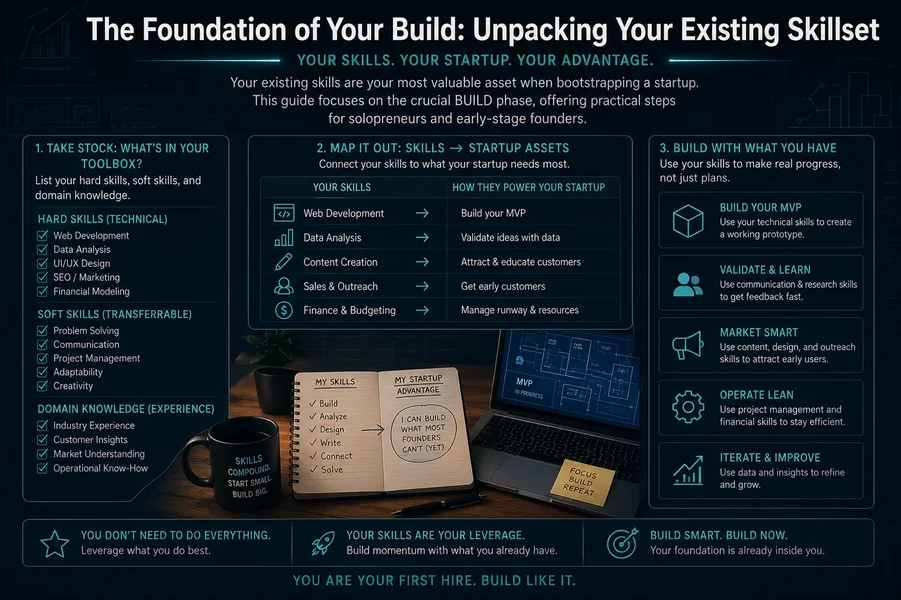
The journey from a disrupted career to a thriving startup is less about starting from zero and more about leveraging the immense, battle-tested toolkit you already possess. As a solopreneur or early-stage founder facing the monumental task of building something from scratch, it’s incredibly easy to feel overwhelmed. You might look at the landscape of tech startups and think, "I have no technical background," or "I've never managed a product release cycle." This is precisely where your past professional experience becomes your most potent, yet frequently overlooked, asset. The build phase of a lean startup is not reserved solely for computer science graduates and software engineers; it is a discipline of structured logic, resource allocation, and problem translation—skills that you have likely spent years perfecting.
This guide is dedicated to the critical BUILD phase of the Lean Startup loop. We will examine how to turn your accumulated knowledge and abilities into tangible development, configure a highly efficient development stack using no-code and low-code infrastructure, and execute a surgical development plan without wasting your limited capital or burning out.
The Psychology of the Build Phase: Overcoming "The Technologist's Mirage"
One of the most dangerous traps for non-technical founders is a cognitive bias we call The Technologist's Mirage. This is the false belief that the success of a startup is primarily determined by the complexity, novelty, or proprietary nature of its underlying code. This illusion causes founders to delay their launch for months—or even years—as they search for a technical co-founder, raise expensive outside capital to hire a software agency, or try to force themselves to learn full-stack programming from scratch.
In reality, the market does not buy code; the market buys solutions to problems. Your customers do not care if your platform is built on a highly sophisticated custom React framework or if it is a clever orchestration of Airtable, Typeform, and Zapier. They only care that their pain point is eliminated quickly, reliably, and intuitively. Once you reframe the "build" process from writing lines of code to architecting a solution workflow, you unlock the ability to move with incredible speed using the skills you already possess.
Mapping Your Skills to the Build Phase
Every successful startup is an exercise in resource coordination. Whether you managed projects, analyzed complex financial data, communicated with demanding clients, or organized chaotic operations in your previous corporate life, you were developing skills that transfer directly to the startup build phase. Let us look at how to actively translate these transferable skills into the context of building your Minimum Viable Product (MVP):
- Project Management as Product Management: If you have ever managed a project, you have negotiated scope, established timelines, coordinated limited resources, and managed stakeholders. In a startup, your MVP is the project, your development roadmap is your timeline, and your remaining savings are your resource constraints. You already know how to break down a massive, intimidating objective into bite-sized, sequential tasks. By applying this structure to your development sprints, you prevent scope creep and maintain momentum.
- Problem-Solving & Analytical Thinking as Systems Architecture: Every business is a system of inputs, processes, and outputs. Your ability to dissect a complex operational workflow, identify structural bottlenecks, and design workarounds is exactly what is required to build an MVP. In the build phase, this translates to mapping out the user journey, analyzing where technical integration gaps might occur, and using creative logic to patch those gaps with simple automations.
- Communication & Feedback Integration: Even as a solo builder, you do not build in a vacuum. Your capacity to clearly articulate a value proposition, actively listen to early testers, and extract the underlying truth from user feedback is invaluable. You will use your communication skills to recruit beta testers, run usability interviews, and negotiate partnerships with API providers or third-party service providers.
- Resourcefulness and Frugality (The Bootstrapper's Superpower): Bootstrapping is the art of turning limitations into creative leverage. If your previous roles required you to execute projects under tight budgets, find clever workarounds to bypass corporate bureaucracy, or use tools in unintended ways to get the job done, you have already mastered the core principles of lean building. This resourceful mindset is infinitely more valuable to a bootstrapper than a million-dollar seed round.
The Non-Tech Founder's Construction Blueprint
To help you systematically translate your previous corporate experiences into direct product development actions, review this transition blueprint:
| Corporate/Previous Skillset | The Lean Startup Translation | Actionable MVP Application |
|---|---|---|
| Corporate Project Manager | Managing feature sprint planning, managing development scope, and setting release dates. | Build a weekly kanban board in Trello or Notion, ruthlessly cutting any feature that isn't required for launch. |
| Financial/Business Analyst | Structuring backend database schemas, tracking data flows, and defining business logic. | Architect your product's relational database inside Airtable or Supabase with clear key fields. |
| Marketing/Sales Specialist | Designing conversion funnels, onboarding flows, and user-facing communications. | Write high-converting, empathetic microcopy for your signup flows, and design automated onboarding emails. |
| Operations Manager | Configuring backend service automations, APIs, and operational workarounds. | Link your front-end form to your fulfillment tools using multi-step zaps in Zapier or Make. |
Actionable Step: The Builder's Skill Audit
Take 30 minutes this week to list your top 5 professional strengths. For each strength, write down exactly how that skill can be applied to coordinate, design, or automate the launch of your MVP. Do not focus on code; focus on the logistical flow of value from your business to your customer.
Executing the Build: From Concept to No-Code Architecture
Now, let’s explore the actual mechanics of building. For bootstrappers, the build phase is about one thing: **tangible creation**. This means assembling your Minimum Viable Product (MVP)—the leanest possible version of your concept that still delivers real, measurable value to your early adopters. It is not about polished perfection; it is about core utility and behavioral validation.
Scoping Your MVP: The Leanest Path to Value
To scope your MVP effectively, you must separate your long-term product vision from your immediate validation goals. Your long-term vision is a mansion; your MVP is a sturdy tent that keeps the rain off your guest. To execute this compression, apply this three-part framework:
- 1. Define the Single Core Problem: What is the absolute primary pain point your product addresses? Your MVP must solve this specific problem, and only this problem. If you are building a tool to help freelancers calculate quarterly taxes, your MVP does not need invoice templates, expense tracking, or accountant messaging. It only needs to accurately calculate quarterly tax liability.
- 2. Identify the Minimum Feature Set: For every feature you consider adding, write down exactly how it directly helps the user solve that core problem. If the link is indirect, remove it from the launch list. To prioritize your engineering tasks mathematically, use this simple ratio:
$$P = \frac{V}{C}$$
Where $P$ is the Priority Score, $V$ is the Value to the User, and $C$ is the Complexity/Time to Build. Always prioritize features where $P$ is exceptionally high—meaning they provide immense value but take very little time to build using your current toolkit.
- 3. Map the User Flow Visually: Grab a sheet of paper and draw every screen or step your user must take to achieve their goal. Ensure there are no dead ends, but ruthlessly eliminate any step that is not strictly necessary. If a user can get their output by submitting a simple single-page form, do not force them to create an account, verify their email, and complete a profile onboarding tour first. Minimize the steps to value.
The Bootstrapped No-Code Tech Stack Selection Guide
If you do not have a programming background, your choice of tools is your most critical strategic decision. The no-code and low-code ecosystem has matured to the point where you can build fully functioning web applications, marketplaces, and automation workflows without writing a single line of syntax. Below is a guide to selecting your development stack based on your business model:
| Business Model | Front-End / UI Layer | Database / Backend Layer | Automation / Logic Layer |
|---|---|---|---|
| SaaS / Web App | Bubble, Softr, or Glide | Airtable or Xano | Zapier, Make, or custom Bubble workflows |
| Directory / Marketplace | Webflow, Framer, or ShareTribe | Airtable or Outseta | Zapier and Memberstack |
| Productized Service | Squarespace, Cardd, or Wix | Typeform and Stripe Payment Links | Zapier routing to Google Sheets / Slack |
Avoiding the "No-Code Lock-In" Trap
While no-code tools are incredible for launching quickly, you must build with future scalability in mind. To ensure you do not run into a technical dead end as your business grows, adhere to these three database design rules:
- Keep Your Data Clean and Separated: Do not hardcode your data inside your design elements. Always keep a clear separation between your user interface (e.g., Webflow, Softr) and your raw database (e.g., Airtable, Supabase). This ensures that if you ever need to migrate your front end to custom code, your data structures remain perfectly intact and easily exportable.
- Design with Clean Relations: Even in spreadsheets like Airtable, use relational logic. Use linked records and unique IDs (like email addresses or auto-generated reference numbers) to connect your users to their transactions, logs, and profiles.
- Standardize Your APIs: Choose tools that support standard webhook configurations and REST API structures. This ensures that as your logic requirements grow more complex, you can easily plug in advanced low-code platforms (like Make or n8n) or write custom scripts to interact with your data.
Implementation Checklist: Your MVP Build
- Step 1: Clearly write down the single, atomic problem your MVP is designed to solve.
- Step 2: List the absolute minimum set of features required to deliver that value. If in doubt, cut it out.
- Step 3: Select 2 to 3 no-code tools that align with your current skills and business model.
- Step 4: Map out your step-by-step user flow, tracking how a user goes from discovery to successful task completion.
- Step 5: Plan your first iteration: what specific subset of features will you build, internal-test, and launch within the next 14 days?
Resource Planning: Building Smart with Limited Means
When you are bootstrapping, you are playing a game of constraints. You do not have the luxury of hire-and-fire cycles, expansive design agencies, or paid marketing testing. Every resource—your capital, your time, and your psychological energy—must be spent with surgical efficiency. In the build phase, structured resource management is your shield against premature failure.
1. Time as Your Primary Investment Capital
As a solopreneur, your most valuable asset isn’t the cash in your bank account; it is your focused attention. When you have unlimited ideas but limited hours, you must protect your schedule with absolute ruthlessness.
- Deep-Work Time Blocking: Designing, configuring, and testing software requires sustained, uninterrupted cognitive focus. Treat your building blocks as non-negotiable, sacred calendar appointments. Block out 3 to 4-hour windows where notifications are muted, email is closed, and your sole objective is to ship a specific functional element of your MVP.
- Applying the "Time-Value Box": Do not spend five hours trying to design a custom logo or polishing the CSS spacing of your landing page header. For every task on your list, ask yourself: "Does optimizing this element directly improve the user's perception of core value?" If the answer is no, time-box the task to 30 minutes, accept a "good enough" solution, and move on.
- The Danger of the "Messy Middle": In every build phase, there is a point where the initial excitement of starting wears off, and you are left with tedious database mapping, bug fixing, and integration errors. This is where many founders abandon their project and start a new, shinier venture. Protect yourself from this by setting small, daily operational targets (e.g., "Today, I will only get the payment webhook to write data to Airtable").
2. Financial Efficiency in Development
A bootstrapper’s primary objective is to survive long enough to achieve product-market validation. Your burn rate determines your runway. To keep your financial footprint as close to zero as possible during development, employ these tactics:
- The "Free-Tier First" Rule: Almost every major SaaS, hosting, database, and automation provider offers a robust free tier designed for early developers. Build and test your entire MVP using these free plans. Do not upgrade to a paid subscription simply for a custom domain or to remove a small logo watermark until you have verified that people are actively using your product and experiencing value.
- Leverage Open-Source Assets: Before buying expensive design assets, custom templates, or premium extensions, look for open-source alternatives. Use free CSS frameworks, open-source UI kits, and free icon libraries (like Lucide, Font Awesome, or Unsplash for visual placeholders).
- Frugal Outsourcing: If you run into a highly technical roadblock that you cannot solve after 4 hours of troubleshooting, do not waste days spinning your wheels. Use platforms like Upwork or Fiverr to hire a specialized expert for a single hour to help you debug that specific issue. This is far more cost-effective than hiring a full-time developer or an agency.
3. Energy Management: Sustaining the Marathon
Building a startup is an endurance sport, not a sprint. If you work 80 hours a week without rest, you will burn out before you ever reach your launch day. Your psychological stamina is a finite, precious asset that must be monitored and replenished.
- Set Micro-Milestones and Celebrate Wins: Because you do not have a boss or a team to provide validation, you must build your own reward loops. Break your build down into micro-milestones (e.g., "Successfully integrated Stripe," "Completed draft of onboarding email sequence"). When you hit a milestone, step away from your desk, reward yourself, and acknowledge your progress.
- Establish a Healthy Distance: Your startup is your project; it is not your identity. When you experience a technical failure or a bug that breaks your app on the night before launch, it is not a reflection of your capability as a founder. Maintaining this mental boundary prevents emotional exhaustion and allows you to approach technical debugging with a calm, analytical mindset.
- Protect Your Physical Health: Sleep deprivation, poor nutrition, and endless screen time degrade your cognitive function. You will write cleaner logic, make smarter architectural choices, and maintain higher resilience if you prioritize basic health hygiene.
Conclusion: The Blueprint of Action
The BUILD phase is the magical arena where your ideas, insights, and background expertise take physical shape. By translating your corporate skills, choosing simple and modular tools, and protecting your resources with discipline, you can effectively build and launch a high-impact startup, even with limited means.
Your previous career was not a separate life; it was the training ground that prepared you for this moment. Step out of the audience, step into the builder's arena, and start assembling your future—one lean, validated iteration at a time.



No comments yet
Be the first to share your thoughts on this article!