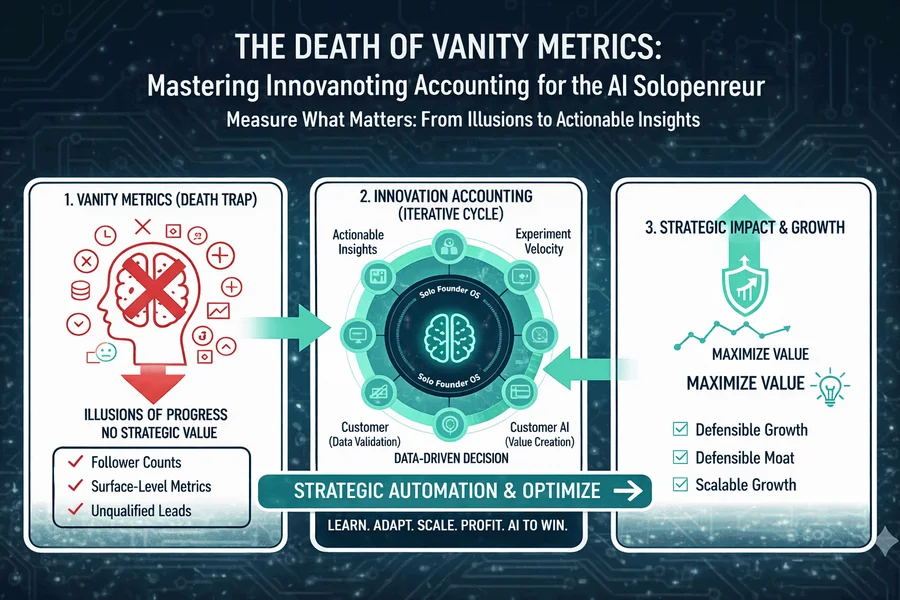
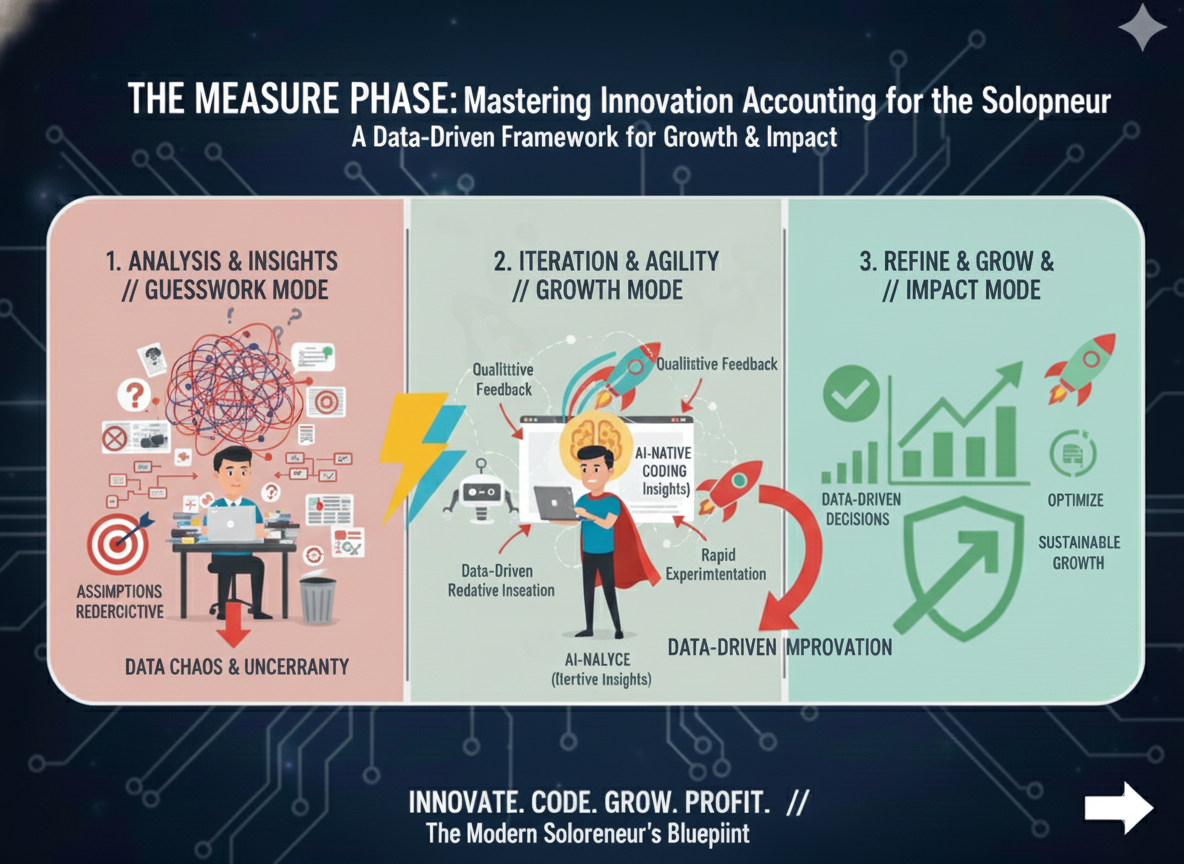
In the fast-paced ecosystem of AI solopreneurship, measurement is often the first casualty of speed. When you can "vibe code" a functional prototype in an afternoon and launch a marketing campaign with a single prompt, the sheer volume of activity can create a dangerous illusion of progress. You see the chart for website visitors ticking upward; you celebrate the milestone of one thousand newsletter signups; you watch as your social media posts garner hundreds of likes.
To reach a sustainable $10,000 monthly run-rate, you must transition from traditional accounting to innovation accounting. You must stop measuring how much you are doing and start measuring how much you are learning.
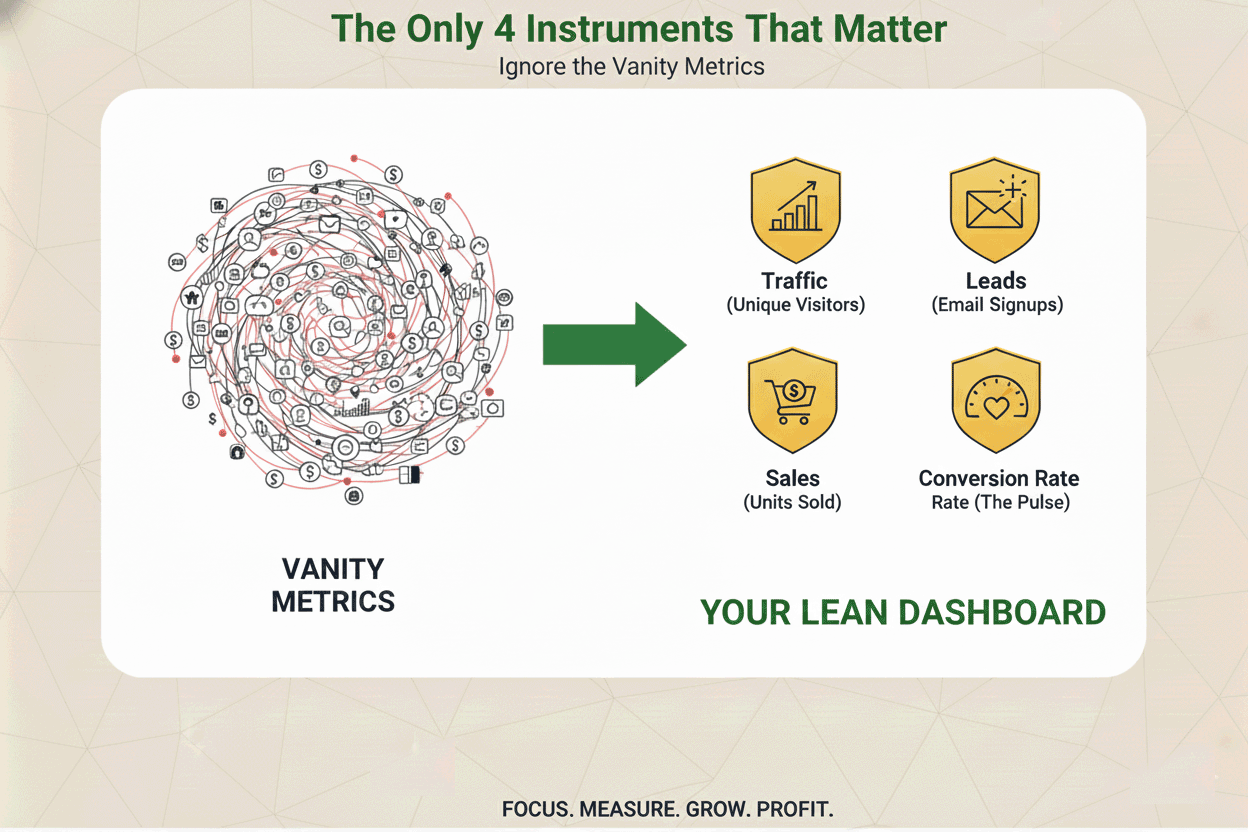
The Vanity Trap: Why Your Current Dashboard is Lying to You
The fundamental problem with vanity metrics like page views, social shares, or total signups is that they are disconnected from the value your AI provides. A user might sign up for your "AI-Powered Content Strategist" because the landing page looks professional, but if they never trigger a single AI action, that signup is a ghost.
Vanity metrics focus on the top of the funnel while ignoring the "leak" at the bottom. In the AI era, where competition is high and attention spans are measured in seconds, the only metrics that matter are those that prove your AI is actually performing the job it was "hired" to do. These are "Sanity Metrics." They provide the cold, hard evidence required to decide whether to persevere with your current strategy or execute a surgical pivot.
The Pillars of Innovation Accounting
Innovation accounting is a framework designed to measure progress in environments of extreme uncertainty. It replaces the traditional profit-and-loss statement with a dashboard of leading indicators that predict future success. For a solo venture, this dashboard revolves around three primary pillars: unit economics, experience latency, and the "North Star" scaling ratio.
1. The North Star: LTV to CAC Ratio
The most critical equation in your business is the relationship between the value of a customer and the cost to acquire them. In a lean startup, you aren't looking for a "good" ratio; you are looking for a ratio that justifies the risk of scaling.
If the ratio is lower than this, you must stop all growth spending. You do not have a marketing problem; you have a product or pricing problem. You must pivot your pricing model or your target audience before you spend another dollar on ads or content.
2. Token Economics and the Efficiency Ratio
Traditional SaaS companies deal with server costs that are relatively stable. AI solopreneurs deal with "Token Economics." Every time a user interacts with your product, it costs you money in real-time. If you use a high-reasoning model for a simple classification task, you are burning your profit margin for no reason.
To ensure you aren't falling into a "Low Margin Trap," you must track your Token Efficiency:
Navigating the AI Pirate Funnel (AARRR)
To truly measure your venture, you must look at the user journey through the lens of the Pirate Metrics framework: Acquisition, Activation, Retention, Referral, and Revenue. For an AI product, the definition of these stages shifts significantly.
Acquisition: Quality over Quantity
Acquisition is the measure of how people discover your product. While total traffic is the easiest number to track, it is often the most misleading. Instead, focus on "Qualified Leads"—users who match your Ideal Customer Profile and have shown a high-intent signal, such as providing a proprietary dataset or asking a specific, painful question that your AI is designed to solve.
Activation: The "Aha!" Moment and Latency
Activation is the most critical stage for AI products. This is the moment a user moves from curiosity to understanding. In the AI world, this is defined by the "Aha!" moment—the first time the user receives high-value, personalized output that they couldn't have generated themselves.
If your AI takes three minutes to process a request, your measurement phase will show a massive drop-off at the activation stage, signaling that you need to optimize your retrieval speed or provide a better "loading state" experience.
Retention: The Ultimate Truth
Retention is the measure of whether users return to your product. In the "Build" phase, you can fool people with a shiny interface. In the "Measure" phase, retention tells you if the product actually works.
Referral: The K-Factor
Referral is when happy users bring in new users. For a solo founder, a high referral rate is the only way to keep your CAC low enough to maintain a healthy LTV:CAC ratio. Track your "Recipient Conversion Rate"—the number of people invited by your active users who actually sign up. If this is low, your referral mechanism is either too friction-heavy or the value proposition isn't clear to outsiders.
Revenue: Willingness to Pay
Revenue is the final validation. Are people willing to part with money for your solution? You should measure "Average Revenue Per User" (ARPU) and track it against your inference costs. In an AI business, you must be wary of "Margin Drift." As users become more sophisticated in how they use your AI, they may trigger more expensive prompts, slowly eating away at the profit you calculated on day one.
The Health of the System: Measuring AI Quality
Beyond the business funnel, the "Measure" phase must account for the technical health of your AI. Traditional software is either "on" or "off." AI is a spectrum of "mostly right" to "dangerously wrong." To ensure your product remains viable, you must track the RAG (Retrieval-Augmented Generation) Triad:
Visibility in the New Market: AI Share of Voice (AISOV)
In a world where users are increasingly getting their answers from ChatGPT, Perplexity, or Gemini rather than Google Search, traditional SEO metrics are losing their dominance. You must measure your AI Share of Voice (AISOV).
AISOV measures how frequently AI models cite or mention your brand compared to your competitors in response to relevant queries. The formula is a variation of the standard share of voice equation:
Turning Metrics into Decisive Action
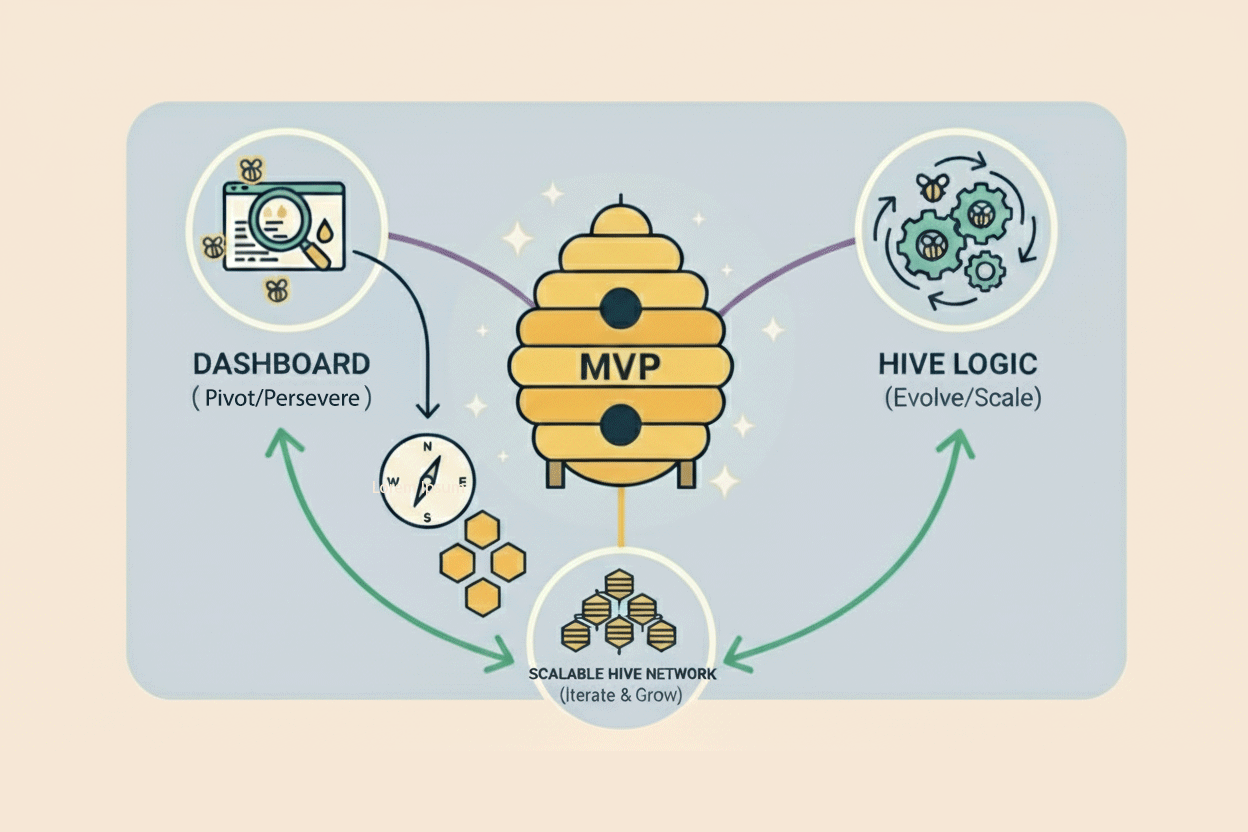
The goal of the "Measure" phase is not to create a pretty chart for a pitch deck. The goal is to facilitate the "Learn" phase. Data is worthless if it doesn't lead to a decision.
In the AI era, the most successful founders are not those who write the best code; they are those who are the best learners. By focusing on Innovation Accounting and ruthlessly eliminating vanity metrics, you ensure that every hour you spend building is an hour spent moving toward a validated, profitable, and scalable future.

No comments yet
Be the first to share your thoughts on this article!