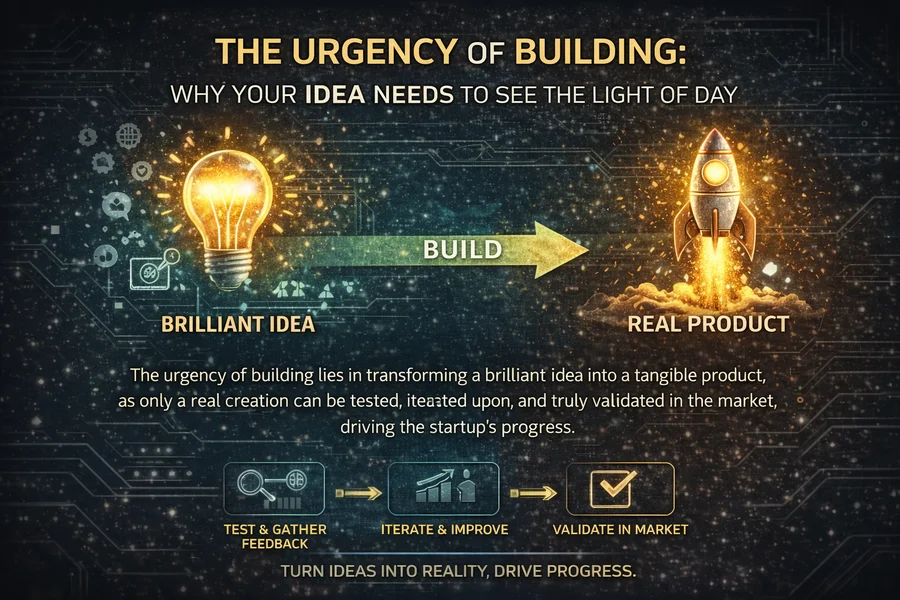
As a solopreneur or early-stage founder, you're likely wearing many hats: visionary, researcher, marketer, and occasional customer support representative. You've spent countless hours dreaming, researching, and talking to potential customers. You have that spark of an idea and a burning desire to solve a problem. But here's the uncomfortable truth: an idea, no matter how brilliant, is just a hallucination until it's made into something real. In the startup ecosystem, momentum is your only real currency.
For those ready to move from planning to doing, the real work begins now. We're talking about the BUILD phase—the driving force of your startup journey. This isn't about creating something perfect or polished; it's about making progress. It's about turning your vision into a working product or feature that can start to interact with the world, receive its first "no," and gather its first piece of critical feedback.
This crucial stage is where the principles of the Lean Startup method, made popular by Eric Ries, truly come into play. Ries stresses the importance of building quickly to begin the Build–Measure–Learn cycle. The goal isn't to create a flawless product but a working version that lets you collect real-world data. This step-by-step approach, based on validated learning, ensures you're building what customers actually need, not just what you think they need. In this phase, your code (or your no-code workflow) is simply a vehicle for learning.
"Building quickly is the engine that drives validated learning. It's about getting your product into users' hands to gather data, not about creating a trophy for your portfolio."
From Concept to Code: The Art of Implementation
The "Build" phase is your chance to create something concrete. It's the link between your abstract ideas and the empirical proof you'll collect. For founders, especially those with limited runway, this means being very smart about what you build. The goal isn't to launch a product with every possible feature, but to create a Minimum Viable Product (MVP). Think of an MVP as the smallest possible manifestation of your product that can offer core value to your target customers and let you start learning immediately.
This focused approach stops you from wasting precious time and money on features that might not be needed. This concept, championed by leaders like Steve Blank and refined by Ash Maurya in "Running Lean," emphasizes that an MVP isn't just a "shitty version" of your product—it’s a version that specifically tests your most dangerous assumptions. If you believe users want to track time, build the timer first, not the user profile settings or the dark mode toggle.
This careful selection is key to avoiding Feature Creep, a common psychological trap where founders believe "one more feature" will finally make the product successful. By focusing on the core value, you ensure your first build directly solves the main problem for your target audience. For our to-do list example, the main idea is that users need a simple way to manage their tasks. Building only the most important features lets you test this hypothesis without adding complexity that muddies the data. If people don't use the basic list, they certainly won't use the calendar integration.
Defining your MVP scope means setting clear, measurable goals. What is the least a user needs to do to experience the "Aha!" moment? This clarity helps guide the building process and provides a standard for judging the MVP's performance. Without a well-defined scope, it's easy to get lost in the "Gold-Plating" phase—polishing things that shouldn't even exist yet.
- Technical Founders: Use frameworks you already know. Now is not the time to learn a new language. Use "Boring Technology" that works reliably.
- Non-Technical Founders: Embrace No-Code/Low-Code. Tools like Bubble, Webflow, or Zapier allow you to build functional applications without writing code. This is often faster for an MVP than hiring an expensive agency.
- Hybrid Approach: Use a landing page (Webflow) to collect signups before building the full app, effectively "building" a test for demand.
The path you choose should match your resources, skills, and timeline. For those with technical skills, directly coding the MVP gives you the most control. However, for founders without technical skills, no-code platforms have democratized the ability to build. These tools let you assemble applications using visual logic, which reduces the time-to-market from months to days. If your budget allows, hiring freelancers can be effective, but you need to manage the project with an iron fist to ensure the scope doesn't grow and the costs don't balloon.
The heart of the Lean Startup is speed. The faster you can get your MVP to real users, the faster you can start getting feedback. This follows the philosophy of "Fail Fast, Learn Faster." By focusing on speed, you accelerate the learning cycle, allowing you to change direction or double down based on actual market proof, not just your gut feeling. This is vital in early-stage startups where your greatest enemy is not a competitor, but the clock.
✅ Pro Tip: Whether you're coding yourself or using no-code, document your User Flows first. Map out every click from "Landing Page" to "Goal Completed." This prevents you from building "dead-end" features that don't lead to user success.
Technical Considerations for the Pragmatic Builder
Building isn't just about writing logic; it involves making smart technical choices that will support your MVP and future growth without becoming a burden. As a solopreneur, being efficient and cost-effective is paramount. This is where Pragmatic Engineering comes in: building only what's needed for today, while leaving the door open for tomorrow.
Choosing the Right Tech Stack
The technology you choose can greatly affect your "Velocity." The key is to pick tools that let you build and test quickly, rather than those that promise the best "Theoretical Scalability" but take longer to set up. Most startups fail long before they reach "Twitter-scale" problems, so don't build for millions of users when you have zero.
- The Frontend: Modern frameworks like React or Vue are powerful, but for a simple MVP, a traditional SSR (Server-Side Rendered) approach or even plain HTML/CSS might get you live faster. If you need a mobile app, look at React Native or Flutter to build once and deploy to both iOS and Android.
- The Backend: Python (Django/Flask) and Node.js are popular because they have vast libraries that do 90% of the work for you. Ruby on Rails remains a "startup darling" specifically because of how quickly it lets you go from zero to a working database-backed app.
- The Database: Stick with PostgreSQL or MySQL. They are the "trucks" of the internet—reliable, well-documented, and capable of handling 99% of startup needs. If your data is highly irregular, look at Firebase or MongoDB for faster initial prototyping.
- Hosting: Use Platform-as-a-Service (PaaS) providers like Heroku, Render, or Vercel. They handle the "DevOps" for you, so you can focus on building features rather than configuring servers.
💡 Key Insight: When selecting your technology stack, prioritize Developer Velocity over System Scalability. Your goal is to find a business model, not to build the world's most robust architecture for a product nobody wants.
Best Practices for Lean Development
Using lean building methods from the start is important for efficiency and long-term sanity. Even if you are a "team of one," these habits will save you hundreds of hours later.
Version Control (Git) is mandatory. Even if you aren't sharing code, Git is your undo button. Use services like GitHub or GitLab to store your work. It allows you to experiment fearlessly, knowing you can always roll back to a working version if you break something. Think of it as an insurance policy for your time.
Automated Testing: While you don't need 100% test coverage, focus on "Smoke Tests"—automated checks for your most critical paths (e.g., "Can a user still sign up?"). This prevents you from breaking your core value proposition every time you add a new feature. Even a small amount of testing can prevent "Technical Debt" from accumulating too fast.
Security is not an afterthought. You don't need an enterprise-grade security audit, but you must implement the basics: handle passwords via hashing (never store them in plain text), use HTTPS, and sanitize user inputs to prevent SQL injection. A security breach is the fastest way to lose the trust you're working so hard to build.
⚠️ Warning: Avoid Premature Optimization. Don't spend a week optimizing your database queries to save 50 milliseconds if you only have 10 users. Spend that week talking to those 10 users instead.
Resource Requirements and Planning: Building Smartly on a Budget
For solopreneurs and startups with limited funds, planning resources isn't just about budgeting money; it's about the strategic allocation of Time, Energy, and Focus. Every hour you spend on your build is an hour you aren't spending on marketing or sales. You must be an expert at managing your own output.
Time Allocation and Project Management
As a solopreneur, your most valuable resource is your time. Using it well is the difference between a launched MVP and a "forever-project."
Time Blocking: Set aside specific, uninterrupted periods for "Deep Work" (building). Treat these times as sacred. Eliminate distractions (Slack, email, social media) to allow for the concentration required for complex building. You will get more done in two hours of focused work than in eight hours of "busy-work."
Task Granularity: Don't put "Build App" on your to-do list. Break it down into tasks that take less than 4 hours. Instead of "Build Login," use "Create Login UI," "Setup Auth Logic," and "Test Login with Mock User." This gives you a psychological win every time you check a box and allows for more accurate tracking of your progress.
Budgeting for the MVP
If you are not fully technical, you will need to spend money, but do so with Frugal Innovation in mind. Your budget should be focused on tools that provide leverage. Spend money on a good no-code tool if it saves you 100 hours of coding. Spend money on a freelancer for a specific, difficult task (like API integration) rather than the whole project. The goal is to maximize the "Learning-per-Dollar" ratio.
💡 Key Insight: Your "Burn Rate" isn't just about cash; it's about your personal enthusiasm. The longer it takes to build, the more likely you are to lose interest or run out of energy. Build for Small Wins to keep your momentum high.
The Takeaway: Build to Learn, Not to Last (Yet)
The "Build" phase is the most exciting and dangerous part of the Lean Startup journey. It’s where your dreams meet the cold reality of implementation. By focusing on a narrow MVP scope, choosing pragmatic tools, and managing your time with discipline, you turn the "Build" phase from a bottomless pit of development into a high-speed engine for discovery.
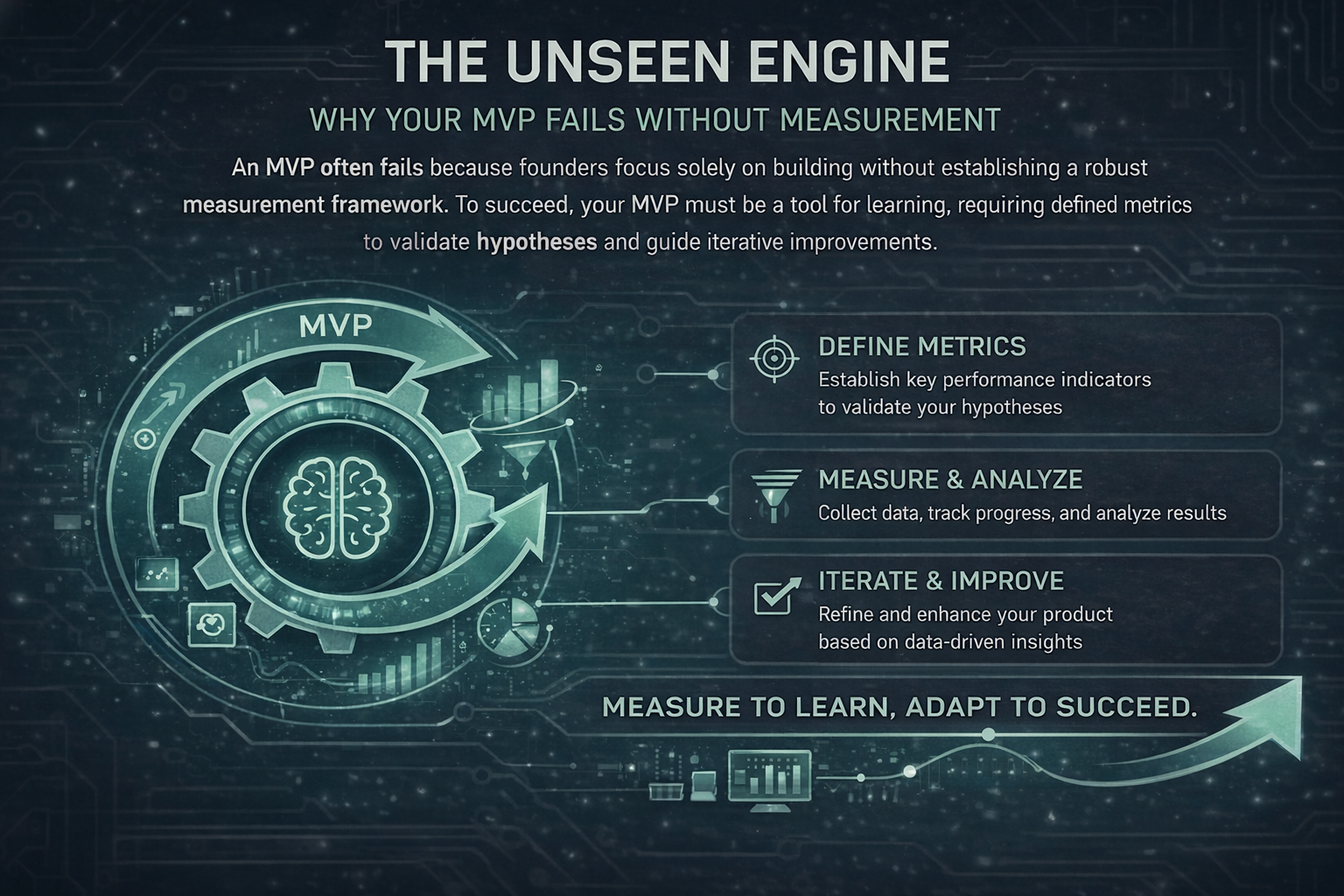
Remember: You are building a Minimum Viable Product. If you aren't a little bit embarrassed by the first version you launch, you've probably launched too late. The goal is to move as quickly as possible into the next phase: MEASURE, where the world will tell you if your build was actually worth it.
✅ Next Step: Open a doc and list the 10 features you want to build. Now, cross off 7 of them. The remaining 3 are your MVP. Start building those—and only those—today.
In the next part of this series, we’ll look at the MEASURE phase: how to set up the analytics and feedback loops to tell if your MVP is a hit or if it’s time to move back to the drawing board.
No comments yet
Be the first to share your thoughts on this article!