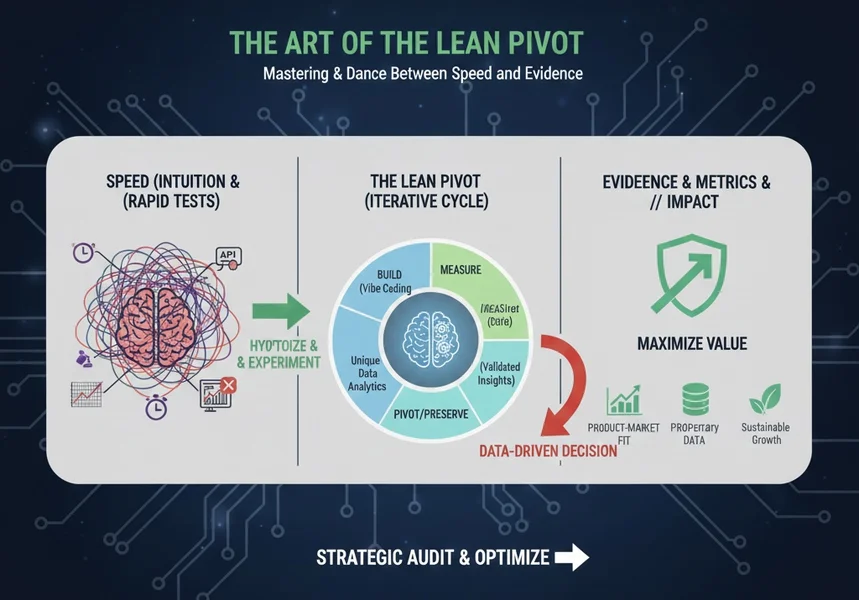
In the high-stakes world of startups, there are two common ways to fail. The first is to build a cathedral in the desert—spending a year of engineering effort on a complex solution for a problem that doesn’t exist. The second is to die in the library—spending a year researching, interviewing, and "validating" while the market moves on and your runway evaporates.
Both paths lead to the same destination: The Graveyard of Lost Potential. Building too fast and validating too long are not just tactical errors; they are fundamental misunderstandings of how value is created. The real skill of a modern entrepreneur is learning how to dance between speed and evidence. You must ship quickly enough to learn from reality, but not so blindly that you burn your life savings on a hallucination.
The Core Tension: Two Types of Waste
Every hour spent in a startup is a gamble. As a founder, you are essentially a capital allocator—even if that capital is just your own time. When we look at the tension between building and validating, we are really looking at two distinct forms of waste.
1. Execution Waste: The Arrogance of the "Visionary"
Execution waste occurs when you build the wrong thing perfectly. It is the result of an action bias that ignores market signals. For many technical founders, the "editor" is a comfort zone. When faced with the terrifying uncertainty of the market, they retreat into code. They tell themselves that "one more feature" will finally unlock growth.
2. Learning Waste: The Fear of the "Scholar"
Learning waste is the opposite. It occurs when you accumulate "insights" that never face the friction of reality. It is often a form of procrastination disguised as "due diligence." Founders in this trap fall in love with the process: the empathy maps, the business model canvases, and the endless "discovery calls."
The Dangers of Building Too Fast
"Move fast and break things" was a great mantra for a company that already had a billion users. For a pre-product-market fit startup, it can be a death sentence.
The Mirage of Momentum
When you’re shipping every day, you feel like you’re winning. Your GitHub contribution graph is green, and your Trello boards are clearing. But momentum is a vector—it has both speed and direction. If your direction is 180 degrees away from user needs, speed only gets you to failure faster.
The "False Negative" Trap
If you ship a "Minimum Viable Product" that is too broken, too ugly, or too confusing, and it fails to gain traction, you face a devastating dilemma: Did the product fail because the idea was bad, or because the execution was poor? When you build too fast, you often create "noise" that masks the "signal." You might kill a billion-dollar idea because your MVP was so unpolished that users couldn't even find the "Sign Up" button.
The Concrete Wall of Technical Debt
Building fast usually means cutting corners. This is fine if you’re building a throwaway prototype. But if you keep building "fast" for six months, you end up with a spaghetti-code monolith. Just as you finally find the "pivot" that could save the company, you realize that your codebase is too rigid to change. You are trapped by the ghosts of your own previous speed.
The Traps of Validating Too Long
On the other end of the spectrum, excessive validation creates its own set of lethal problems.
The "I Like It" Fallacy
The biggest problem with pure validation (interviews and surveys) is social politeness. People are generally nice. If you show them a mockup and ask, "Would you use this?", most will say "Yes." This is a weak signal. Real validation only happens when there is an exchange of value: a user giving you their time, their data, or their money. If you spend months collecting "likes" and "interests," you are building a house on sand.
The Loss of Founder Intuition
While data is crucial, great products also require a point of view. If you spend all your time asking users what they want, you end up with a "faster horse" rather than a car. You can "validate" the life out of a truly innovative idea because it doesn’t fit into a user's current mental model. At some point, you have to stop asking and start showing.
At some point, you have to stop asking and start showing.
The Competitive Window
Markets are not static. While you are conducting your 50th user interview to find the "perfect" feature set, a competitor might launch a "good enough" version and capture the network effect. Validation is a luxury that the clock eventually expires.
A Better Frame: The Smallest Next Step
Instead of choosing between "Building" and "Validating," the LeanPivot approach asks: "What is the cheapest way to de-risk my biggest assumption?"
This requires a shift in thinking from "Product Development" to "Risk Management." Every startup is a collection of risks. Your job is to tackle them in order of lethality:
Practical Strategies for the Dance
To successfully navigate between speed and evidence, you need a set of "operating rules" that force you out of your comfort zone.
1. The "Thin Slice" Architecture
Don't build a "lite" version of a 10-feature platform. Instead, build a complete, end-to-end experience for a single use case. If you are building a project management tool, don't start with a dashboard, a calendar, and a chat app. Start with a single "Add Task" button that actually works and notifies one person. This is a "thin slice." It allows you to test the core value proposition without the bloat of a full build.
2. Time-Boxed Discovery Sprints
Validation should never be an open-ended phase. Set a hard deadline. "We have 14 days to find 10 people who will pay $20 for this concept." If you don't hit the goal by day 14, you don't "keep researching." You either pivot the idea or you kill it. The time-box prevents research from becoming a lifestyle.
3. High-Fidelity Smoke Tests
Before you write a single line of backend code, build a landing page that looks like a finished product. Drive $100 of targeted ad traffic to it. If people don't click the "Get Started" button when they think the product is real, they certainly won't use it when you've spent three months building it. This is "validation through behavior," which is 10x more valuable than "validation through conversation."
4. The "No-Code" Bridge
Use no-code tools (Zapier, Airtable, Webflow) as a bridge. If you can solve a user's problem using a spreadsheet and a manual email, you have validated the value. Once the manual process becomes too painful to handle because you have too many customers, that is when you earn the right to write custom code.
5. The "Kill-Switch" Metric
For every new feature or experiment, define a "Failure State" before you start.
- "If this feature doesn't reach a 20% weekly retention rate within 30 days, we remove it from the app."
Bringing It Together: The Parallel Loop
The most successful founders don't treat validation and building as linear phases (Phase 1: Research, Phase 2: Build). Instead, they treat them as parallel streams.
In a given week, a LeanPivot team is:
- Building the next thin slice of the product.
- Measuring the data from the slice they shipped last week.
- Talking to users about the slice they plan to build next month.
This creates a continuous feedback loop. The "speed" comes from the small, incremental builds. The "evidence" comes from the constant stream of user data.
Conclusion: The Wisdom of the Pivot
The word "pivot" is often used as a euphemism for failure. In the LeanPivot philosophy, a pivot is a success—it is the act of using evidence to avoid a disaster.
The goal of your startup is not to prove that your initial idea was right. Your goal is to find a business model that works before you run out of money. To do that, you must be willing to sacrifice your code on the altar of data, and your theories on the altar of shipping.
Stop asking if you should build or validate. Start asking: "How soon can I be proven wrong?" The faster you find the "No," the closer you are to the "Yes" that actually scales.

No comments yet
Be the first to share your thoughts on this article!