Every founder hears the alluring whisper of the startup life: massive impact, financial freedom, and building your own empire. It’s an irresistible call that promises to elevate you from the mundane—the perfect "eerie-sistible" path to self-made success.
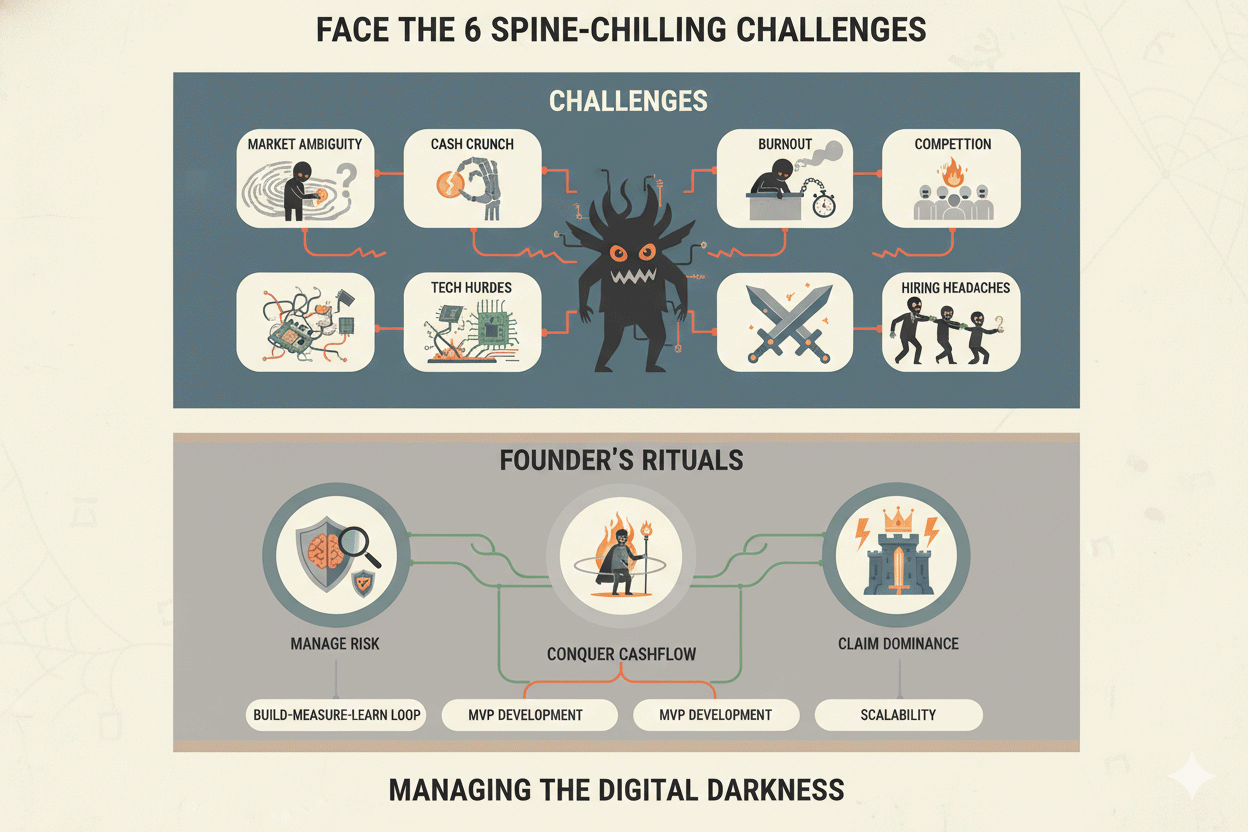
But let's be honest. Beneath the polished pitch decks and successful headlines, the early days are a true horror show. Running lean, chasing an unproven idea, and facing down cash crises introduces high-stakes pressure that can turn your hopeful vision into a founder's nightmare. This is the period of existential risk, where decisions are made under immense pressure and resources are terrifyingly scarce.
We're going to pull back the curtain on the six most terrifying struggles all early-stage founders face. We've framed each as a wicked Trick (the immediate, universal pain) and a powerful corresponding Treat (the competitive edge you earn). More importantly, we will introduce the Founder’s Ritual, the secret weapon based on Lean principles that allows you to manage risk and defeat these entrepreneurial demons. Face these ghosts with preparation, and you won’t just survive the startup crypt—you'll claim the treasure of market dominance.
The Six Most Terrifying Trials of Early-Stage Founding
1. The Crypt of Market Validation: Who Are You Selling To?
The TRICK: The Overwhelming Pressure to Be Everything to Everyone
When you start, the fear of saying "No" to a potential customer is palpable, but chasing too many markets is the fastest way to fail. You risk becoming too vague to attract a real customer, or too niche to generate serious revenue. This is the Market Ambiguity Trap. If your Ideal Customer Profile (ICP) is still a ghost—a collection of assumptions rather than a validated persona—every decision, from product features to marketing dollars, is a random gamble. You must validate that core problem-solution fit fast before your precious runway vanishes. You’re forced to bet your entire future on a series of unproven hypotheses.
The TREAT: Precision Messaging Drives Breakthrough Sales
By forcing the discipline to define a crystal-clear, defensible target, you gain an unmatched competitive advantage. This precision allows your small team to craft messages that genuinely hit a nerve, instantly cutting through the noise made by larger, generic competitors who try to serve everyone. When you solve a crucial, acute pain point perfectly for a specific group, you don't just establish credibility—you become the obvious, indispensable choice. You can own that segment of the market before anyone else even sees the opportunity, creating immediate, powerful network effects within that community.
The Founder's Ritual (Lean Strategy): The Customer Interview (Build)
The key to escaping the Market Ambiguity Trap is replacing assumptions with Validated Learning. You can’t build your way to product-market fit; you have to talk your way there. This is where the Lean Startup's Build phase begins, not by writing code, but by building and testing hypotheses.
By rigorously practicing this ritual, you avoid building expensive solutions to problems no one cares about.
2. The Phantom of Cash Flow: The Never-Ending Money Scare
The TRICK: The Monetary Mummy’s Embrace (The Draining Budget)
Whether you’re bootstrapped or banked, money is a finite resource under constant siege. The danger is the "Monetary Mummy’s Embrace," where your venture is slowly choked by operating costs while you desperately wait for sales to materialize or the next wire transfer to land. Every early startup runs on an increasingly narrow runway. Balancing essential costs (salaries, tools) against the desperate need for growth spending (hiring, marketing) is constant stress. This unpredictability doesn't just compromise stability; it forces founders to make rushed, short-term decisions that undermine long-term strategy, and ultimately, it kills sleep.
The TREAT: The Spellbinding Power of Valuation and Return
The counterpoint to financial fear is the exponential financial reward. By solving a huge problem early on, you unlock the potential for massive returns and high valuations that make the early struggles worth it. Crucially, early success means you are not reliant on funding simply to survive; you seek funding to accelerate. Every successful early metric, like a consistent rate of Monthly Recurring Revenue (MRR) or a high Net Promoter Score (NPS), acts as a powerful lever, stabilizing the business by attracting essential future funding and valuable strategic partners, dramatically reducing your cost of capital in subsequent rounds.
The Founder's Ritual (Lean Strategy): Actionable Metrics (Measure)
The key to managing cash flow is managing what you measure. The Lean Startup insists on ignoring Vanity Metrics (total signups, social media followers) and focusing only on Actionable Metrics that drive growth.
- Define Baseline: Establish current performance (e.g., conversion rate from free trial to paid).
- Tuning the Engine: Run an experiment (A/B test a new pricing page).
- Pivot or Persevere: Based on the results, decide whether the hypothesis was confirmed (persevere) or denied (pivot).
3. The Siren Song of Solitude: The All-Hands Founder
The TRICK: Wearing All the Hats Until You Collapse
In the earliest stages, you don't have departments—you have a team of one, two, or three, covering every single functional area: development, sales, legal, HR, and accounting. The founder is the ultimate bottleneck. Low-leverage admin tasks constantly interrupt high-leverage work, leading to relentless context-switching and exhaustion. This operational strain is the direct path to burnout, threatening the very engine of the business: you.
The TREAT: Unfettered Alignment and Blazing Speed
The reward for this incredible workload is the massive benefit of total control and agility. With a small team, communication is instant, and bureaucratic sludge is nonexistent. You have complete authority over your strategy and can pivot, deploy, and execute major changes in days, not months. This shared urgency and direct responsibility fosters an unmatched development and market velocity that big, slow-moving companies can only dream of. When a major bug is found, it can be fixed in hours, not weeks, which is a powerful advantage in building early trust.
The Founder's Ritual (Lean Strategy): Small Batch Size (Build)
The key to balancing the workload and avoiding burnout is to minimize the amount of work in progress, focusing on small, high-impact iterations. This is the Lean concept of Small Batch Size.
4. The Black Magic of Acquisition: Hunting the First Believers
The TRICK: The Haunting Silence of Zero Customers
Getting those first paying customers—the ones who truly validate your idea—is the hardest part of the journey. You face the "Haunting Silence," shouting into the void trying to convince skeptics to trust an unproven brand. Traditional marketing is too expensive and inefficient for an unproven product. You desperately need social proof, and that critical currency—the successful client testimonial or case study—is agonizingly difficult to earn without initial customers. You are selling hope, not history.
The TREAT: High-Fidelity Feedback and Customer Evangelists
Your first customers are not just revenue; they are early adopters and co-creators of your product. Early adopters, by definition, are searching for your solution and are often willing to tolerate imperfections in exchange for solving an acute pain. By engaging directly with them, you get invaluable, unfiltered feedback that instantly refines your product-market fit. This focused interaction turns those early users into passionate evangelists for your brand, providing the critical word-of-mouth growth you need to scale without relying on massive ad spend.
The Founder's Ritual (Lean Strategy): Conversion Experiments (Measure)
Acquisition success isn't about spending more; it's about learning which channel and message works most efficiently. This requires systematic testing within the Measure phase.
5. The Viral Curse of Churn: The First Impression Crisis
The TRICK: The Snowball Effect of a Single Failure
When your customer base is tiny, every interaction is magnified, and the consequence of poor service is severe. For a young company, a major bug or a critical customer service failure acts like a "Viral Curse." A poor experience can instantly damage your fragile reputation and halt growth in a tight-knit industry. Until you build trust, the damage applied by one failure is existential, and high churn—the quiet killer of startups—can doom your business before it ever scales.
The TREAT: Building a Legendary Customer Culture
Your small size is the perfect opportunity to build a legendary customer service culture. Unlike large, impersonal corporations, your team can establish a high-touch, personalized relationship with every early user. This level of dedication is an unforgettable competitive differentiation. You turn those initial users into fiercely loyal advocates who will defend your brand publicly, stabilizing your revenue and building a powerful brand asset that fuels future growth through reduced churn.
The Founder's Ritual (Lean Strategy): The Engine of Growth (Learn/Build)
Customer feedback, especially from those who leave, is the highest form of Validated Learning available. This feedback should immediately inform the next Build cycle.
6. The Werewolf's Dilemma: Strategy vs. The Brutal Pivot
The TRICK: The Ghost of Failed Hypotheses (The Cost of Hesitation)
The most painful moment is recognizing you need to abandon your original vision and execute a complete strategic pivot. Many founders struggle for months, paralyzed by their emotional attachment to the initial idea (the "zombie project"), even when the data shows it's flawed. The real risk here isn't the financial loss; it's the wasted time and the morale drain. Hesitation kills more startups than competition ever will because it prevents you from starting the next, potentially successful, experiment.
The TREAT: Agility and Low-Risk Testing
The best defense is your inherent simplicity and low structural complexity. You have no legacy systems or bureaucracy to dismantle. This allows for unmatched strategic agility and low-risk testing. If a concept fails to gain traction, the resource loss is minimal. This low barrier to change is your greatest advantage, allowing you to rapidly test, gather data, and reposition the company until Product-Market Fit is genuinely achieved. The pivot becomes a sign of intelligence, not failure.
The pivot becomes a sign of intelligence, not failure.
The Founder's Ritual (Lean Strategy): Pivot or Persevere (Decide)
This is the ultimate decision point in the Build-Measure-Learn loop. Once an experiment is completed and the data is analyzed, you must use Innovation Accounting to make a non-emotional call.
The Final Positive Incantation: Courage to Continue
Look, launching a startup is a horror movie, and you're the hero. You have to be prepared to face down financial monsters, workload demons, and the ever-present threat of market rejection. It demands grit, tenacity, and a healthy awareness of what can go wrong.
But the Lean Startup methodology is your powerful grimoire. It teaches you to substitute guesswork with rigorous testing, to choose validated learning over vanity metrics, and to use the scarce resources you have—time and cash—on the highest-impact activities. Your goal is not to execute a perfect plan, but to learn faster than your resources are depleted.
Your goal is not to execute a perfect plan, but to learn faster than your resources are depleted.
Remember the gifts you possess: speed, control, and the ability to connect deeply with your market. The real magic isn't in avoiding the struggle; it's in being faster, smarter, and more adaptable than the competition.
The courage to continue, adapt, and execute is the one ritual that guarantees you the ultimate treat. Now go claim your victory.

No comments yet
Be the first to share your thoughts on this article!