Congratulations. You’ve passed the $10 stress test. You’ve survived the 30-day launch sprint. You have real, paying customers who value your "AI Superagent" output. By any traditional metric of a solo venture, you have "made it."
But success in the AI era brings a new, invisible problem that high-performers often fail to see until it’s too late: The Founder’s Ceiling.
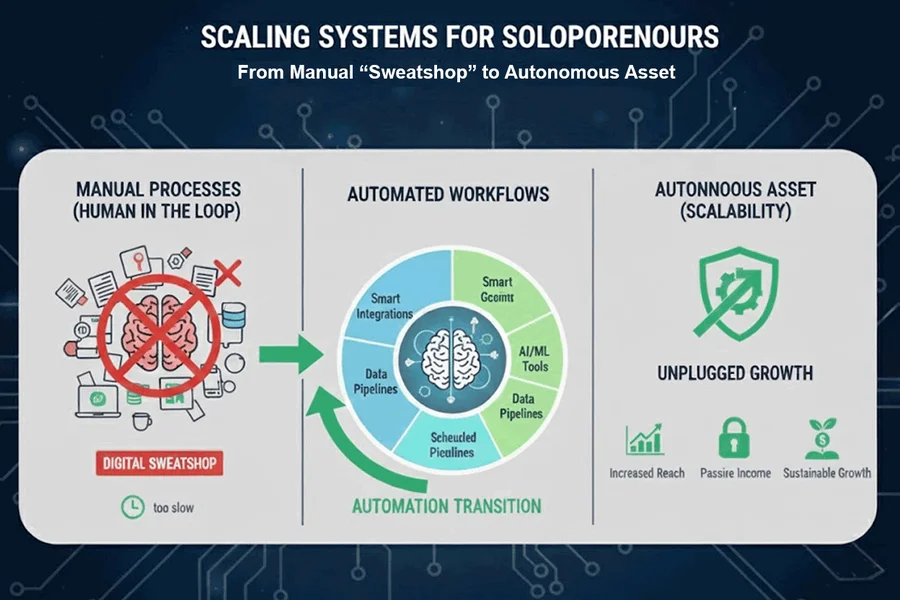
Right now, your business likely looks like a "Digital Sweatshop." You are the "Human in the Loop." You are checking every prompt, fixing every hallucination, and manually hitting "Send" on every deliverable. You haven't built a scalable business yet; you’ve built a high-tech freelance gig. You have traded your old boss for a set of demanding APIs and a client base that expects 24/7 uptime. If you go on vacation, the revenue stops. If you get sick, the AI sits idle.
The final stage of the AI Solopreneur’s Launchpad is about Systems. We are going to move you from being the "Driver" of the AI to being the "Architect" of the system that drives itself. We are moving from manual labor to Infinite Leverage.
Here is how you scale from a lean service provider to a Micro-SaaS owner.
The Service-to-Product "Flip": The Consultant’s Paradox
In the traditional startup world, founders spend millions of dollars and thousands of hours building a product in a vacuum, then pray that the market actually wants it. In the AI Solopreneur world, we do the opposite. We start with a Productized Service.
A Productized Service is a fixed-price, fixed-scope offering delivered with the help of AI.
- Example: "I will provide 4 deep-dive SEO audits per month for $499."
The beauty of this model is that it solves the "Consultant’s Paradox"—the fact that the better you get at your job, the less you can bill (if you bill by the hour). In an AI-driven service, efficiency is your profit margin.
The secret to scaling is the "Flip." As you deliver this service to your first 5 or 10 clients, you are secretly building the "internal tools" to make your own life easier. You are creating the perfect prompt chains, the robust database schemas, and the edge-case handling logic. You are seeing the "bugs" in the real world before you ever write a line of software.
The Flip happens when you stop selling the output (the audit) and start selling access to the engine (the tool).
By starting as a service, you have been "paid to do R&D." You know exactly what the customer wants because you’ve been doing it for them manually. You aren't guessing what features to build; you are simply automating the tasks you’re tired of doing yourself. This is the most "de-risked" way to build a SaaS product in history.
Moving from "Human-in-the-Loop" to "Human-on-the-Loop"
To scale, you must fundamentally change your relationship with the intelligence you've harnessed. Most solopreneurs stay stuck in the "Worker" phase because they don't trust the AI. They remain "Human-in-the-Loop" (HITL).
- Human-in-the-Loop (HITL): The AI cannot finish the task without your intervention. You are a component of the machine. You are the bottleneck. (Scalability: Low).
- Human-on-the-Loop (HOTL): The AI completes the entire task autonomously, but it pauses at a "Quality Gate." You simply glance at a dashboard and click "Approve" or "Regenerate." (Scalability: High).
The "Confidence Score" Trigger
The most advanced AI solopreneurs don't just "check the work"; they build systems that evaluate themselves. This is called Self-Reflexive Architecture. You program your system to evaluate its own work using a separate, high-reasoning model (like OpenAI o1 or Claude 3.5 Sonnet) to play the role of a "Quality Auditor." The auditor assigns a Confidence Score to the output.
This allows you to handle 100 or 500 clients while only "working" on the 5% of tasks that are actually difficult or novel. Your time is no longer spent on the average; it is spent only on the exceptions. This is how a single person manages a volume of work that used to require a 20-person agency.
The Autonomous Stack: Multi-Agent Orchestration
As you scale, a single "System Prompt" is a point of failure. If you ask one AI to research, analyze, write, and format a 2,000-word report, the quality will degrade. The "cognitive load" on the model is too high.
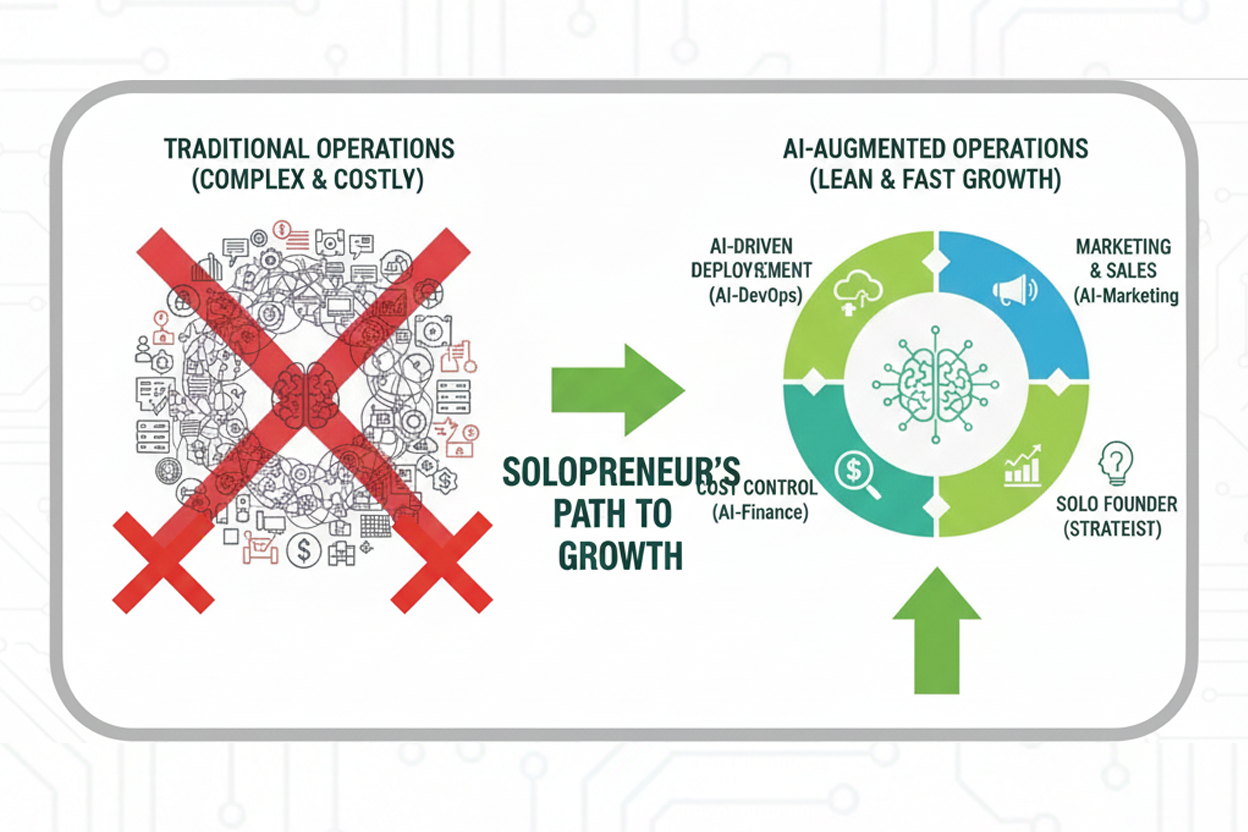
To reach true scale, you must move toward Multi-Agent Systems. Think of your business like a tiny digital factory. Instead of one giant AI trying to be a "Generalist," you break the process down into specialized agents with distinct personalities and constraints:
Using tools like LangGraph, CrewAI, or sophisticated Make.com blueprints, you can coordinate these agents. This "Modular Architecture" is much more resilient. If the "Researcher" fails because a website changed its layout, you only have to fix that one tiny agent, not the entire business model. You are now a Manager of Agents, not a Writer of Prompts.
The Front-End (The Client Interface)
The interface is the client's window into the AI Superagent, and its design directly impacts adoption and perceived value. For the solo entrepreneur, the goal is rapid deployment and maintenance-free operation.
- Softr or Bubble: These remain the recommended starting points. They offer drag-and-drop interfaces for building fully functional client portals without writing code. Users can:
- Upload their proprietary data (PDFs, CSVs).
- Trigger the AI Superagent workflows via a button or form submission.
- View their historical results in a clean, branded dashboard.
- Manage their own subscriptions via Stripe integration.
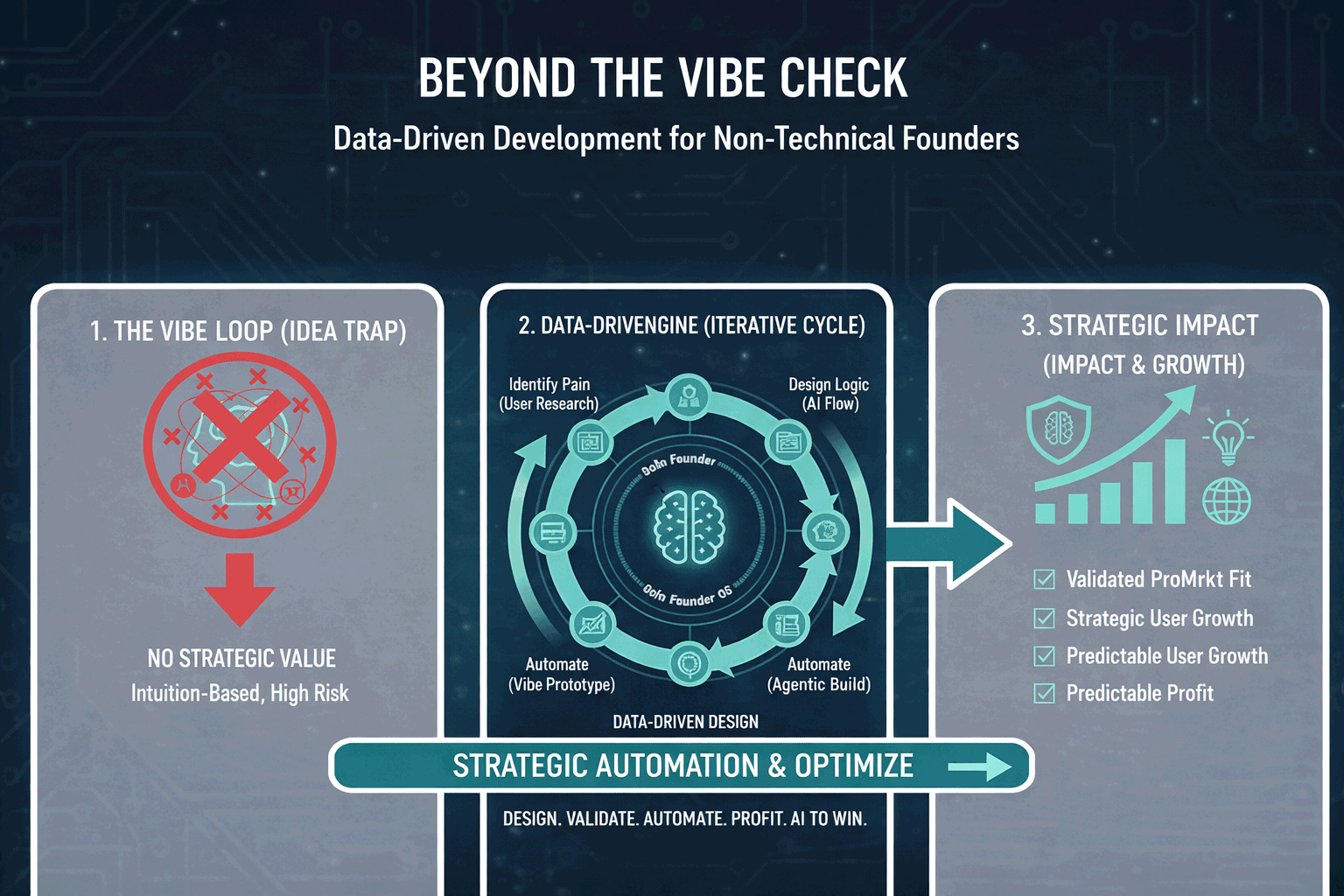
- Vibe Engineering: This is where the interface design meets prompt engineering. A well-designed "No-Code" interface is inherently a form of "Vibe Engineering." It guides the user's interaction (the vibe of the request) into a structured format (a refined prompt). For example, a simple drop-down menu that asks "What is the desired tone?" (e.g., "Formal," "Casual," "Urgent") is an interface element that engineers the vibe of the subsequent AI output, ensuring the AI performs within the expected constraints.
- React/Next.js/Vue (The Code-at-the-Edge): As your Micro-SaaS gains traction and requires highly custom UI/UX or integration with complex third-party systems, you will inevitably transition to a traditional frontend framework. These are hosted "at the edge" (like on Vercel or Netlify) for maximum speed and lower latency.
- Pros: Unmatched flexibility, performance, and the ability to handle extremely complex or high-volume user interactions.
- Cons: Requires dedicated coding skills, a more involved DevOps setup, and significantly increases initial development time.
- Definition: "Vibe Coding" is the practice of designing the entire user experience—from the visual design to the microcopy and the prompt structure—to maximize the quality and consistency of the AI's output. It's about designing for the AI as much as for the human.
- Implementation: In a Vibe-Coded interface, the user doesn't just fill out a form; they are subtly guided to provide the exact context the AI needs.
- Contextualizing Uploads: Instead of a generic "Upload PDF," the system might prompt, "Upload the Annual Financial Report you want the AI to summarize."
- Proactive Feedback: The interface provides real-time feedback on the quality of the user's input, like a "Context Quality Meter," nudging them toward a better result before the AI is even triggered.
- Personalized Workflows: The UI dynamically adjusts based on the user's historical preferences, reinforcing the "vibe" that has previously yielded the best results.
- Replit or Bolt: For the technical solo entrepreneur, environments like Replit offer an incredibly fast way to stand up a full-stack proof-of-concept. These platforms abstract away complex deployment, allowing the focus to remain purely on the product's core value.
- "Lovable" MVPs: This approach is ideal for building a Lovable Minimum Viable Product—one that focuses on delighting a small user base with a core, magical AI feature before scaling the entire infrastructure. It emphasizes rapid iteration and feedback loops.
- Emergent Design: Using these lightweight environments fosters Emergent design principles. The frontend is not over-engineered upfront but evolves organically in response to user behavior and the unexpected capabilities of the underlying AI Superagent. The interface is seen as a constantly improving experiment, not a static deliverable.
Exit-Ready Systems: Documenting the Machine
A business you can't sell is just a job. Even if you never plan to sell your AI venture, you should build it as if you were going to exit tomorrow. This is the ultimate test of a "System." If a stranger could buy your business and run it without calling you, then—and only then—do you truly own a company.
This requires building Standard Operating Procedures (SOPs) for your AI.
- The Prompt Library: A version-controlled repository (even just a Notion doc) of every prompt that runs your business. You must treat prompts like source code.
- The Failure Log: A document detailing exactly what to do when an API goes down, a model update breaks your formatting (model drift), or a client's data is malformed.
- The Quality Benchmark: A set of "Golden Examples"—perfect outputs that you use to test new models. When OpenAI releases "GPT-5," you run your Golden Examples through it. If the quality drops, you don't upgrade. If it improves, you do.
When your processes are documented and your agents are autonomous, your business becomes an income-generating machine. You have achieved the ultimate goal of the AI Solopreneur: Decoupling your income from your hours.
The Psychological Shift: From Maker to Manager
The final barrier to scaling isn't technical; it's psychological. To grow, you must let go of the "Maker" identity.
In the beginning, you were the one writing the prompts. You felt the "craft" of it. To scale, you must become a Systems Manager. You must be okay with the AI doing a task at 95% of your quality if it means you can do it 1,000 times faster.
Most solopreneurs fail here because they value their own "touch" too highly. The AI Solopreneur realizes that Leverage is the only metric that matters. If you can spend one hour building a system that saves you 10,000 hours, you have won the game of modern business.
Final Thoughts: The Infinite Leverage of the Solo Founder
We are living in a unique window of history—the era of the "One-Person Unicorn." For the first time, a single individual with a laptop, a clear "Domain Moat," and a systems mindset can command the productive power that used to require a floor full of employees and a $50 million payroll.
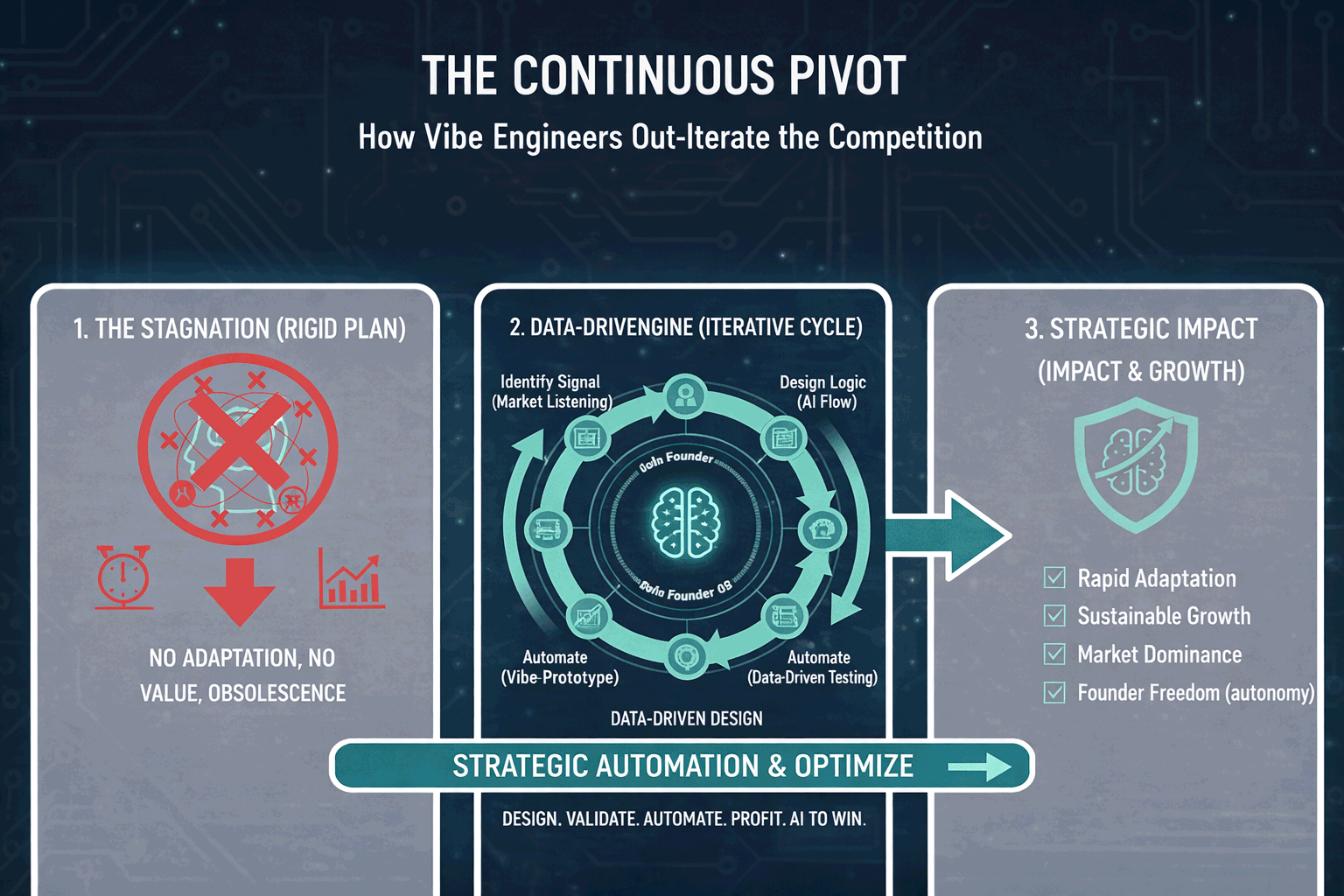
But this leverage is a double-edged sword. It requires Structured Creativity to find the right path and Rigorous Systems to stay on it. Without systems, AI just makes you fail faster. With systems, AI makes you unstoppable.
The future doesn't belong to the biggest companies. It belongs to the fastest, most autonomous systems. Build yours.
The "Launchpad" ends here, but your venture is just beginning.
Series Wrap-Up: Your Path to Superagency
- Post 1: Beyond the Wrapper — Understanding the shift from chat to agency.
- Post 2: Your Domain is Your Moat — Why your past experience is your only defense.
- Post 3: Structured Creativity — How to manufacture unique business models.
- Post 4: Intelligence Arbitrage — Mastering the math of tokens and margins.
- Post 5: The 30-Day Launch Sprint — The tactical guide to shipping your MVP.
- Bonus: Scaling Systems — Turning your service into a Micro-SaaS.
Are you ready to launch? Join the next cohort of the AI Solopreneur’s Launchpad [Link].

No comments yet
Be the first to share your thoughts on this article!