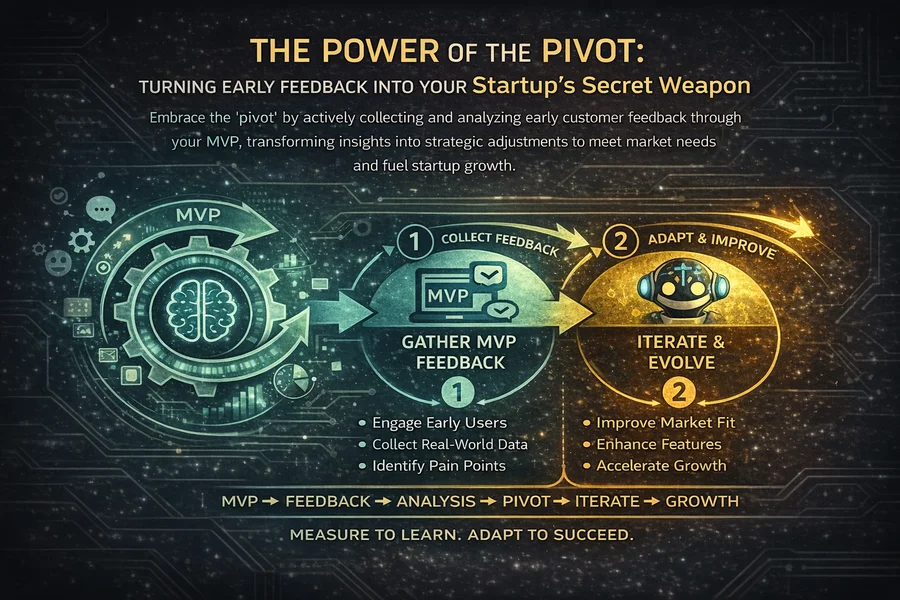
As a solopreneur or founder of an early-stage startup, you're often navigating uncharted territory. You’ve poured your energy into building something you believe in, but how do you know if it’s truly what your customers need? This is where the magic of the Lean Startup's "Learn" phase truly shines. It’s not about having all the answers from day one; it’s about building a system to continuously discover them. Your Minimum Viable Product (MVP) is your primary tool for this discovery, and its true value lies not just in what it does, but in what it teaches you.
This approach is deeply rooted in the principles laid out by Eric Ries in "The Lean Startup," emphasizing validated learning over exhaustive planning. In a traditional business model, success is often measured by how closely you follow the plan. In a Lean Startup, success is measured by how quickly you can realize the plan is wrong and adjust. This focus on validated learning is a cornerstone of lean methodologies, ensuring that development is driven by real-world data rather than the internal echo chamber of a founder's mind.
Forget the notion of launching a perfect, feature-complete product. Your MVP is designed to get you into the hands of real users as quickly as possible, so you can start gathering crucial feedback. This feedback is gold. It’s the raw material that will shape your product, your strategy, and ultimately, your company's success. The "Learn" phase is where you transform that raw material into actionable insights, guiding your next steps and preventing you from wasting precious time and resources on building something nobody wants. This iterative process of Build-Measure-Learn is the engine of innovation, as championed by lean pioneers like Steve Blank and Ash Maurya. It’s the process of turning uncertainty into a sustainable business model.
Establishing Your Feedback Loop: The Lifeline of Your MVP
The most critical aspect of the "Learn" phase is establishing a robust feedback loop. Think of it as the communication channel between your product and your customers. Without this, your MVP is essentially shouting into the void. This loop needs to be designed from the outset, not as an afterthought. A well-defined feedback loop is essential for the continuous discovery process that defines lean startups. This is what helps you avoid the "Sunk Cost Fallacy"—the tendency to keep building a failing product simply because you've already invested so much time in it.
For solopreneurs and bootstrapped startups, this means identifying the most direct and efficient ways to connect with your early adopters. You don't need expensive focus groups; you need authentic conversations. Personally emailing or messaging your first users after they've engaged with your MVP is a powerful way to gather insights. When you do this, ask specific, open-ended questions about their experience. This direct outreach shows your users that you value their input and are committed to improving the product based on their needs. These personal connections build loyalty and can turn early users into passionate advocates for your product.
Methods of Establishing the Loop
- In-App Surveys: Implementing simple, unobtrusive surveys within your MVP is incredibly effective. Tools like Tally or Typeform make this straightforward. Focus on asking one or two key questions at a time—like "What was the most confusing part of your experience today?"—to avoid overwhelming users.
- User Interviews: Scheduling short, 15-minute focused calls with your users is often the richest source of qualitative feedback. User interviews allow for deeper exploration and can uncover insights you might not have anticipated. This qualitative data is crucial for understanding the "why" behind the quantitative metrics you tracked in the Measure phase.
- Observed Usage: While not "direct" feedback, observing how users interact with your MVP (via tools like Microsoft Clarity or Hotjar) provides invaluable data. If you see ten people in a row struggle to find the "Save" button, you don't need to ask them if the UI is confusing—you've already learned it is.
The key here is consistency. You need to actively seek out feedback, not just passively wait for it. Make it a habit to engage with your users regularly. This consistent interaction builds trust and encourages more candid feedback. Regularly checking in with your users creates a partnership, making them feel invested in the product's success. This ongoing dialogue ensures your product evolves alongside user needs, creating a sustainable competitive advantage.
The Art of Customer Feedback Collection: Beyond "Do You Like It?"
Collecting feedback is more than just asking users if they like your product. In fact, "Do you like it?" is one of the worst questions you can ask. Most people are polite and will say "yes" even if they never plan on using the product again. To get real insights, you need to understand their problems, their workflows, and their unmet needs. This aligns with Ash Maurya's Lean Canvas, which emphasizes problem and solution validation.
Your questions should be designed to test your core hypotheses. Consider the "Jobs to be Done" theory: people don't just buy products; they "hire" them to do a specific job. Your goal in the Learn phase is to find out exactly what that job is. For example, if your hypothesis is that busy professionals need a faster way to schedule meetings, your questions should uncover the friction in their current process.
High-Impact Questions to Ask:
- "Describe your biggest challenge when scheduling meetings with external clients." This helps you understand the existing problems users face, giving you context for their needs. It opens the door to understanding their current frustrations and pain points.
- "How much time do you currently spend trying to find a mutually available slot?" Quantifying the problem helps you understand its impact and the potential value of your solution. If the problem only takes them 2 minutes a week to solve, they likely won't pay for your tool.
- "When you used our MVP, what was the most frustrating part of the process?" This directly assesses the user experience and identifies friction points. It tells you exactly where your MVP might be falling short of its promise.
- "What alternative solutions have you tried in the past to solve this problem?" This reveals existing workarounds and competitor solutions. If they've tried everything else and failed, you know you're in a high-demand market.
Iteration Strategies: Turning Insights into Action
Once you've collected feedback, the real work begins: iteration. This is where you act on what you've learned to improve your MVP and get closer to product-market fit. Iteration is not about making massive, sweeping changes every time. It's about making small, focused adjustments based on validated learning. This iterative approach minimizes risk and maximizes learning speed.
Think of your iteration process as a series of experiments. Each piece of feedback you receive is a potential hypothesis to test. This systematic approach allows you to improve your product without getting overwhelmed by the sheer volume of "to-do" items.
For example, if multiple users found your signup process confusing, your iteration might involve simplifying the form fields or adding clearer instructions. After implementing these changes, you'd then monitor usage and ask users specifically about their signup experience again. This systematic approach to problem-solving is what drives progress in a lean startup. Each iteration brings you one step closer to a product that users truly love.
"The only way to win is to learn. The learning is the process that builds victory." - Richard Bach
The Pivot vs. Persevere Decision: The Moment of Truth
One of the most challenging aspects of the "Learn" phase is deciding whether to persevere with your current direction or to pivot. A pivot isn't a failure; it's a strategic shift based on overwhelming evidence that your initial assumptions were wrong. This decision is a critical juncture for any startup. Making the right pivot decision at the right time can be the difference between a thriving business and a slow, painful bankruptcy.
When to Persevere
You persevere when the feedback you're receiving generally validates your core problem hypothesis and your proposed solution. Your users might be asking for enhancements or bug fixes, but they are still using your MVP to solve their primary problem. This indicates you're on the right track, and you should double down on your current path, focusing on optimization and growth.
When to Pivot
You pivot when the feedback consistently shows that your core problem hypothesis is incorrect, your solution isn't resonating, or your target audience is entirely different than you initially thought. A pivot is a course correction. It's a recognition that the market has spoken and you need to listen. Types of pivots include:
- Zoom-in Pivot: A single feature of your MVP becomes the whole product.
- Customer Segment Pivot: The product stays the same, but it's for a different type of user.
- Customer Need Pivot: You realize the problem you're solving isn't the one users care about, so you solve a different problem for the same people.
- Platform Pivot: Changing from an app to a platform, or vice versa.
The "Learn" phase of the Lean Startup is an ongoing, infinite loop. Your MVP is not a static product; it's a dynamic tool for discovery. By actively establishing feedback loops, expertly collecting customer insights, and making informed iteration decisions, you transform your initial idea into a business that truly serves its customers. This continuous cycle of learning and adaptation is the bedrock of successful entrepreneurship. By embracing this iterative journey, you increase your chances of building a sustainable, impactful, and profitable business. The insights gained from this process are your most valuable asset.
Conclusion: You’ve now walked through the entire Build-Measure-Learn cycle. You’ve learned how to build a lean MVP, how to measure what actually matters, and how to learn from the results to iterate or pivot. The final step is simply to start the loop over again. The faster you can move through this cycle, the faster you will find success.

No comments yet
Be the first to share your thoughts on this article!