We have reached the final stage of the Lean Startup loop for AI agents. You’ve Built a vertical skill using a variant like OpenClaw or Nanobot. You’ve Measured its ROI, success rate, and "Blast Radius" using tools like Lobster or IronClaw.
Now comes the moment of truth in April 2026: The Learn Phase.
In the biology of the "Claw" family, there is a process called molting. A crustacean grows until its old shell is too tight, it sheds that shell, and it hardens a new, larger one. As a founder or solopreneur, your AI strategy must do the same. If you stay in your "scrappy" shell too long, you stop growing. If you jump into a "giant" shell too early, you get eaten by overhead costs and complexity.
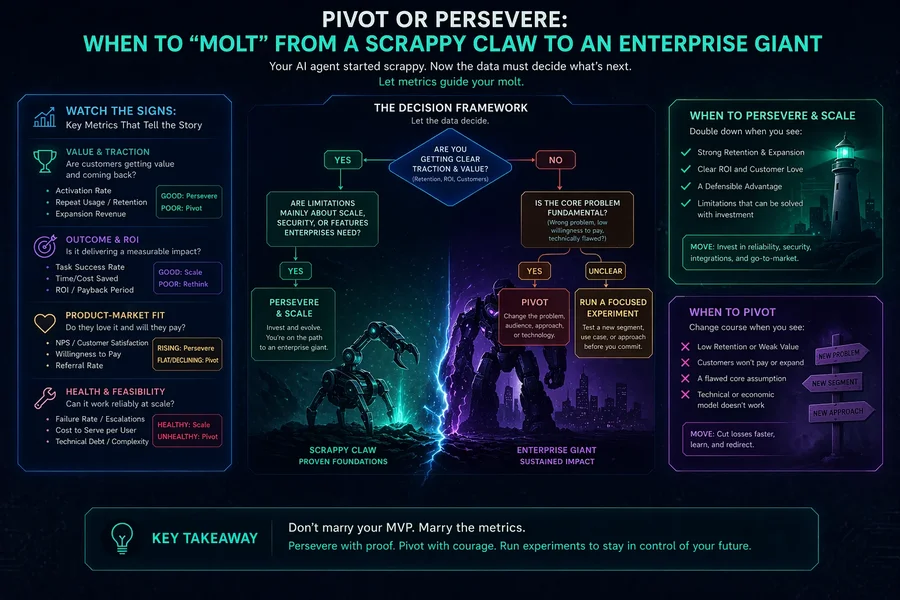
This post is about how to read the data from Post 2 to decide: Do you Persevere (Double down), Pivot (Change the shell), or Molt (Scale to Enterprise)?
The "Signal to Molt": When Your Scrappy Shell is Too Tight
Most solopreneurs start with a "laptop-first" approach. You run OpenClaw or OllamaClaw on your local machine using Llama 4 or Mistral Small 3. It’s fast, it’s free, and it’s private. Eventually, the constraints that helped you build the MVP will start to hinder your growth.
Signal 1: The Multi-User Bottleneck. The moment you hire your first employee or take on a co-founder, a local-first Claw starts to fail. If the agent only lives on your MacBook running a local Gemma 3 instance, your team can’t use it. Your personal productivity tool is now a departmental silo.
Signal 2: The Context Ceiling. You’ve been using Nanobot to summarize customer feedback. It works great for 10 emails. But now you have 10,000. Even with 2026's optimized Phi-4 edge models, the local hardware is hallucinating because the RAG (Retrieval-Augmented Generation) density is too high for your local RAM.
The Pivot: When the Measurement Says "Stop"
In Post 2, we looked at failure rates. Let’s say your measurement showed that your "Auto-Sales Agent" has a 60% failure rate using GPT-5.x Thinking. It keeps over-analyzing and offending potential leads because it lacks the nuance of your industry. In a Lean Startup, you don't just "try harder" with a longer prompt. You Pivot.
In a Lean Startup, you don't just "try harder" with a bad prompt. You Pivot.
The Vertical Pivot (Vision/Hardware): Perhaps the problem isn't the AI's intelligence, but its input. If a text-based agent is failing to help a field technician, pivot to VisionClaw. Use a multimodal Gemini 3.x Flash-Lite feed via a wearable or camera. Suddenly, the failure rate drops because the agent can finally "see" the broken gear instead of guessing from a description.
The Platform Pivot (Mobile/Android): If your measurements show that you only ever use your agent when you are away from your desk, but the current Claw requires your laptop to be open, you have a Distribution Failure. Pivot to DroidClaw and move the intelligence to the device where the user actually lives—the smartphone.
When to Persevere: The "Boring" Path to Profit
Sometimes, the data is just... good. Your OpenClaw skill is saving you 5 hours a week, the API costs for Claude 4 are $12 a month, and the failure rate is negligible. Founders often mess this up by getting bored. They want to switch to the "new shiny" variant just because a Llama 4-Omni demo is trending on X.
If it’s working, Persevere. Instead of changing the tech stack, focus on Deepening the Skill:
- Use ClawHub to find complementary skills.
- If your "Invoice Agent" is working, build a "Payment Follow-up Skill" to attach to it.
- This is Horizontal Scaling—increasing value without increasing architectural complexity.
Scaling to the "New Giants": NemoClaw and Beyond
Eventually, if your startup succeeds, you will face the "CISO Boss Battle." Big company IT departments will ask: "Where is the data stored? Who has access? Where are the SynthID watermarks and audit logs?" Your scrappy Python script won't cut it. This is the Enterprise Molt.
Variants like NemoClaw (The Nvidia Path) aren't for weekend tinkerers. They are for companies that need to prove Privacy, Governance, and Custom Model Alignment. High-value enterprise customers care more about Safety than Features. Compliance is the feature here.
The Evolution into "ClawClaw" (The Meta-Agent)
The ultimate "Learning" in the 2026 ecosystem is that no single agent should do everything. As you mature, you will realize that you have a "Fleet." You have a VisionClaw for the warehouse, a ZeroClaw for the edge sensors, and an OpenClaw for the office.
The final stage of the Learn phase is implementing ClawClaw—the orchestrator. This is a "Meta-Agent" (often powered by a high-reasoning GPT-5.x) that receives a request, analyzes which "Sub-Claw" is best suited, and routes the work. This allows you to keep your units small and modular. If the "Vision" part of your business needs an upgrade to a newer Gemini model, you only molt that one agent, not the whole company.
Summary: Your 90-Day Roadmap
The Claw family doesn't need you to be a genius; it just needs you to be a builder who listens to the data.
Conclusion of Series
You now have the framework to navigate the "Claw" ecosystem without getting lost in the hype. You have moved from a "Tinkerer" to a "Lean Founder."
What is the one "Signal" you've seen in your data this week that suggests you might need to Pivot or Molt?



No comments yet
Be the first to share your thoughts on this article!