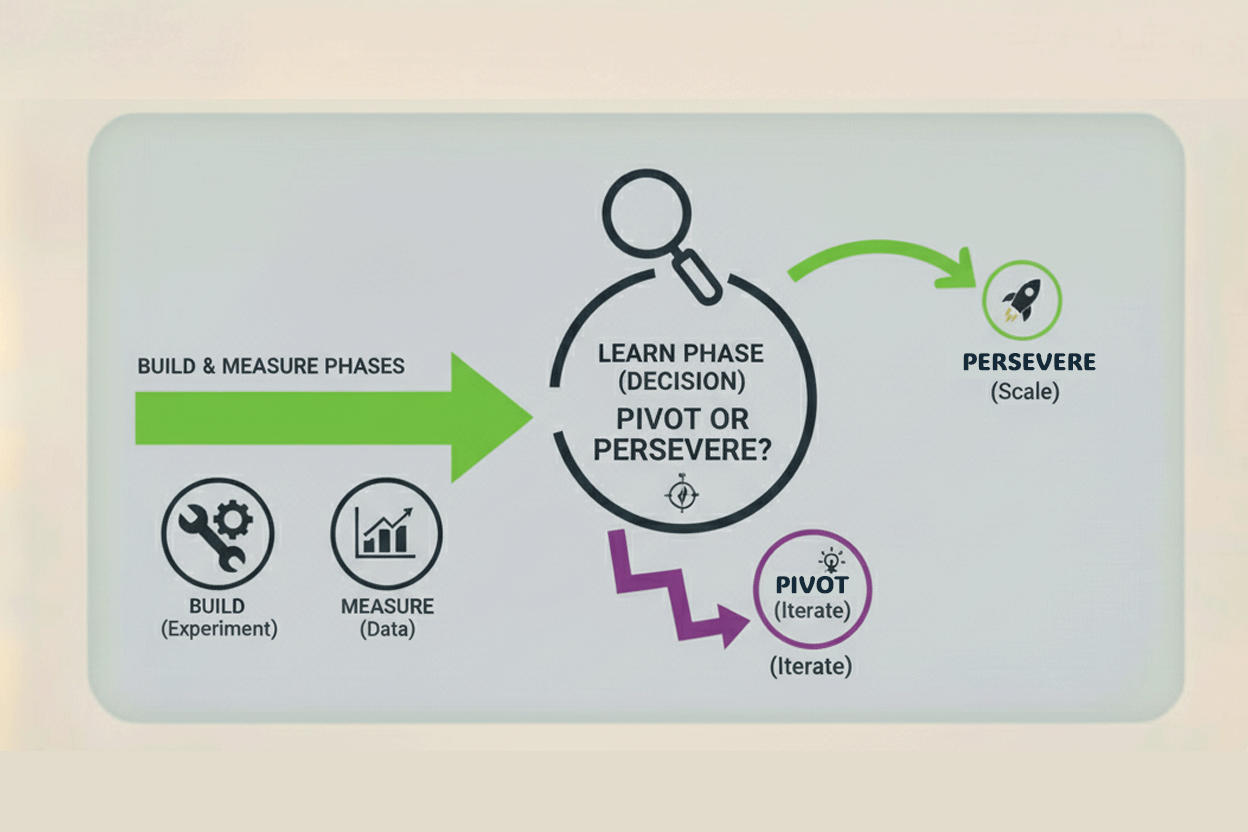
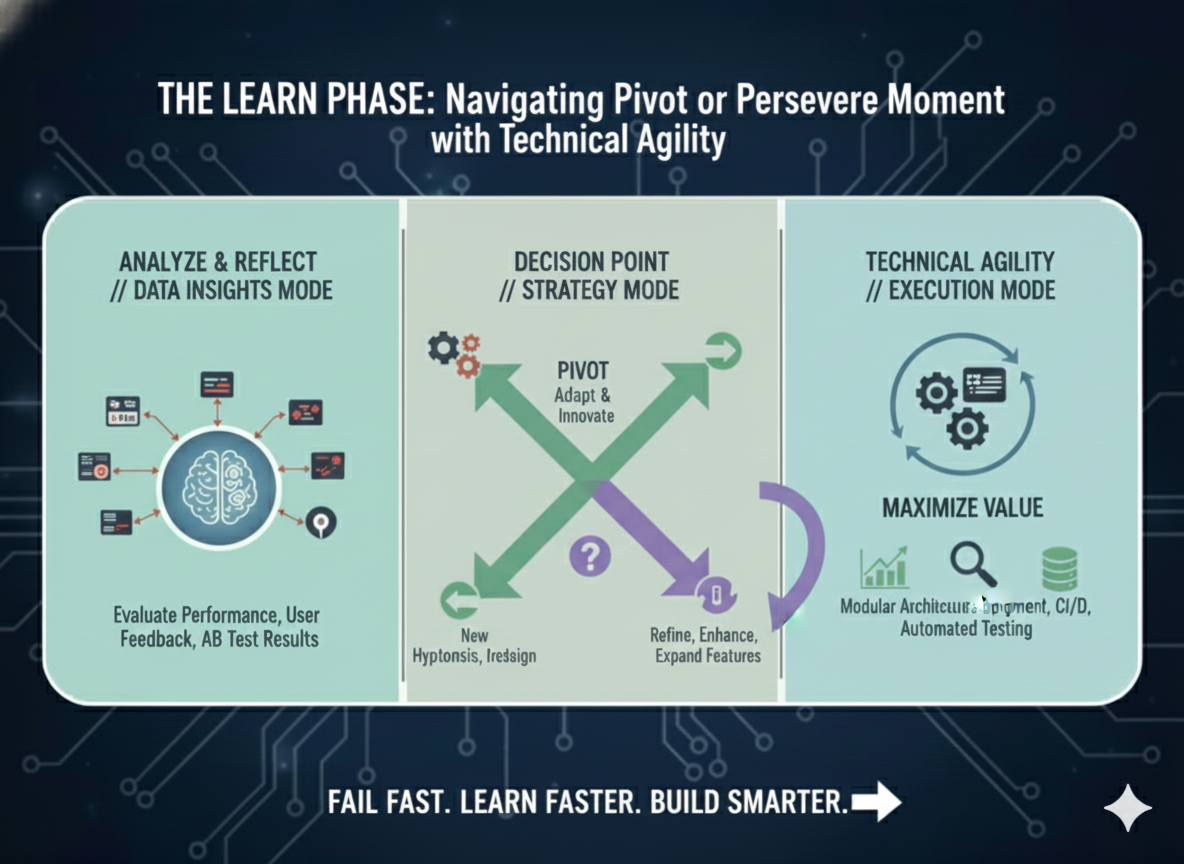
The Learn phase is the definitive moment of truth in the Minimum Viable Experiment (MVE) cycle. Having invested time in the BUILD phase and meticulously gathered objective data in the MEASURE phase, you are now tasked with the single most critical decision: Pivot or Persevere.
You must choose one of two paths, and you must choose it quickly:
The most dangerous choice is neither: it's indecision. Letting a failed MVE linger consumes time, capital, and mental energy that could be better spent on the next experiment.
The Decision Spectrum: Understanding the Pivot
A "Pivot" isn't a random change; it’s a structured course correction based on a specific piece of validated learning. Understanding the types of pivots ensures you’re making a strategic shift, not just a frantic tweak.
The Danger of the "Tweak"
A common startup failure is the Tweak: small, incremental changes (like adjusting a headline color or using a different image) made without a clear hypothesis. Tweaks consume time but yield zero profound learning. If the MVE fails, the pivot must be structural.
The Four Strategic Pivots Driven by Channel Data
When your MVE delivers unfavorable metrics (e.g., high traffic but zero conversions), the LEARN phase directs you to one of these pivots:
Avoiding Organizational Failure Traps
The objective data generated in the MEASURE phase is your shield against internal biases and emotional decision-making. Two major traps can derail the LEARN phase:
The Content Mismatch Trap ("Feature-Speak" vs. Pain-Point Language)
If your MVE delivered high visibility (e.g., strong AISOV or high Social Shares) but a catastrophic Conversion Rate (CR), the learning is simple: Your content failed to resonate with the problem the user was trying to solve.
The failure often stems from Feature-Speak: focusing on what your product does ("Our platform offers 10,000 integrations!") rather than what the user achieves ("Stop wasting hours copying data between apps.").
The Learn-Driven Content Pivot:
The decision is not to tweak the headline; it is to pivot the entire content philosophy.
The Funding Paradox: Metrics vs. Momentum
A well-funded startup often struggles with the "Funding Paradox." The excitement of large investment rounds can create a false sense of security, confusing investor interest (momentum) with genuine market demand (metrics). If you have cash runway, you are prone to ignoring a low LTV:CAC ratio because you assume you can "outspend" the problem.
The Learn-Driven Financial Defense:
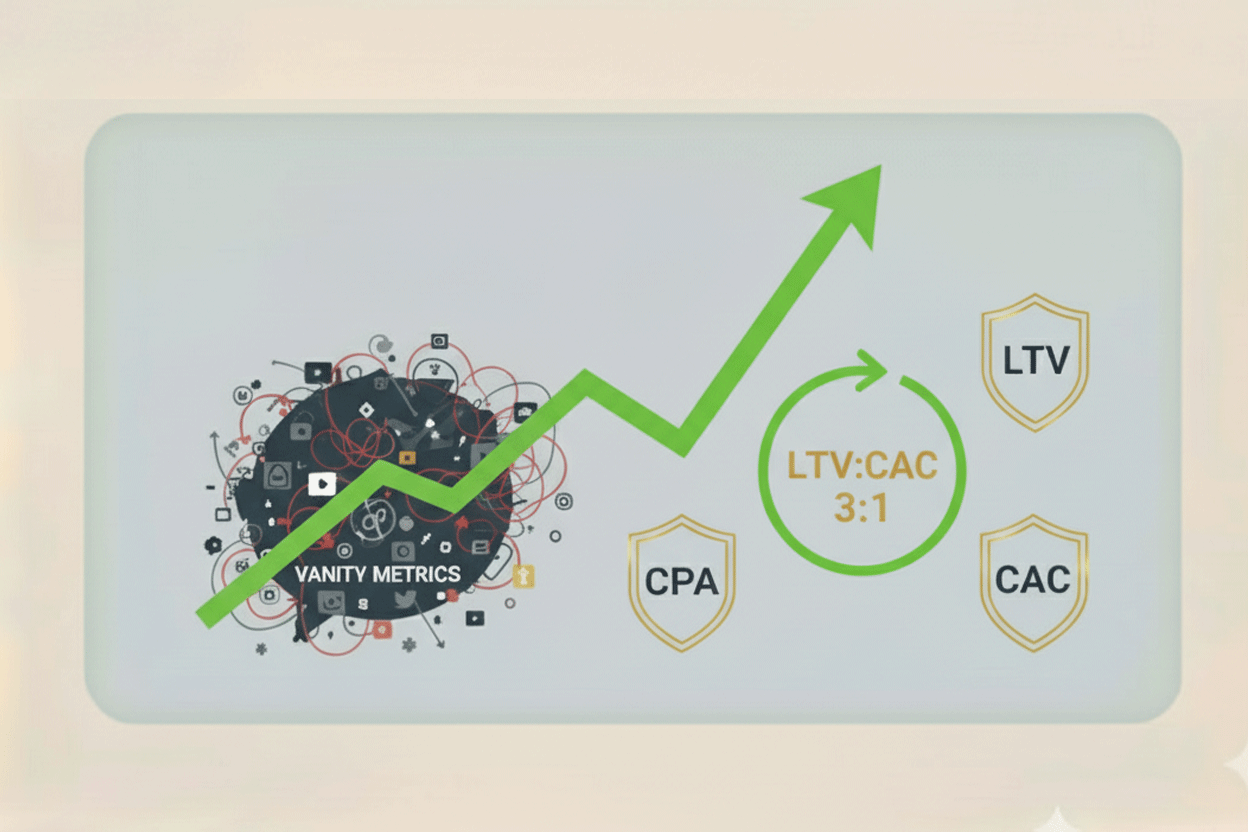
The objective MVE protocol—where decisions are based on the non-negotiable unit economics of CAC and LTV—is your best defense. If the data shows CAC is $100 and LTV is only $150, you are not profitable, even if you just raised $5 million. The LEARN phase must dictate a pivot on either the Pricing Model (raising LTV) or the Channel Selection (lowering CAC).
The AI Citation Gap: Your Next AEO Move
If your AI Optimization (AEO) MVE confirmed a high post-citation conversion rate (users who came from the "dark funnel" converted well) but a disappointingly low AI Share of Voice (AISOV) compared to competitors, your learning is specific and potent: AI trusts third-party sources more than self-promotion.
This disparity is the AI Citation Gap. AI models, by their nature, prioritize content with the highest E-E-A-T (Experience, Expertise, Authority, Trust), and third-party publications and high-authority review sites carry more E-E-A-T weight than a new company's own blog.
The Learn-Driven Pivot: Targeted PR
Instead of continuing to optimize your own site, the LEARN phase directs you to pivot your efforts to securing mentions on sites the AI already trusts.
Operational Pivots: Scaling Success Without Breaking the Business
A channel MVE can succeed wildly by generating high demand (low CAC, high CR), only to expose a fatal flaw in the operational side of the business. The LEARN phase must address this operational risk before scaling marketing further.
The Logistics Pivot (For Product Startups)
If a marketplace MVE (e.g., Amazon) validates product demand, the immediate learning focuses on fulfillment. If fulfillment costs or processing speeds are unscalable or consume too much of the gross margin, the LEARN phase dictates a Pivot on the supply chain model before scaling marketing expenditure further.
Tactical Lean Logistics Pivot:
- Move to JIT: Implement a Just-in-Time (JIT) inventory system where the MVE validated the product-channel fit, minimizing inventory costs and maximizing cash flow.
- Validate Drop-Shipping: Run a small MVE dedicated to validating a drop-shipping partner's reliability and speed. If they pass the test, you can scale marketing without operational bottlenecks.
The Service Delivery Pivot (For SaaS/Service Startups)
A successful lead-gen MVE (e.g., 20 Qualified Demo Requests from a B2B channel) can overwhelm a nascent service delivery model.
The Failure Mode: The sales team becomes the bottleneck, leading to long lead times, poor demo quality, and high churn—destroying the LTV you validated in the MVE.
The Learn-Driven Service Delivery Pivot:
The learning is that the marketing channel is too effective for the current operations. The decision is to temporarily pause the marketing channel and pivot the product/service delivery model to handle the volume.
This operational pivot ensures that when you restart the successful channel, the LTV you projected in the MEASURE phase is actually achievable.
Final Summary: Data, Discipline, and Decisiveness
The LEARN phase is where the startup marketer proves their worth not just as a content creator or optimizer, but as a strategic business leader. Every MVE decision is a choice about where to allocate the company's remaining runway.
By institutionalizing this rigor, you ensure that every dollar you spend is an investment in learning and every piece of data is a directive for growth.

No comments yet
Be the first to share your thoughts on this article!