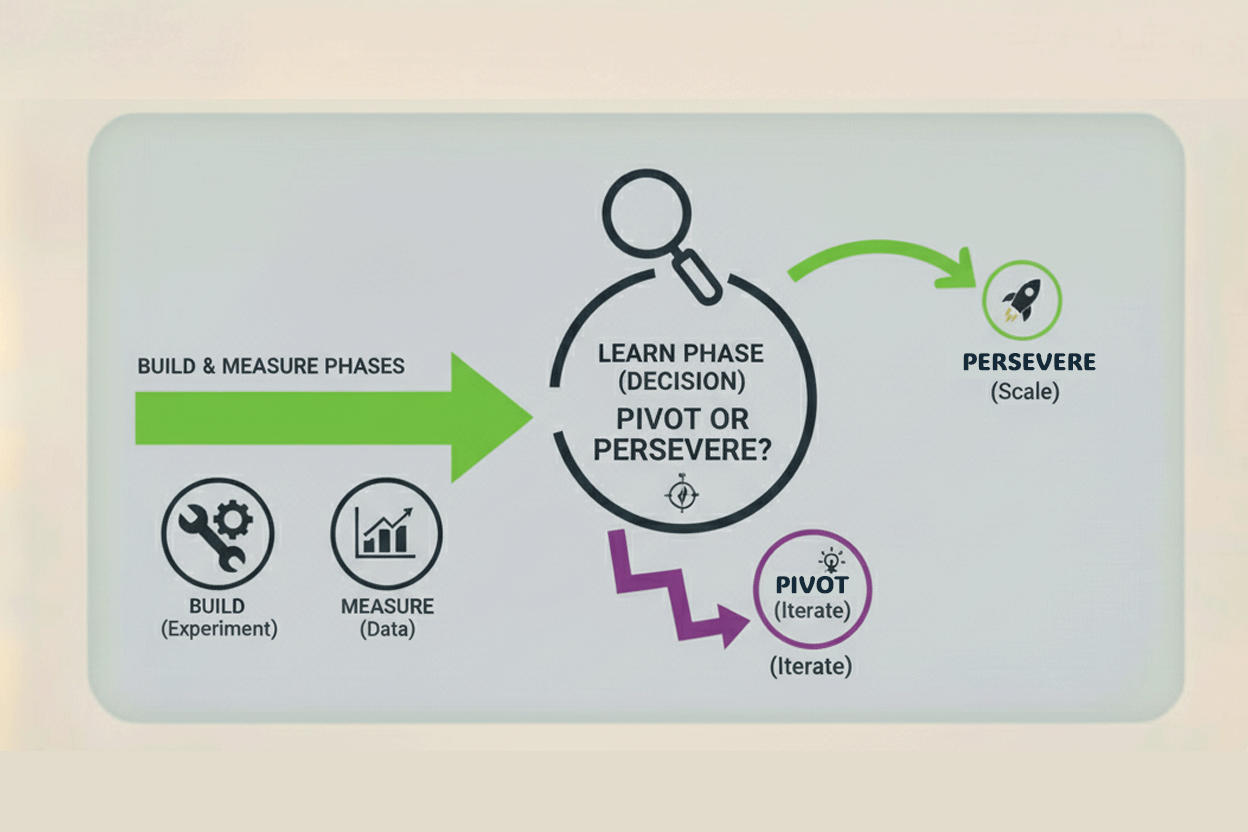
The Learn phase is the definitive moment of truth in the Minimum Viable Experiment (MVE) cycle. Having invested time in the BUILD phase and meticulously gathered objective data in the MEASURE phase, you are now tasked with the single most critical decision: Pivot or Persevere.
This phase is where organizational maturity is tested. The goal isn't just to succeed; the goal is to learn rapidly. A failed MVE that yields profound, actionable data is infinitely more valuable than a successful MVE that you can’t financially sustain. Therefore, "failure" should be reframed as Validated Failure—a process that has successfully eliminated a non-viable path and preserved your scarce resources for the next attempt.
You must choose one of two paths, and you must choose it quickly:
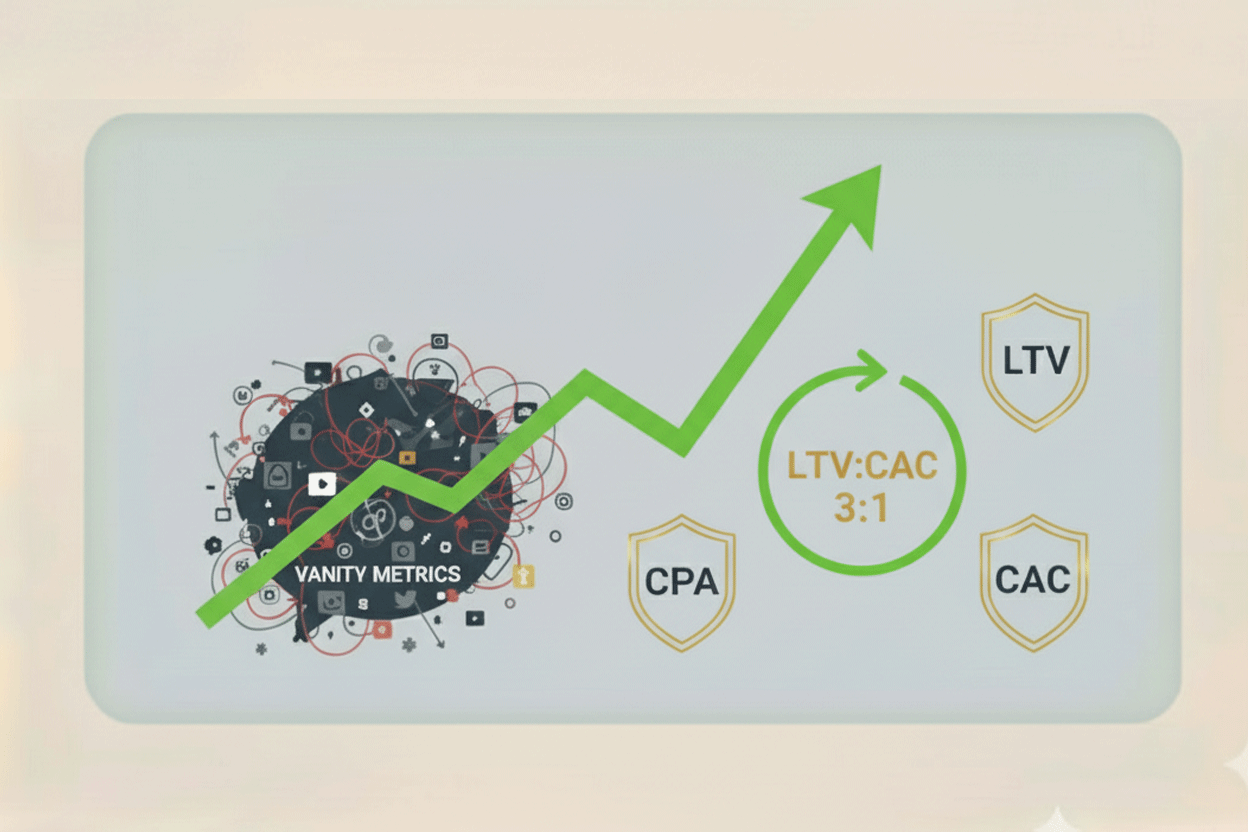
- Persevere: The MVE criteria were definitively met (CAC is sustainably low, LTV:CAC ratio is $3:1$ or better, and qualitative data validated the core user problem). You allocate immediate resources to scale the channel, double down on the content, and move to the next iteration.
- Pivot/Kill: The MVE criteria were *not* met. You immediately Kill the channel to stop the bleeding, or you execute a surgical Pivot—changing one core component (the content, the audience, or the hypothesis) based on the specific learning derived from the failure.
The most dangerous choice is neither: it's indecision. Letting a failed MVE linger consumes time, capital, and mental energy that could be better spent on the next experiment.
The Decision Spectrum: Understanding the Pivot
A "Pivot" isn't a random change; it’s a structured course correction based on a specific piece of validated learning. Understanding the types of pivots ensures you’re making a strategic shift, not just a frantic tweak.
The Danger of the "Tweak"
A common startup failure is the Tweak: small, incremental changes (like adjusting a headline color or using a different image) made without a clear hypothesis. Tweaks consume time but yield zero profound learning. If the MVE fails, the pivot must be structural.
The Four Strategic Pivots Driven by Channel Data
When your MVE delivers unfavorable metrics (e.g., high traffic but zero conversions), the LEARN phase directs you to one of these pivots:
- Zoom-In Pivot (Content/Messaging): The MVE was too broad (e.g., "marketing software"). The data shows a massive appetite for a tiny subset (e.g., "marketing automation for local florists"). The learning is that the specific niche is the real market. You pivot by focusing all subsequent content and targeting on that micro-segment.
- Zoom-Out Pivot (Audience/Problem): The MVE targeted a narrow niche, but the qualitative interviews revealed the core problem is universal across a much larger, wealthier audience. The learning is that you started too small. You pivot the next MVE to a much broader customer segment.
- Customer Segment Pivot (Channel Mismatch): You targeted B2B decision-makers on TikTok. The MVE showed high engagement but zero qualified signups. The learning is that the channel's intent profile is mismatched. You pivot the next MVE, taking the exact same value proposition to a high-intent channel like LinkedIn or AI Answers.
- Channel Pivot (Platform Mismatch): You invested in Google SEO, but the data showed all high-intent searches are being monopolized by AI summaries. The learning is that the entire discovery mechanism has shifted. You pivot to a new channel (e.g., from Classic Search to AI Optimization).
Avoiding Organizational Failure Traps
The objective data generated in the MEASURE phase is your shield against internal biases and emotional decision-making. Two major traps can derail the LEARN phase:
The Content Mismatch Trap ("Feature-Speak" vs. Pain-Point Language)
If your MVE delivered high visibility (e.g., strong AISOV or high Social Shares) but a catastrophic Conversion Rate (CR), the learning is simple: Your content failed to resonate with the problem the user was trying to solve.
The failure often stems from Feature-Speak: focusing on what your product does ("Our platform offers 10,000 integrations!") rather than what the user achieves ("Stop wasting hours copying data between apps.").
The Learn-Driven Content Pivot:
The decision is not to tweak the headline; it is to pivot the entire content philosophy.
- Analyze Qualitative Data: Review your user interviews, specifically looking for the exact words and phrases users used to describe their pain.
- Map Pain to Content: Redo your content map, ensuring every piece of content—from a TikTok video to an Amazon product description—starts with the customer's pain point (e.g., "Getting fired for missing a deadline") and immediately introduces your solution as the relief ("Use this one-click app...").
- Execute a Zoom-In Pivot: Often, the content mismatch reveals you’re solving a small problem for a large audience. The pivot focuses your content on the most urgent, specific, and painful problem identified. Nearly two-thirds of B2B buyers prefer content organized around the problems they are trying to solve, validating that this pivot is essential for growth.
The Funding Paradox: Metrics vs. Momentum
A well-funded startup often struggles with the "Funding Paradox." The excitement of large investment rounds can create a false sense of security, confusing investor interest (momentum) with genuine market demand (metrics). If you have cash runway, you are prone to ignoring a low LTV:CAC ratio because you assume you can "outspend" the problem.
The Learn-Driven Financial Defense:
The objective MVE protocol—where decisions are based on the non-negotiable unit economics of CAC and LTV—is your best defense. If the data shows CAC is $100 and LTV is only $150, you are not profitable, even if you just raised $5 million. The LEARN phase must dictate a pivot on either the Pricing Model (raising LTV) or the Channel Selection (lowering CAC). Never allow cash on hand to justify poor unit economics. Your decision must always be based on the scalability demonstrated by the MVE.
The AI Citation Gap: Your Next AEO Move
If your AI Optimization (AEO) MVE confirmed a high post-citation conversion rate (users who came from the "dark funnel" converted well) but a disappointingly low AI Share of Voice (AISOV) compared to competitors, your learning is specific and potent: AI trusts third-party sources more than self-promotion.
This disparity is the AI Citation Gap. AI models, by their nature, prioritize content with the highest E-E-A-T (Experience, Expertise, Authority, Trust), and third-party publications and high-authority review sites carry more E-E-A-T weight than a new company's own blog.
The Learn-Driven Pivot: Targeted PR
Instead of continuing to optimize your *own* site, the LEARN phase directs you to pivot your efforts to securing mentions on sites the AI *already trusts*.
- Analyze Competitor Citations: Use your AISOV data to identify the specific third-party publications, industry blogs, and review platforms where AI is citing your competitors, but ignoring you. These are your High-Leverage Publications.
- Hypothesize the Content Angle: Don't pitch your product. Pivot your PR outreach to offer unique, proprietary data or expert commentary on the topic where your competitor is being cited. For example, if competitors are cited for "best free invoicing software," offer the publication an exclusive, data-driven report on "The True Cost of 'Free' Invoicing Tools in Q4."
- New MVE: Targeted PR: Your next MVE is a two-week sprint dedicated entirely to securing three confirmed citations or placements on those High-Leverage Publications.
- The Result: Securing a citation on an authoritative domain immediately injects E-E-A-T into your brand's digital profile. This simultaneously closes the AI Citation Gap and exponentially increases your AISOV by leveraging the trust equity of the third-party site. This is often a more scalable growth lever than direct SEO.
Operational Pivots: Scaling Success Without Breaking the Business
A channel MVE can succeed wildly by generating high demand (low CAC, high CR), only to expose a fatal flaw in the operational side of the business. The LEARN phase must address this operational risk before scaling marketing further.
The Logistics Pivot (For Product Startups)
If a marketplace MVE (e.g., Amazon) validates product demand, the immediate learning focuses on fulfillment. If fulfillment costs or processing speeds are unscalable or consume too much of the gross margin, the LEARN phase dictates a Pivot on the supply chain model before scaling marketing expenditure further.
Tactical Lean Logistics Pivot:
- Move to JIT: Implement a Just-in-Time (JIT) inventory system where the MVE validated the product-channel fit, minimizing inventory costs and maximizing cash flow.
- Validate Drop-Shipping: Run a small MVE dedicated to validating a drop-shipping partner's reliability and speed. If they pass the test, you can scale marketing without operational bottlenecks.
The Service Delivery Pivot (For SaaS/Service Startups)
A successful lead-gen MVE (e.g., 20 Qualified Demo Requests from a B2B channel) can overwhelm a nascent service delivery model.
The Failure Mode: The sales team becomes the bottleneck, leading to long lead times, poor demo quality, and high churn—destroying the LTV you validated in the MVE.
The Learn-Driven Service Delivery Pivot:
The learning is that the marketing channel is too effective for the current operations. The decision is to temporarily pause the marketing channel and pivot the product/service delivery model to handle the volume.
- Automate the Demo: Pivot from manual 1:1 demos to a high-quality, pre-recorded, interactive product tour (minimizing human labor).
- Implement Onboarding Automation: Pivot manual client setup to a self-service, automated onboarding flow.
This operational pivot ensures that when you restart the successful channel, the LTV you projected in the MEASURE phase is actually achievable.
Final Summary: Data, Discipline, and Decisiveness
The LEARN phase is where the startup marketer proves their worth not just as a content creator or optimizer, but as a strategic business leader. Every MVE decision is a choice about where to allocate the company's remaining runway.
- Be Decisive: Accept Validated Failure as a win. Pivot or Persevere immediately.
- Be Data-Driven: Do not let funding or vanity metrics distract you. Every decision must align with the goal of achieving a sustainable LTV:CAC ratio.
- Be Holistic: Address both the marketing channel (Pivot/Kill) and the operational capacity (Logistics/Service Pivot) that the MVE exposed.
By institutionalizing this rigor, you ensure that every dollar you spend is an investment in learning and every piece of data is a directive for growth.


No comments yet
Be the first to share your thoughts on this article!