Forging Your Feedback Loop: The Direct Line to Your Customer
Without a robust feedback loop, your "learning" is based on guesswork, and guesswork is a costly luxury that solo founders cannot afford. Think of your feedback loop as a vital communication channel—a direct line from the real world back to your strategic thinking. It is how you continuously validate or invalidate your assumptions about your customers, their problems, and your proposed solutions.Establishing this loop doesn't require a six-figure research budget. For solopreneurs, it starts with raw, direct interactions that strip away the layers between the builder and the user.The Quantitative and Qualitative Mix
While your measurement engine (Step 5) provides the what, your feedback loop provides the why. You need both. If your analytics show that users are dropping off at the sign-up page, the numbers won't tell you if the form is broken, the price is too high, or the "Submit" button is simply ugly. Only a feedback loop can answer that.- Direct Conversations: Make it a habit to talk to your users. These conversations are gold. Ask open-ended questions like, "What was the most challenging part of this task before you found us?" or "If you could wave a magic wand and change one thing about this app, what would it be?"
- Simple Surveys: Tools like Google Forms or Typeform are more than sufficient. Keep them short—three questions max. Focused surveys have much higher completion rates than long-winded "customer satisfaction" audits.
- In-App Feedback Widgets: Integrating a simple "Give Feedback" button captures spontaneous thoughts from users while they are engaged. This yields immediate, honest responses that users might forget by the time they get a follow-up email.
- Social Media & Community Monitoring: Listen to the "unsolicited" feedback on platforms like Reddit, X (Twitter), or niche Discord communities. People are often more honest when they aren't talking directly to the founder.
"The goal of a startup is to figure out the right thing to build—the thing customers want and will pay for—as quickly as possible." — Eric Ries
✅ Tip: Proactive vs. Reactive Feedback
Don't wait for customers to complain. Proactively ask for their thoughts. For example, instead of just sending a "Thank you" email, include a specific question: "What’s the one thing you wish you could do with our product that you can’t right now?" This shifts the conversation from troubleshooting to opportunity identification.From Data Points to Deeper Insights: Iteration Strategies That Matter
Gathering feedback is only half the battle. The real magic happens when you translate those data points into actionable insights that drive iterative improvements. This is where your startup truly begins to "evolve." Iteration isn't about making minor cosmetic changes to satisfy one vocal user; it's about making fundamental adjustments based on the aggregate truth of your market.Consider the case of Sarah, a solopreneur who built a niche online course platform for artisanal bakers.1
Initial Hypothesis: Sarah assumed bakers wanted a highly visual, video-heavy course structure to learn complex pastry techniques.
2
The Feedback: Customer interviews revealed that while they liked the videos, their actual "pain point" was the business side of baking—pricing their goods, managing order forms, and marketing on Instagram.
3
The Iteration: Instead of filming more videos, Sarah developed business templates and order-management tools. This was an iteration born directly from listening to the user's "Job to Be Done."
Strategies for Solo Iteration
- Prioritize Based on Impact: Not all feedback is created equal. Use the ICE Framework (Impact, Confidence, Ease) to score potential changes. Focus on iterations that offer high impact for the core customer but require low effort for you to build.
- Small, Frequent Updates: Don't wait for a "Big Bang" release. Aim for weekly or bi-weekly updates. This allows you to test the impact of individual changes and course-correct before you’ve spent too much time on a feature that doesn't move the needle.
- The "Jobs to Be Done" Lens: Always ask: "What 'job' is the customer hiring this product to do?" If the feedback suggests they are using your tool for a different "job" than you intended, your iterations should lean into that new reality.
✅ Tip: The "What If" Experiment
Before coding a complex feature requested by users, run a manual "what if" experiment. If users want a "Recommendation Engine," manually email them five recommendations based on their profile. If they click and engage, then spend the time building the automated version.The Pivot or Persevere Decision: Navigating Uncertainty
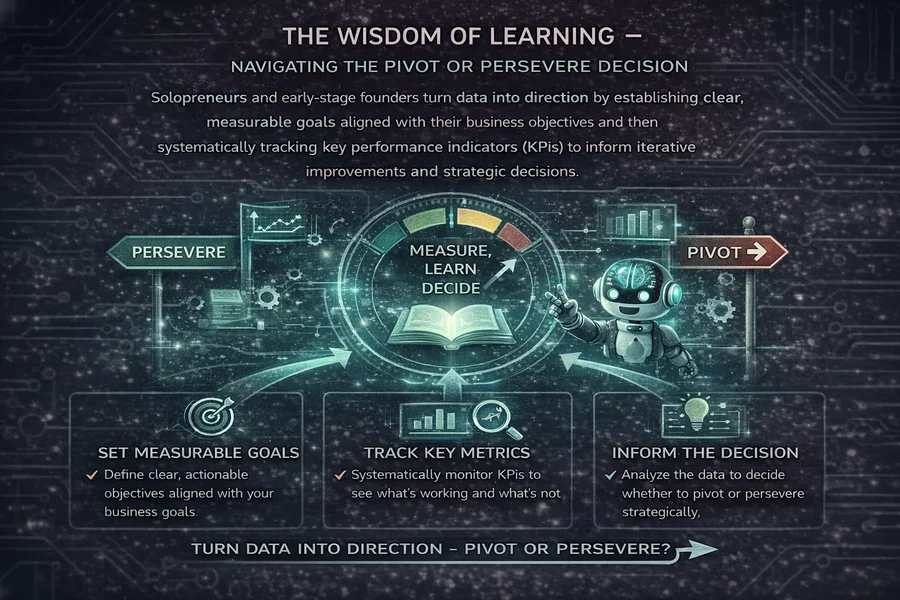
The ultimate test of your learning engine is the Pivot or Persevere meeting. This is a recurring appointment you should have with yourself (perhaps once a month). It is the moment you look at your validated learning and decide if your current strategy is leading you to a sustainable business, or if you are running into a brick wall.A Pivot is a structured course correction designed to test a new fundamental hypothesis about the product, strategy, and engine of growth. It is not a sign of failure; it is a sign of intelligence.The Pivot Catalog: Common Strategic Shifts
- Zoom-In Pivot: What was previously considered a single feature of the product becomes the whole product. (Example: Our Task Manager might pivot to only being a "Focus Timer" if that's the only feature people use).
- Zoom-Out Pivot: The entire product becomes a single feature of a much larger product.
- Customer Segment Pivot: You have a great product but for the wrong people. You shift from selling to solopreneurs to selling to corporate HR departments.
- Platform Pivot: Changing from an application to a platform, or vice versa.
- Business Architecture Pivot: Shifting from high-margin, low-volume (B2B) to low-margin, high-volume (B2C).
1
The Data: Usage patterns showed that teams ignored the "Creative" features but were using the app's secondary task-list and calendar tools daily.
2
The Pivot: Alex realized the "job" his customers were hiring the app for was Remote Coordination, not brainstorming. He shed the complex creative tools and refocused 100% on streamlined task management.
3
The Result: Retention tripled because the product finally matched the user's primary need.
Applying Learning: The Solopreneur Cycle in Action
Let's revisit our core examples to see how they close the loop.Example 1: The Task Manager Solopreneur- Observation: Users love the "Focus View" but they are still churning after 30 days.
- Learning: Interviews reveal that users feel anxious because they can't see "what's next." They feel focused but "blind."
- The Decision: Persevere with Iteration. The founder adds a "Peek" feature—a small preview of the next task. This addresses the anxiety while keeping the core "Aha! Moment" intact.
- Observation: Traffic is high, but sales are zero. The Artisan has tried three different web designs.
- Learning: A survey reveals that customers think the pottery looks "too expensive" because of the professional lighting, yet the actual price is reasonable.
- The Decision: Customer Segment Pivot. The artisan realizes their marketing is attracting "luxury seekers" who want high-end brands, but their product is actually for "eco-conscious locals." They shift their marketing to local community groups, and sales begin to flow.




No comments yet
Be the first to share your thoughts on this article!