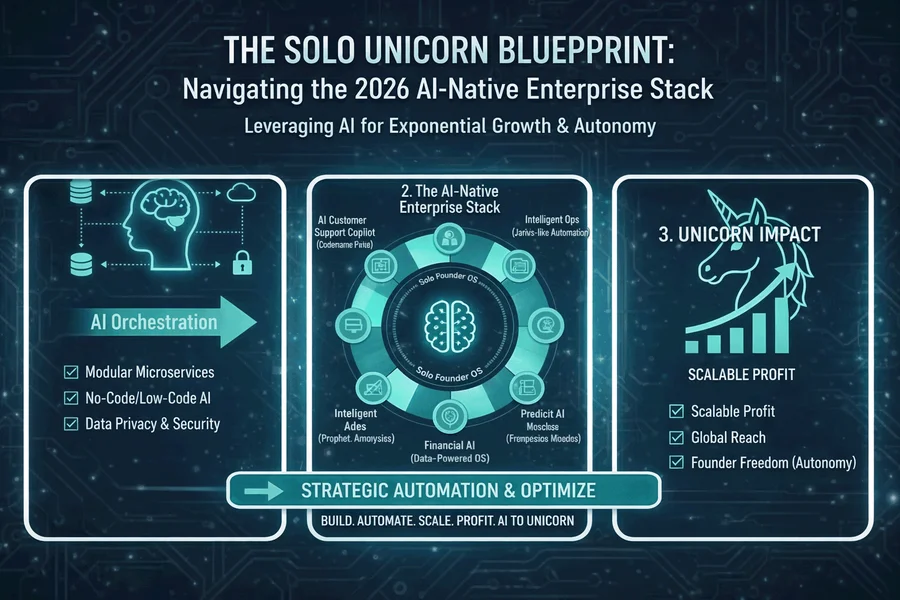
The year 2025 will be remembered as the moment the AI revolution stopped being an experiment and became the foundational operational layer of modern business. The speculative era of isolated "chat" interfaces is over, replaced by a rigorous, integrated stack that embeds artificial intelligence into the core DNA of the high-growth startup.
We are entering the era of the Solo Unicorn: an enterprise-grade business that can be built, scaled, and operated by a single founder or a skeletal team. This isn't just about "doing more with less"; it is about a structural shift in how value is created. By leveraging the 2026 AI-native stack, a lone founder can now command the output equivalent to a 50-person organization from a decade ago.
Macroeconomic Shifts: Pruning and Prioritization
The current fiscal landscape is defined by a paradoxical mix of austerity and aggression. On one hand, we see a massive pruning of legacy, headcount-heavy startup models. On the other, there is record-breaking spend on high-efficiency, AI-native software.
The data is clear: AI has graduated from an R&D experiment to a recurring operating expense at the center of modern P&Ls. Spending growth is compounding monthly for tools that automate developer workflows, simplify large language model (LLM) orchestration, and power real-time voice and video production for sales and support.
In this environment, developers have emerged as the most strategic spenders. Coding and model-infrastructure tools sit at the very front of enterprise value creation. The market is signaling exactly which tool categories will compound value and which will be commoditized.
Growth Metric | Reported Trend | Strategic Implication |
|---|---|---|
Generative Video | ~1,900% YoY growth | Video is moving from a luxury experiment to a standard creative tool. |
AI-Native IDEs | ~1,000% YoY growth | AI-driven environments (e.g., Cursor) are the new default for dev. |
LLM Spend | +80% growth | Companies are scaling API usage to power internal, proprietary features. |
Marketing Budgets | CRM Pullback | Budgets are shifting from tracking work (CRMs) to tools that do work (agents). |
Strategic Imperative 1: Adopt "Vibe Coding"
The dominance of coding tools like Cursor, Windsurf, and Replit signals a complete paradigm shift in software construction. We have entered the era of vibe coding: a development approach where the primary "programming language" is natural language, not syntax.
In a vibe-coded world, the founder describes requirements, constraints, and desired outcomes in everyday English. The AI assistant handles the tedious work of writing boilerplate, wiring dependencies, and refactoring. This is Software 3.0—software defined by intent, with machines handling implementation details.
The Vibe Coding Workflow
This dramatically reduces cognitive load. It allows solopreneurs to keep their attention where it matters: high-level product design, value proposition, and customer development—the heart of the Lean Startup "build-measure-learn" loop.
Key Tools in the Stack:
- Cursor: Its "Composer" mode excels at context-aware code generation and project-wide refactoring.
- Windsurf: An agentic IDE that can autonomously modify files and run commands to complete multi-step tasks.
- Replit: Provides instant, no-setup environments for rapid prototyping and browser-based deployment.
Strategic Imperative 2: Optimize Intelligence Costs
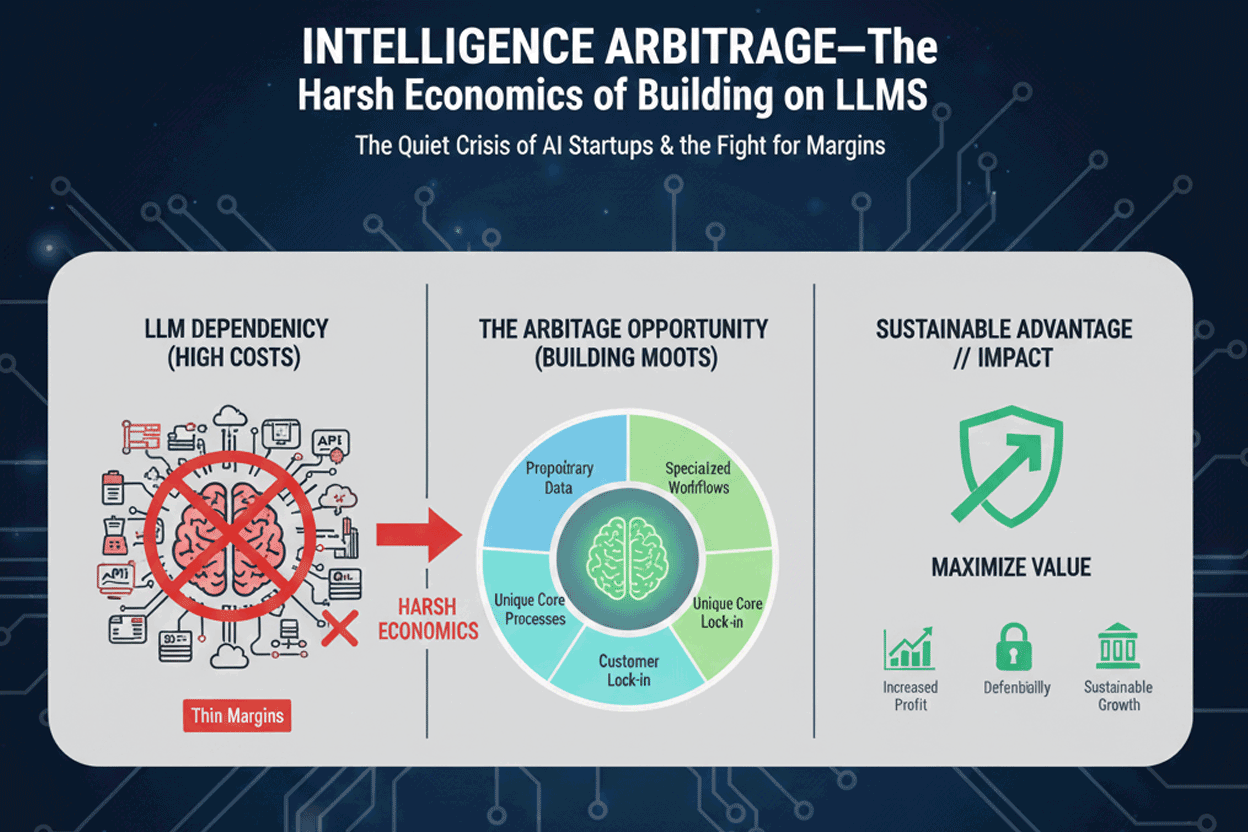
As LLMs proliferate, the "picks and shovels" of the AI boom have evolved into a sophisticated orchestration layer where the unit of optimization is intelligence, not infrastructure. Founders must now become model-agnostic, routing tasks to specific models based on cost, speed, latency, and reasoning capability.
Intelligence Arbitrage and Model Routing
Platforms like OpenRouter have emerged as the connective tissue of this multi-model world. They offer a unified API that exposes over 100 frontier and open-source models, enabling automatic routing and performance comparison at the request level.
This capability unlocks intelligence arbitrage:
- High-volume, low-complexity tasks (classification, basic summarization) are routed to small, cheap models.
- Low-volume, high-stakes tasks (complex reasoning, legal analysis) are reserved for expensive frontier models.
The economic survivability of an AI-native business now depends on tracking its Gross AI Margin ($M_g$):
$$M_g = \frac{\text{Revenue} - \text{AI Compute Costs}}{\text{Revenue}}$$
Orchestration Components:
- FireCrawl: Turns messy websites into structured context for research.
- Exa: A semantic web search API for discovering niche communities and partners.
- LangChain: A framework for building RAG (Retrieval-Augmented Generation) agents that stitch together multiple data sources.
Strategic Imperative 3: Automate GTM Early
The sales and marketing landscape has shifted from manually pushing leads through static CRMs to orchestrating AI-powered Go-To-Market (GTM) engines. Instead of hiring a full sales team, lean startups are wiring together a modular GTM stack that can generate, enrich, and contact thousands of prospects per week with high personalization.
The Three-Pillar Outbound System
A dominant pattern in high-growth solo ventures is the integration of Apollo, Clay, and Instantly:
This modular configuration replaces bloated, monolithic CRMs. Each tool is best-in-class for its function and loosely coupled via APIs. By automating GTM early, a solo founder designs the sales engine as a product—instrumented, iterated, and increasingly autonomous—rather than a headcount problem.
Strategic Imperative 4: Prioritize Behavioral Validation
The Lean Startup principles—rapid iteration and validated learning—are amplified by the 2026 stack. The "LeanPivot" approach treats every feature and campaign as a testable hypothesis backed by real behavioral data.
The Build-Measure-Learn Loop in 2026
- Build: Use vibe coding or no-code platforms to create "thin slices"—fully coherent experiences for a single, narrow use case.
- Measure: Instrument with tools like PostHog to capture real user behavior (activation, retention) instead of vanity metrics like followers.
- Learn: Run explicit "pivot or persevere" analyses tied to Kill-Switch Metrics (e.g., 20%+ weekly retention). If these aren't hit, the product structure changes.
The 48-Hour Launch Blueprint
New Frontiers: Multimodal and FinOps
The "experimental to standard" transition is especially visible in multimodal AI (video, voice, search) and the underlying financial operations stack.
Multimodal Expansion:
- Generative Video: Tools like Kling AI and Runway allow teams to generate cinematic product clips from text prompts, shifting high-quality video from a specialized workflow to an everyday marketing asset.
- Voice Agents: Retell AI and ElevenLabs illustrate how voice AI is becoming operational, powering customer support and lead qualification at scale.
- Conversational Search: Perplexity has become the default for citation-backed research, aggregating competitive insights across the open web.
Compute and Operations:
- Specialized Compute: Vast.ai and Groq enable cheaper and faster AI inference via alternative hardware, allowing lean teams to run workloads traditionally reserved for massive budgets.
- FinOps: Fondo and Finta automate bookkeeping, tax filing, and treasury, helping startups recover R&D credits without building a finance team.
Scaling the Stack: Guardrails and Identity
As a startup graduates from MVP to growth, the founder must transition toward production-ready infrastructure, specifically around AI safety and reliability.
The Guardrail Protocol
As soon as AI touches live customers, "guardrails" must become first-class citizens:
- PII Redaction: Masking sensitive personal data before it hits third-party LLMs.
- LLM-as-a-Judge: Using a reliable, high-reasoning model to check the outputs of cheaper, high-throughput models for factual accuracy.
- Prompt Caching: Storing responses for identical prompts to reduce latency and token costs.
Identity and Authentication
Identity is a foundational decision. Solo founders should optimize for speed-to-market using managed providers like Clerk or Supabase, which bundle authentication, MFA, and session management out of the box. Only after achieving Product-Market Fit (PMF) should they consider migrating to more customizable or self-hosted solutions for greater control.
The 2026 stack represents a profound democratization of leverage.
Conclusion: The Path to the Solo Unicorn
The 50 fastest-growing vendors of 2026 show a consistent pattern: the biggest winners are those that have commoditized the "picks and shovels" of the AI revolution. Tools like Cursor, OpenRouter, and Kling AI are not just "helpers"; they are the core infrastructure of the AI-native enterprise.
For the modern founder, the path is clear:
- Adopt vibe coding to collapse the distance between idea and implementation.
- Optimize intelligence costs by treating model routing as a board-level concern.
- Automate GTM early to scale conversations without scaling headcount.
- Prioritize behavioral validation to ensure you are building what users actually use.
The 2026 stack represents a profound democratization of leverage. With the right strategic imperatives and a disciplined lens, a single founder can orchestrate a global operation with capital efficiency that was unthinkable a decade ago. The constraint is no longer technology—it is clarity of focus and speed of learning.

No comments yet
Be the first to share your thoughts on this article!