
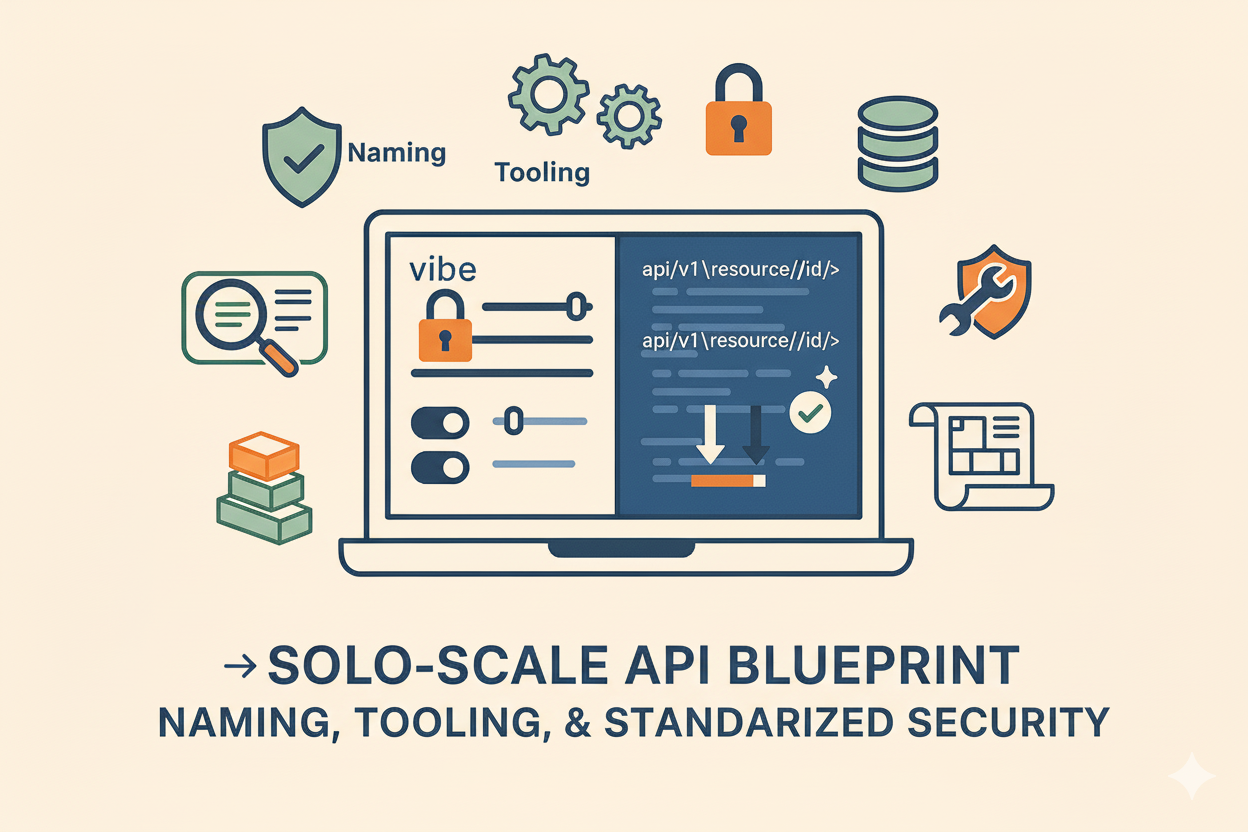
The first two posts in our series laid the architectural groundwork: Vibe Coding demands empathy in design, and the ultimate goal is a Minimum Adaptive Product (MAP) secured by operational safety nets like Idempotency and Cursor Pagination. These are internal choices that prevent future failure.
This final installment addresses the external reality. Your API is your company's public-facing contract. A developer or an AI agent interacting with it forms an immediate judgment about your professionalism, stability, and reliability. This judgment is based on three key pillars:
- Predictability: Can the client guess what the endpoints do? (Naming Conventions)
- Documentation: Is the API instantly understandable? (Tooling Choice)
- Trust: Is the data safe, and is the system protected? (Standardized Security & Rate Limiting)
For the lean solopreneur, adopting industry standards in these areas means you instantly professionalize your product, removing cognitive barriers and inviting integration. You are not just building an API; you are constructing a universally recognized language of success.
Speaking the Predictable Language of REST
The greatest asset of a Vibe-Coded API is predictability. A developer or an autonomous AI agent should be able to look at your endpoint and guess its function with high accuracy, without needing to dive deep into documentation for every single call. This is the essence of REST (Representational State Transfer) architecture—it trades creativity for clarity, which is the Vibe the client truly needs.
REST trades creativity for clarity, which is the Vibe the client truly needs.
If you violate RESTful principles, you create mental debt for every client, slowing down adoption and making your service look amateurish. Adhere to these key naming rules to ensure high-vibe predictability:
Rule 1: Nouns, Not Verbs (Resources, Not Actions)
The URI (Uniform Resource Identifier) should name the resource collection being acted upon, using plural nouns. The action itself is defined by the HTTP Method.
- Anti-Vibe (Verbs in URI):
- POST /createUser
- GET /getUsers
- DELETE /removeUser/123
- Vibe-Coded (RESTful Nouns):
- POST /users (Creates a new user)
- GET /users (Retrieves the collection of users)
- DELETE /users/123 (Deletes user 123)
Adding verbs to the URI is redundant and violates the core REST architectural style. It forces the client to remember two redundant pieces of information (the method and the verb) when the method alone (POST, GET, DELETE) is sufficient to convey intent.
Rule 2: URI Hygiene (Lowercase and Hyphens)
Prioritize maximum readability across all operating systems and environments. Consistency is king for Vibe Coding.
- Use lowercase letters exclusively for URI paths. Case sensitivity can lead to hard-to-debug client errors.
- Use hyphens (-) to separate words for readability. Avoid underscores (_) as they can be visually obscured in some browsers or font families, or they can clash with internal language conventions.
- Example: /inventory-reports/daily-snapshot is preferred over /Inventory_Reports/DailySnapshot.
Rule 3: Actions Are Methods, Not Resources
The HTTP method is the universal language for data manipulation requests. Stick to the standard definitions:
|
HTTP Method |
Action/Intent |
Safe & Idempotent? |
|
GET |
Retrieve a resource or collection |
Yes (Safe) |
|
POST |
Create a new resource or execute a non-idempotent action |
No |
|
PUT |
Complete replacement of a resource |
Yes (Idempotent) |
|
PATCH |
Partial update of a resource |
No (Often enforced with Idempotency Key) |
|
DELETE |
Remove a resource |
Yes (Idempotent) |
An AI agent, when reading your OpenAPI specification, immediately maps the HTTP method to a fundamental operation. Do not invent custom semantics; use the standard dictionary.
Rule 4: Query Parameters for Flexibility
Filtering, sorting, and pagination should not lead to new resource paths. They should be handled by the query component (query parameters) appended to the URI.
- Anti-Vibe: /users/active or /users/sorted-by-date
- Vibe-Coded: /users?status=active&sort_by=created_at&order=desc
This preserves the integrity of the resource path (/users) while allowing for unlimited, dynamic filtering and sorting without creating a sprawling, confusing endpoint landscape.
Choosing Velocity: The Solopreneur's Toolkit
Velocity for the solopreneur means choosing tools that automate the tedious, yet critical, aspects of API development. This is why FastAPI (Python) has become the gold standard for high-velocity, lean startups.
If your foundation is Python, FastAPI is the ultimate Vibe Coding assistant, automating the two largest sources of friction: data validation and documentation.
Automated Documentation and Developer Experience (DX)
The core challenge of API documentation is keeping it up-to-date with the code. If the code changes and the documentation doesn't, you instantly destroy client trust and create integration friction.
FastAPI solves this by requiring you to define your data structures using Pydantic models. By using Python type hints and Pydantic, you define the required fields, data types, and constraints for both the request body and the response structure.
FastAPI then automatically performs two crucial functions:
This instant, high-quality documentation is the ultimate signal of professionalism and is essential for autonomous AI agents, who rely entirely on parsing the OpenAPI schema to understand your API's capabilities. By choosing FastAPI, you choose automatic professionalism, freeing your time for core business innovation.
Securing the Foundation with Standards
Security is the bedrock of trust. An API can be perfectly Vibe-Coded, scalable, and predictable, but if its security framework is non-standard or easily compromised, its viability is zero.
For the solopreneur, adopting standardized security practices is crucial for two reasons: protection and facilitation of future integrations (e.g., integrating with partners or third-party services).
1. Bearer Tokens and HTTPS (The Basics)
- The client authenticates and receives a token (often a JSON Web Token, or JWT).
- For subsequent requests, the client sends this token in the Authorization request header: Authorization: Bearer <your-jwt-token>.
- The API server validates the token to grant access.
2. The Industry Standard: OAuth 2.0 and JWTs
While a solopreneur might be tempted to build a custom authentication system, this is the most dangerous form of architectural waste. Custom security systems are rarely secure and always non-standard, creating massive integration friction.
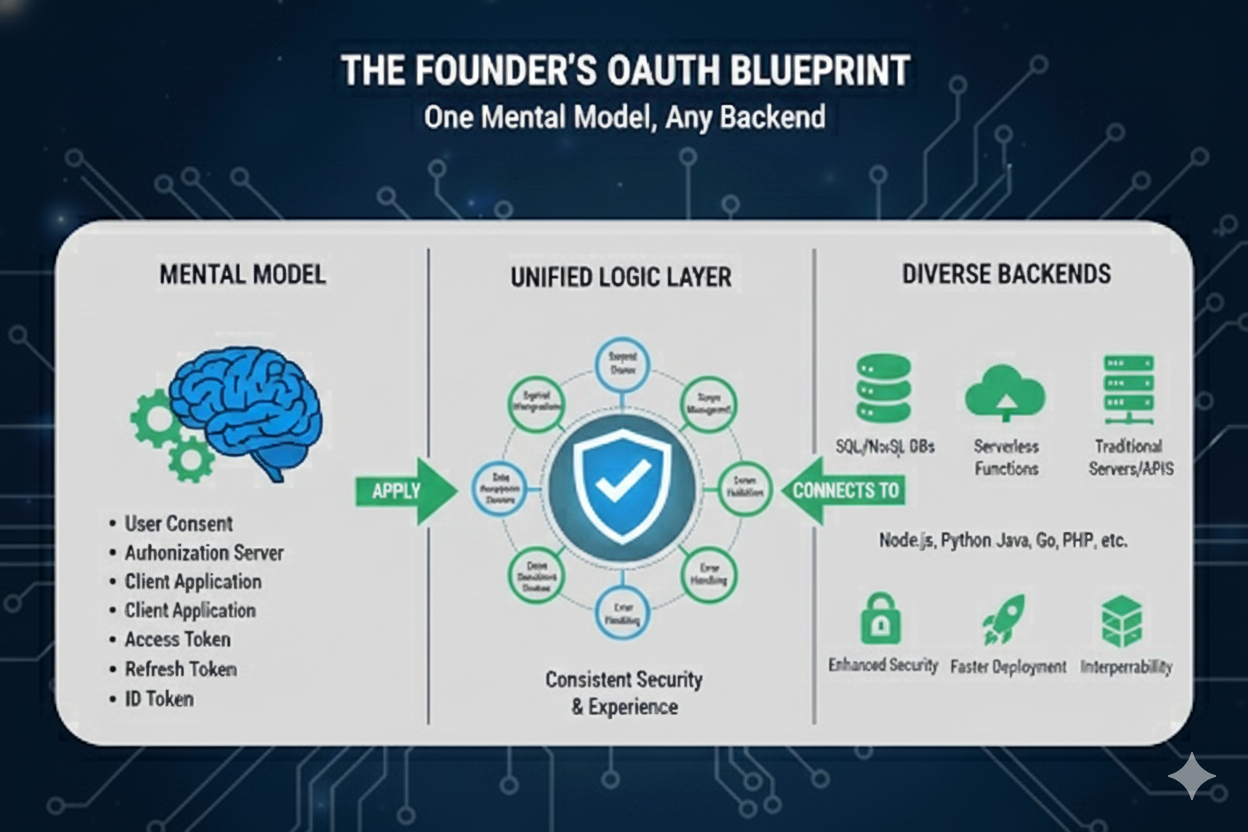
The OAuth 2.0 framework is the undisputed industry standard for authorization. It defines how a client can obtain an access token without ever having to handle a user's password.
By adopting OAuth 2.0 (and using JWTs for the actual bearer token), you immediately:
- Professionalize the API: You speak the same language as Stripe, Google, and Amazon Web Services, signaling immediate competence.
- Simplify Future Growth: Integrating with specialized identity providers (like Auth0 or Firebase Authentication) or delegating authority to third-party partners becomes plug-and-play.
- Decouple Security: You separate the concerns of who a user is (authentication) and what they can do (authorization), making your core business logic cleaner and easier to maintain.
A JWT is a secure, self-contained method for transmitting information between parties as a JSON object. It contains information about the user, their role, and the expiration time. The server verifies its cryptographic signature to ensure it hasn't been tampered with. This standard provides a crucial foundation for trust and delegation.
Financial Safeguard: Rate Limiting
Rate limiting is the final, essential safety net. It is not just a technical optimization to prevent server overload; for a solopreneur, it is a critical operational and financial safeguard.
If your Lean startup uses cloud infrastructure (which you will), an unexpected high volume—whether from a non-malicious bug in a client application or an actual malicious attack—can instantly trigger massive overage bills. A runaway client could bankrupt the business before you wake up the next morning.
Rate limiting is the architecture that says, "No single client can consume infinite resources."
Key-Level Rate Limiting
The most effective strategy for a B2B or consumer API is Key-level Rate Limiting. This controls the number of requests tied to a specific API key or authenticated user identity.
This strategy ensures:
- Fair Usage: One heavy user cannot inadvertently or maliciously consume all shared resources, protecting performance and reliability for everyone else.
- Financial Cap: It provides a crucial financial safety net by capping your exposure to runaway cloud usage costs.
The Token Bucket Algorithm
While implementation details vary, the Token Bucket Algorithm is a popular and Vibe-Coded strategy for managing limits.
Imagine a bucket that can hold a maximum number of tokens (e.g., 100 tokens). Every time a request is made, one token is removed. Tokens are added back to the bucket at a constant rate (e.g., 5 tokens per second).
- Burst Capacity: The maximum size of the bucket allows for sudden, temporary bursts of activity (the client can use all 100 tokens at once).
- Sustained Rate: The replenishment rate controls the maximum average sustained traffic.
This provides the optimal Vibe: clients can handle momentary spikes, but they are prevented from maintaining a sustained, destructive volume of requests. It is flexible, fair, and provides predictable consumption patterns.
Conclusion: The Ultimate Leverage of Vibe Coding
You started this journey with the decision to be lean, agile, and effective. The three posts in this series have provided a complete architectural strategy for the solo founder in the AI age:
- Vibe Coding (Post 1): Design with empathy for the client, focusing on Clarity, Context, and Semantic Consistency, and leveraging HATEOAS for ultimate adaptability.
- Architectural Safety Nets (Post 2): Automate trust with Idempotency and secure scalability with Cursor Pagination.
- Professional Polish (Post 3): Adopt predictable Naming Conventions, use high-velocity tools like FastAPI for auto-documentation, and standardize Security with OAuth 2.0 and Rate Limiting to cap financial risk.
Vibe Coding is the art of maximizing leverage by investing in foresight. By applying these standards from day one, you build an API that is not only robust but also lovable, instantly recognizable by the world of developers and fully prepared to be consumed as a tool by the rapidly expanding ecosystem of autonomous AI agents.
This blueprint ensures that as your product accelerates, your architecture will facilitate, not impede, your growth. Go forth and build!




No comments yet
Be the first to share your thoughts on this article!