
Imagine you are a pilot flying a small plane in the early morning. You are high in the air, but suddenly, you are surrounded by thick, grey clouds. You cannot see the ground, you cannot see the horizon, and you have lost your sense of "up" and "down." In this situation, you have two choices. You can try to "feel" your way through the sky, guessing your orientation based on your gut and the "vibe" of the wind. Or, you can trust the dashboard in front of you—the dials that tell you your speed, your altitude, and exactly how much fuel you have left.
Building a startup in 2026 without a measurement framework is like being that pilot and choosing to ignore the dashboard. In the "Vibe Coding" era, where we can build functional apps in a weekend, the risk of flying blind has never been higher. You might feel like you are moving fast, but without data, you have no idea if you are gaining altitude or if you are about to crash into a mountain of wasted time. This guide is designed to help you build your own dashboard using the AARRR (Pirate Metrics) framework, adapted for the modern solopreneur.
"In God we trust; all others must bring data." — W. Edwards Deming
The Pirate’s Map: Understanding AARRR Metrics
The most famous way to track a startup’s health is a system called Pirate Metrics. Created by Dave McClure, it is called Pirate Metrics because the five stages—Acquisition, Activation, Retention, Referral, and Revenue—spell out "AARRR." For a "Vibe Developer," this framework is the antidote to the chaos of rapid shipping. It helps you visualize the entire journey a person takes with your business, from the moment they first hear your name to the moment they pay you money.
1. Acquisition: Finding the Front Door
Acquisition is the measure of how people find you. In 2026, we have a "Sea of Sameness" in marketing. Everyone is using AI to generate content and ads. To measure acquisition correctly, you must look past the total number of visitors and focus on Channel Efficiency.
Are people clicking an ad on Instagram? Are they finding your GitHub repo? Or are they clicking a link in a niche community like IndieHackers? By measuring acquisition, you can stop wasting time on channels that don't convert. For example, if you spend ten hours a week on X (Twitter) but only get five visitors, while one well-placed post on a Subreddit brings in five hundred, the data is telling you where to double down. Don't fight the numbers.
2. Activation: The "Aha!" Moment
Activation happens when a visitor has their first great experience with your product. Just because someone signs up doesn't mean they are a customer yet. Activation is the moment the user realizes, "Oh, I get it! This is going to save me three hours of work."
If Acquisition is like getting someone to walk into your store, Activation is the moment they try on a shirt and realize it fits perfectly. This is the most critical stage for a "Vibe" product, because if your app is "ugly" but delivers an instant "Aha!" moment, the user will stay. If it's beautiful but confusing, they will leave.
Deep Dive: The "Aha!" Moment Across Industries
To measure activation correctly, you have to identify the specific action that proves the user has found value. This moment looks very different depending on what kind of business you are building. You must track the "Time to Aha!"—the number of seconds from landing on your page to experiencing value.
A. Software as a Service (SaaS): The Efficiency Moment
In software, the "Aha!" moment is about solving a problem faster than the user could do it manually. It isn't enough for them to just "create an account." They need to see the machine work.
- Project Management App: The moment isn't account creation; it's when they move their first "task" to the "Done" column or invite their first teammate. They see the potential for a more organized life.
- AI Summarization Tool: The moment happens when they paste a long transcript and receive a 95% accurate summary in under 10 seconds. The value is the time they just saved.
- DevOps Tool: The "Aha!" happens at the first successful automated deployment. They realize they never have to run that manual script again.
B. E-commerce: The Confidence Moment
For online stores, activation is about the transition from "just looking" to "I want this specific thing." This is often a mental shift triggered by personalization.
- Personalized Apparel: The "Aha!" moment might happen when a user takes a "Size Quiz" and sees a list of clothes guaranteed to fit their body type. They feel understood.
- Niche Marketplace: Activation happens when a user uses a specific filter and finds a rare item they’ve searched for for years. The value is the discovery of the "unfindable."
C. Content and Community: The Connection Moment
If your startup is a community or a course, activation is emotional or intellectual. You are selling belonging or knowledge.
- Online Community: The "Aha!" moment usually happens when a new member posts a question and receives a helpful, friendly reply from a stranger within minutes. They realize they are no longer alone.
- Paid Newsletter: Activation occurs when the user receives their first "members-only" email and finds an answer to a problem they've been struggling with. The value is "insider" knowledge.
3. Retention: The King of All Metrics
Retention is the most important metric for long-term survival. It measures how many people come back after their first visit. If you have high acquisition but low retention, your business is a "Leaky Bucket." You are pouring new people in at the top, but they are all falling out through a hole in the bottom.
It is significantly cheaper to keep an existing customer than it is to find a new one. In a "Vibe" build, retention tells you if the "core vibe" is actually useful. If people use your AI agent once and never come back, the AI agent is a novelty, not a utility. You track this by looking at "Cohort Analysis"—how many people who signed up in Week 1 are still active in Week 4?
"Retention is the only thing that matters. If you can't keep users, you don't have a business; you have a revolving door."
4. Referral: The Ultimate Compliment
Referral happens when your customers are so happy that they become your unpaid sales team. This is the ultimate proof of product-market fit. In 2026, the "Viral Coefficient" (how many new users each existing user brings in) is the holy grail. You can track this through "Invite" buttons or by monitoring how often your content is shared. If your referral rate is high, your acquisition costs will eventually drop to near zero.
5. Revenue: Proving the Business Model
At the end of the day, a business must make money. Revenue metrics track sales, subscriptions, and "Average Order Value." This is where you see if people value your solution enough to open their wallets. If you have thousands of users but zero revenue, you have a hobby, not a business. Measuring revenue helps you understand if your pricing is right and if the business can sustain your life as a solopreneur.
Connecting Metrics to Your Lean Canvas
While Pirate Metrics track the customer, the Lean Canvas tracks your business plan. Every box on a Lean Canvas is actually a "guess" or an assumption. For example, if you wrote on your canvas that "Busy lawyers will pay $50 a month for this," that is a hypothesis. To turn that hypothesis into a fact, you need a metric.
You must connect your measurements back to your canvas boxes. If your "Unique Value Proposition" is speed, but your "Activation" data shows users are spending 10 minutes trying to set up the tool, your data is telling you that your canvas is lying to you. This is Innovation Accounting—using data to prove or disprove your business plan so you can pivot before you run out of cash.
Your 2026 Measurement Toolbelt
As a "Vibe Developer," you don't need a data science team. You need simple, integrated tools that give you "Ground Truth" for under $100 a month.
The Art of Data-Driven Decisions
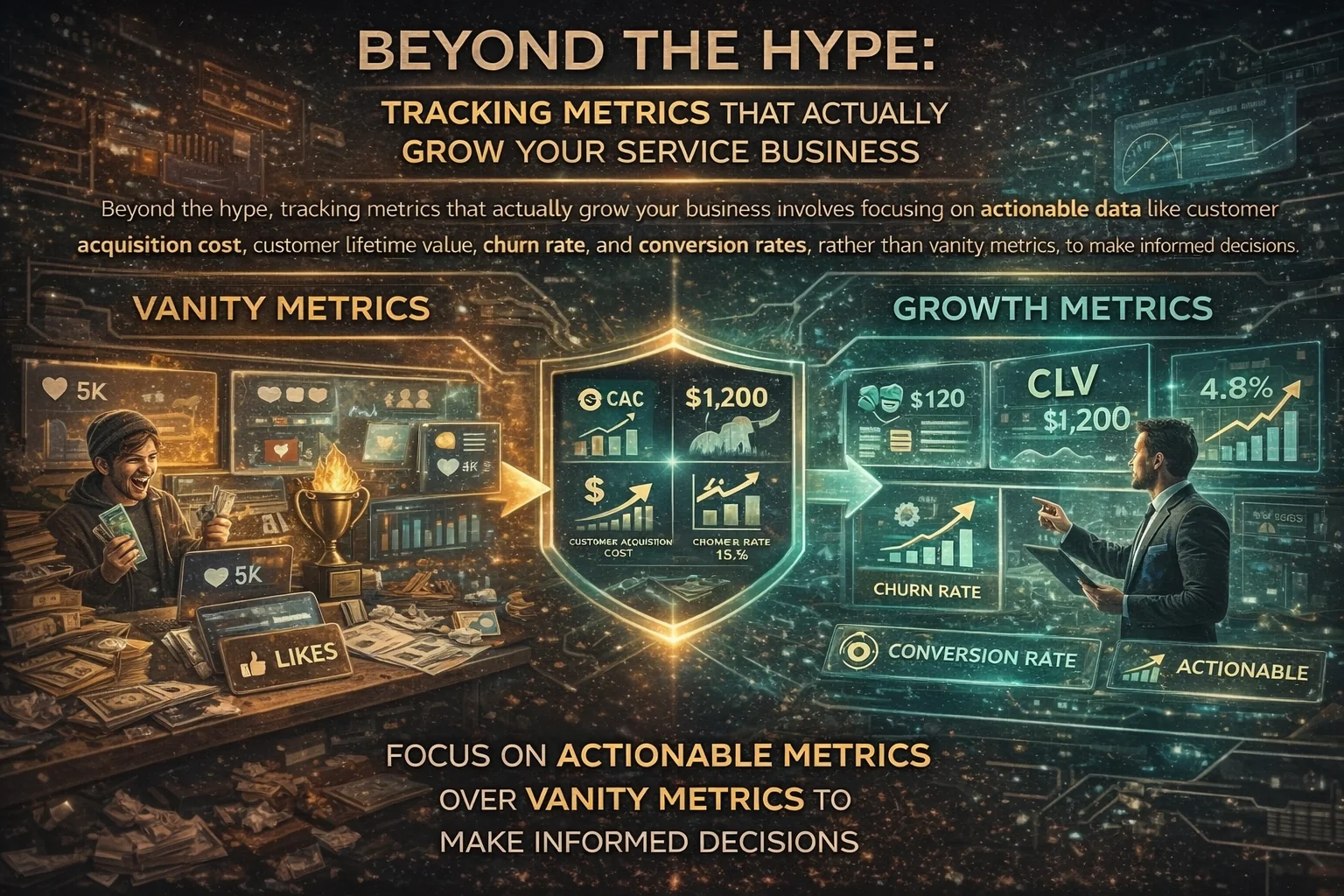
Having a pile of data is only half the battle. The real power comes from Interpretation. You must ask "why" behind every number. If your conversion rate dropped last week, don't just be sad about it. Ask what changed. Did you change the color of a button? Did your website become slower to load? Did you start a new ad campaign that is attracting the wrong audience?
Connect your data to your "Vibe" guesses. If you guessed that people would love a specific new AI feature, but the data shows that only three people clicked on it, you have to be honest with yourself. The data is telling you that your guess was wrong. This isn't a failure; it’s a success! You just saved yourself months of work on a feature that nobody wanted. You now have the freedom to build something else.
⚠️ Important: Beware of "Confirmation Bias." It is very easy to look for the one number that proves you are a genius while ignoring the ten numbers that prove you are on the wrong track. Be a scientist, not a fan of your own work.




No comments yet
Be the first to share your thoughts on this article!