

In the vacuum of a startup's early days, data is often used as a security blanket rather than a flashlight. Founders obsess over real-time dashboards, watching the needle flicker with every tweet or LinkedIn post. But in the Lean Startup methodology, "Measure" is not a synonym for "Track." It is a synonym for Validate.
The Anatomy of the Leap-of-Faith Assumption (LOFA)
Every business plan is a collection of logical leaps. We assume people have a problem, we assume they want our solution, and we assume they will pay enough for it to make us profitable. These are your Leap-of-Faith Assumptions (LOFAs).
The Two Pillars of LOFA
Most startups fail not because they couldn't build the product, but because they were wrong about one of these two foundational guesses:
- The Value Hypothesis: This tests whether a product or service actually delivers value to customers once they are using it. What is the "Aha! moment"? If this is false, your product is a novelty, not a utility.
- The Growth Hypothesis: This tests how new customers will discover a product. It isn't just about marketing; it’s about the engine of growth. Is it viral? Is it paid? Is it sticky?
Detailed Case Study: Zappos and the "Mall Validation"
In 1999, Nick Swinmurn had a LOFA: "Customers are willing to buy shoes without trying them on." At the time, this was a radical, almost absurd assumption. Conventional wisdom said shoes were "high-touch" items—you needed to feel the leather, check the arch, and walk in them.
The Traditional Approach: Swinmurn could have spent $2M on a warehouse, hired a logistics team, and built a massive inventory system to "launch" Zappos.
The Lean Approach: He went to a local mall, took photos of shoes on the shelves, and posted them on a rudimentary website. When someone clicked "buy," he went back to the mall, bought the shoes at retail price, and mailed them from the post office.
The Learning Metric: He wasn't tracking "Total Site Visits" or "Social Mentions." He was tracking the Yield of Trust: How many people, when presented with a grainy photo, would actually enter their credit card information? By losing money on every sale, he bought the most valuable commodity in the world: Certainty.
Activity Metrics vs. Learning Metrics: Avoiding the Vanity Trap
The most dangerous numbers are the ones that make you feel good. Eric Ries famously coined these "Vanity Metrics." To move from a project to a business, you must transition from Activity (what we are doing) to Learning (how the world is responding).
The Activity Metric (The "Noise")
Activity metrics are often cumulative and always go up. They provide a "theater of success" that satisfies investors but starves the product of truth.
- Total Registered Users: This number never goes down, even if 99% of those users haven't logged in since 2022. It hides the "leaky bucket."
- Raw Web Traffic: 50,000 hits this month! (But were they bot traffic? Did they bounce in 2 seconds?)
- Features Shipped: "We pushed 12 new updates this quarter." This is a measure of effort, not impact.
The Learning Metric (The "Signal")
Learning metrics are usually ratios or cohort-based. They are designed to disconfirm your biases.
- The "Magic Moment" Ratio: What % of users perform the core action (e.g., sending their first invoice) within 24 hours?
- Cohort Retention: Of the users who joined in January, how many are still active in March? If this number isn't stabilizing, you don't have a business; you have a treadmill.
- Net Promoter Score (NPS) / Sean Ellis Test: If 40% of your users say they would be "Very Disappointed" if your product disappeared tomorrow, you have reached the "Product-Market Fit" baseline.
The Innovation Accounting Ladder
How do you measure progress when you have zero revenue? You climb the ladder of evidence.
| Phase | Core Question | The "Evidence" Metric |
|---|---|---|
| Level 1: Problem | Is the pain real? | Currency Exchange: Will they give you their email, their time (30-min call), or a "Letter of Intent"? |
| Level 2: Solution | Is our fix the right one? | Engagement Density: How often do they use the "manual" version of the tool without being prompted? |
| Level 3: Scale | Can we grow sustainably? | The Payback Ratio: Is $LTV > 3 \times CAC$? (Lifetime Value vs. Customer Acquisition Cost). |
The Psychology of Measurement: Why We Lie to Ourselves
Building a culture of measurement is harder than setting up Google Analytics. It requires Intellectual Honesty. Most founders suffer from "Confirmation Bias"—they seek out the data that proves their vision is working and ignore the data that suggests a pivot is necessary.
"The first principle is that you must not fool yourself, and you are the easiest person to fool." — Richard Feynman
Rituals for Honesty:
- The Pre-Mortem: Before you launch a feature, write down exactly what numbers would constitute a failure. If you wait until after the data comes in, you will "rationalize" the poor results as "just a tracking error" or "seasonal dip."
- Celebrate "Negative" Results: If an experiment fails, the team should be rewarded for finding the truth quickly. A failed experiment that cost $500 is a $50,000 savings in future engineering time.
Designing Metrics Backwards from the Decision
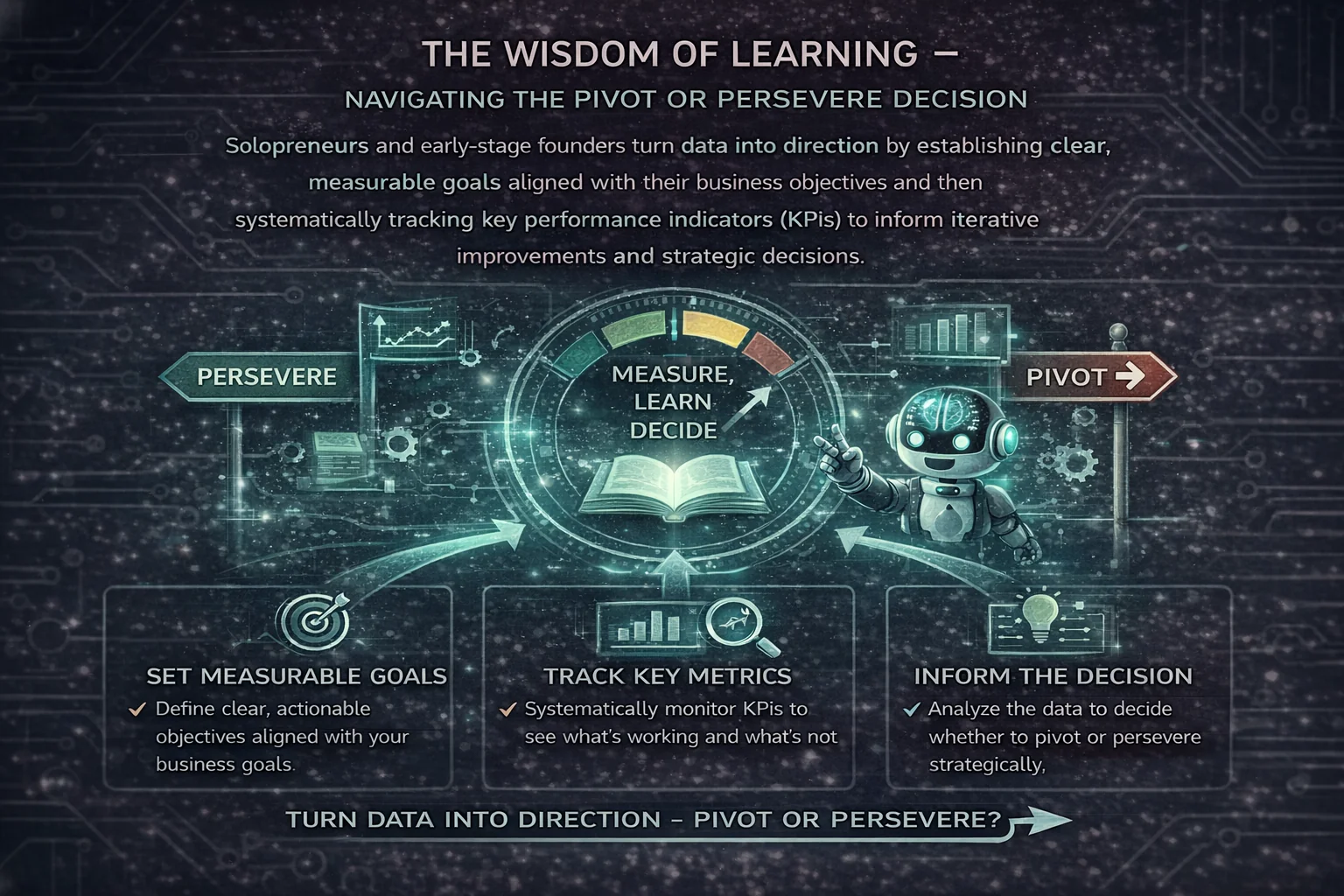
A metric is only useful if it changes a decision. If you would do the same thing regardless of what the number says, stop tracking it.
Conclusion: Speed is Secondary to Direction
In the Build-Measure-Learn loop, speed is the engine, but Innovation Accounting is the steering wheel. Without it, you are just a fast car driving toward a cliff.
Start today by identifying your single biggest Leap-of-Faith Assumption. Don't build a dashboard for it. Just find one metric that could prove you wrong. When you stop fearing the data and start using it to find the truth, you stop being a dreamer and start being a founder.




No comments yet
Be the first to share your thoughts on this article!