
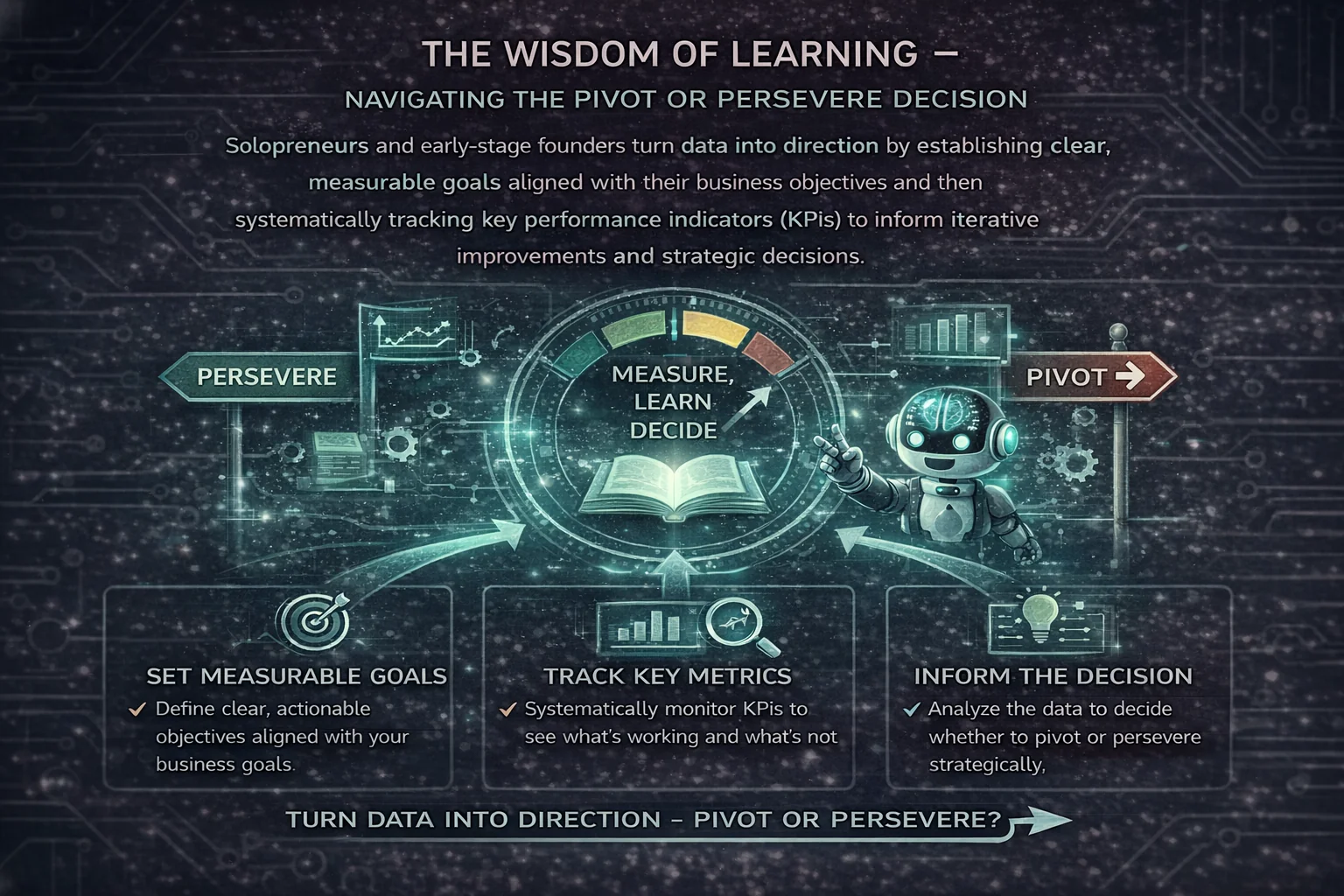
If Build is how you expose reality and Measure is how you make sense of it, then Learn is where the transformation happens. This is the moment you stop asking, “What happened?” and start asking, “So what—and now what?”
Validated Learning: The Startup's Only True Currency
In the early days, traditional accounting is a hallucination. High sign-up numbers can mask a "leaky bucket," and early revenue can come from "consulting-trap" customers who will never scale. In this fog, Validated Learning is the only unit of progress that matters.
The Three Questions of Progress:
- Psychological Clarity: Do we understand the user's "Job-to-be-Done" better than we did 30 days ago?
- Pain Categorization: Can we distinguish between a "shark bite" (urgent pain) and a "mosquito bite" (minor annoyance)?
- Uncertainty Reduction: Have we killed at least one major "Leap-of-Faith Assumption" (LOFA) this month?
If you aren't reducing uncertainty, you are just "playing startup." Validated learning is what turns chaotic activity into compounding insight.
The Internal Model vs. The Evidence Ledger
Every founder starts with an Internal Model—a story of how the world should work. Paul Graham’s failure with his 1995 art gallery startup is the classic example of an internal model that never collided with reality. He assumed galleries wanted an online presence; he didn't learn until months later that they actually feared the transparency the internet provided.
"The 'Learn' phase is the structural collision between your ego’s vision and the market’s reality."
Operationalizing the Collision
To move from gut feeling to evidence-based leadership, you need a translation layer:
The Pivot/Persevere Framework: Deciding Without the Emotion
The decision to pivot is the "dark night of the soul" for a founder. Sunk cost bias makes us want to keep digging the same hole. To remove the emotion, look for Signal Patterns.
The Pattern of Convergence (Persevere)
You should keep pushing when the data shows convergence—meaning different data points are pointing to the same truth:
- Language Mirroring: Unrelated users use the exact same vocabulary to describe their frustration.
- Desperate Hacking: Users are using your broken, buggy MVP to solve a problem because the alternative is even worse.
- High Gravity: Even when you stop marketing, a small group of users keeps coming back. They are "pulled" into the product.
The Pattern of Disconfirmation (Pivot)
It is time to change direction when you hit the "Nice-to-Have" Wall:
- The Polite "No": Everyone says the idea is "great" and "smart," but no one will give you a credit card or a date for a follow-up.
- Metric Flatlining: You’ve iterated on the UI five times, but the retention curve hasn't budged. The problem isn't the how; it's the what.
- The "Side-Project" Signal: Users ignore your main feature but obsessively use a small "utility" tool you built as an afterthought. (e.g., Slack starting as an internal tool for a gaming company).
Case Study: The "Blue Light" Pivot
Imagine a team building a complex Project Management Tool for Architects. After six months, the data shows:
- The Activity: 2,000 signups, but 90% churn after 48 hours.
- The Hidden Signal: A tiny cohort of 20 users (all Freelance Interior Designers) are using the "Photo Markup" tool 50 times a day. They don't use the project management features at all.
The Decision: The "Learn" phase identifies this as an Emergent Pull. A persevere decision would be to "fix the onboarding for architects." A Pivot decision would be to strip away the project management bloat and relaunch as "MarkupPro for Designers."
Building a Culture of Disconfirmation
Human beings are wired for Confirmation Bias. Founders are especially susceptible. To counter this, you must build "Truth Rituals" into your team's DNA.
When to Stop Exploring and Start Scaling
The Build-Measure-Learn loop is not a treadmill; it's a search for a vein of gold. You move from Exploration (Lean Startup) to Exploitation (Scaling) when:
| Indicator | The "Scale" Signal |
|---|---|
| Customer Profile | You can describe them with "uncomfortable clarity" (e.g., "Marketing ops leads at 50-person SaaS companies using HubSpot"). |
| Onboarding | Users find value without a founder "holding their hand" through the process. |
| Unit Economics | You have a "Strong" evidence score that customers will pay 3x more than it costs to acquire them. |
Final Thought: Your Real Moat is Judgment
In an era where AI can generate code and marketing copy in seconds, features are no longer a sustainable moat. Your only real advantage is proprietary judgment—a nuanced understanding of your market that you've earned through a hundred failed and successful experiments.
By treating "Learning" as the primary product of your startup, you stop gambling and start investing. You aren't just building software; you are building a Portfolio of Evidence. When you stand in front of investors or employees, you won't be selling "hope"—you'll be selling truth.





No comments yet
Be the first to share your thoughts on this article!