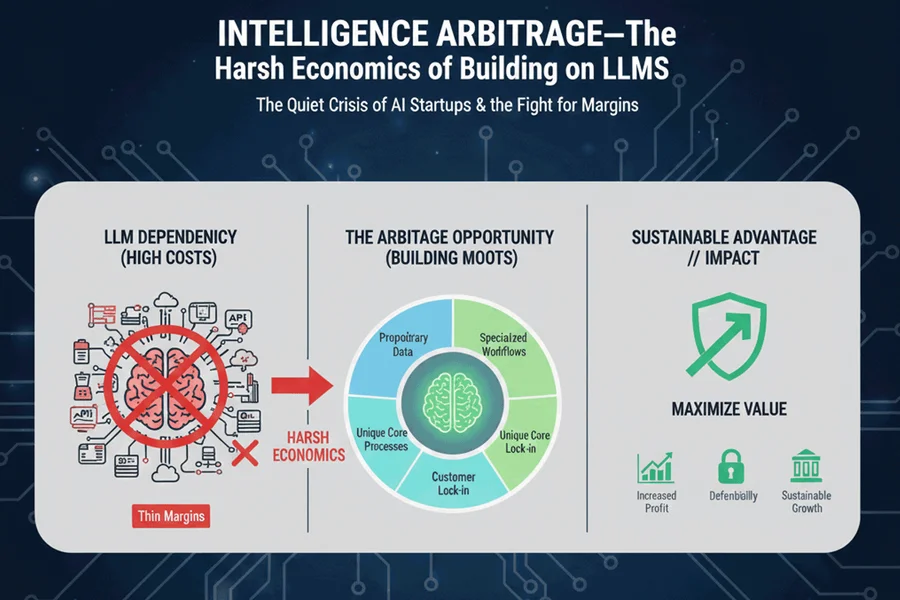
There is a quiet crisis happening in the world of AI startups.
Thousands of founders are building impressive applications, gaining users, and even seeing revenue—only to realize that at the end of the month, they are "buying dollars for $1.20." They’ve built a product where the cost of the API calls, the vector database hosting, and the development time exceeds the lifetime value of the customer. They have fallen into a trap where growth actually accelerates their bankruptcy.
In the industry, we call this the "Token Trap."
To survive as a lean solopreneur, you cannot afford to be a tech optimist. You must be an Intelligence Arbitrageur. You need to understand the "First Principles" of AI costs and build a business model that scales without eating your margins. You need to treat machine intelligence not as a magic wand, but as a raw commodity that must be refined and sold at a significant markup.
In Module 3 of The AI Solopreneur’s Launchpad, we stop dreaming and start calculating.
What is Intelligence Arbitrage?
Arbitrage is the practice of taking advantage of a price difference between two or more markets. In the context of AI, Intelligence Arbitrage is the ability to buy raw, unstructured "machine intelligence" at a wholesale price (API tokens) and sell it as "structured, high-value outcomes" at a premium price.
The "Arbitrage Delta" is where your profit lives.
To understand this, think of the AI model as crude oil. Crude oil is cheap, but it’s messy and hard to use. You can’t put it in your car. Your job as a solopreneur is to build the "refinery." You take the raw tokens (crude oil), process them through your proprietary workflows, guardrails, and industry-specific context, and turn them into "gasoline"—a high-value, ready-to-use outcome for the customer.
If a professional consultant charges $200 to audit a legal contract, and your AI Superagent can do it for $0.50 worth of tokens, your arbitrage opportunity is massive. But if you build a "generic chat bot" that costs you $0.10 per message in API costs and you try to sell it for $10 a month, a single "power user" who sends 100 messages a day will bankrupt you in three days. You aren't just selling a tool; you're selling the spread between human labor costs and machine inference costs.
The Token Economy: Understanding Your Unit Economics
Every AI business has a "Unit of Value." For a writer, it’s a word; for a coder, it’s a function; for a researcher, it’s a report. To build a feasible business, you must know the exact cost of that unit down to the fourth decimal point.
We use the following formula to calculate the Gross Margin per AI Action:
$$Margin = Price_{Customer} - (Cost_{Tokens} + Cost_{Infrastructure} + Cost_{Support})$$
The Hidden COGS (Cost of Goods Sold)
Most major providers (OpenAI, Anthropic, Google) charge by the "Token" (roughly 750 words per 1,000 tokens). However, the "Token Cost" is only the beginning. To truly understand your unit economics, you must account for the Inference-to-Outcome Ratio.
The Cascade Architecture: Designing for Profit
The biggest mistake solopreneurs make is using the "best" model for every task. This is like hiring a PhD in Physics to count change at a cash register. It’s overkill, and it’s expensive.
To maintain high margins, we teach the Cascade Architecture. This is a system where requests are "routed" to the cheapest possible model capable of handling the task.
- Tier 1: The Gatekeeper (Free/Cheap): Uses a tiny, fast model (e.g., Llama 3-8B, GPT-4o-mini) to classify intent and handle simple requests.
- Tier 2: The Worker (Medium): Utilizes a mid-range model (e.g., Claude Haiku, Gemini Flash) for 80% of routine tasks like formatting or summarizing.
- Tier 3: The Specialist (Expensive): Escalates to high-end "Reasoning" models (e.g., Claude Opus, OpenAI o1) only for complex logic, multi-step math, or high-stakes creative tasks.
By cascading your requests, you can reduce your COGS by up to 90% without the user ever noticing a drop in quality. You are optimizing for Intelligence-per-Dollar, not just Intelligence.
The Hallucination Tax: The Cost of Being Wrong
In a traditional SaaS, a bug might crash a page. In an AI SaaS, a "bug" (a hallucination) can give a user dangerous advice or incorrect financial data. This creates a hidden cost we call the Hallucination Tax.
Every time the AI is wrong, it costs you:
- Support Time: Humans have to manually fix the error.
- Churn: The user loses trust and cancels.
- Liability: In certain industries, a wrong answer can lead to legal issues.
To mitigate the Hallucination Tax, you must build a "Human-in-the-Loop" (HITL) trigger. Your system should automatically flag any AI output with a "Confidence Score" below 85% for manual review. Your goal is to automate 95% of the work, but that final 5%—the "human audit"—is what allows you to charge premium prices. Customers don't pay for the AI; they pay for the assurance that the AI is right.
The $10, 1-Hour Stress Test
Before you build a landing page, before you write a line of code, and before you name your business, you must pass the Stress Test.
Most founders spend six months building a "Minimum Viable Product" (MVP) only to find out nobody wants it. We prefer the "Minimum Viable Offer" (MVO). The goal of the MVO is to prove Incentive, not just Interest.
If you can't pass the $10 test, you shouldn't spend $1,000 on a developer or 100 hours on a no-code build. The $10 test is the "Proof of Arbitrage."
The Lean Canvas for AI Ventures
Traditional business plans are where ideas go to die. For an AI solopreneur, the landscape changes too fast for a 20-page document. Instead, we use a one-page Lean Canvas specifically adapted for the unique constraints of generative AI:
- The Moat (Defensibility): How will you retain customers if a competitor or major AI provider replicates your core function?
- The Model Strategy: Which models will you cascade, and what is your "Token Budget" per user?
- The Hallucination Hedge: What is your specific mechanism for catching and correcting AI errors?
- The Feedback Loop: How are you using human corrections to improve your AI system prompts or fine-tune models?
Time Shifting: The "Resilience" Exercise
Finally, we perform a mental exercise called Time Shifting. This is how you ensure your business isn't a "feature" that gets swallowed by the next model update.
The 1995 Test
Ask yourself: "How would I have solved this problem in 1995 (before LLMs)?"
If the answer is "I couldn't," then your business is likely too dependent on the current tech hype. If the answer is "I would have hired a team of 10 juniors in an offshore office to manually read these documents," then you have found a High-Value Labor Replacement opportunity. The AI is just a more efficient way to perform a task that has always had value.
The 2030 Test
Ask yourself: "How will OpenAI or Google solve this natively by 2030?"
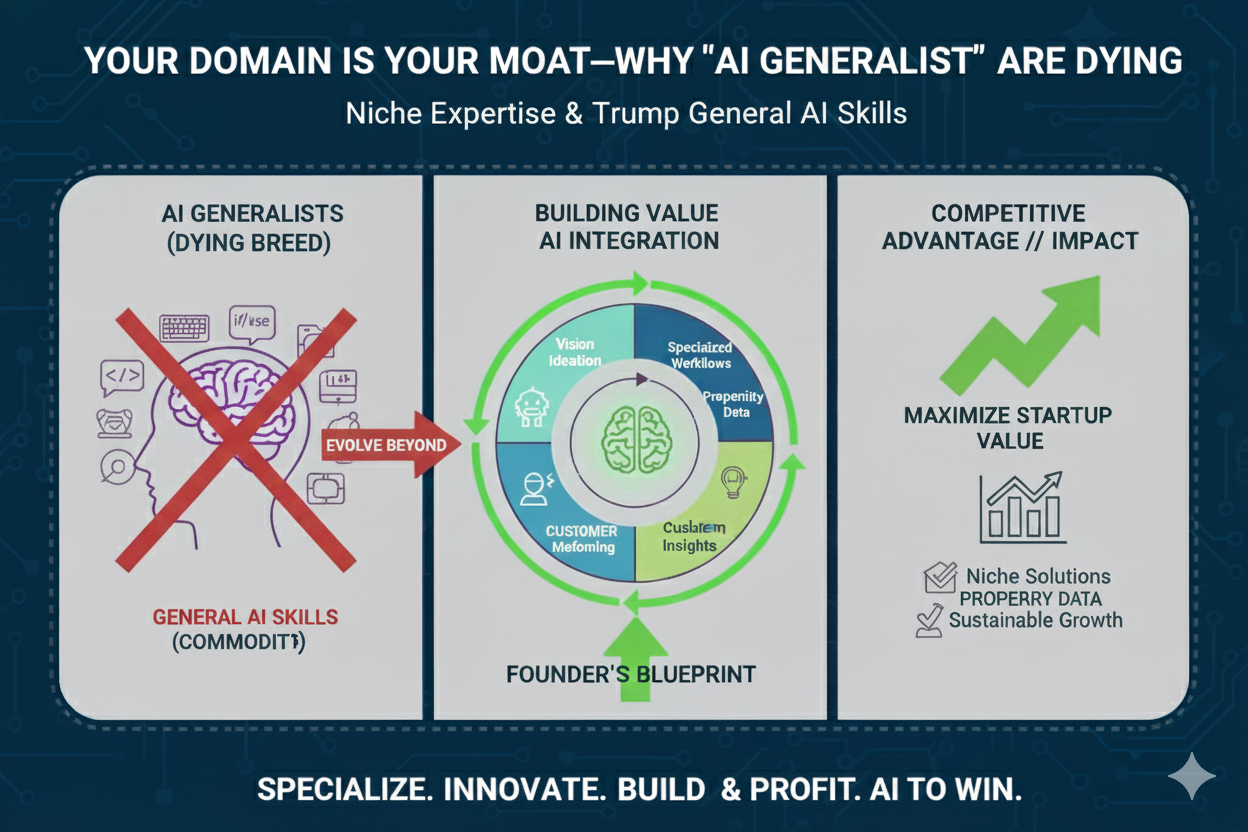
Big Tech loves "horizontal" problems (writing, summarizing, general chatting). They hate "vertical" problems (compliance for German dental practices, auditing specialized chemical patents). If your value proposition is a "button" that Big Tech will eventually add to their OS, you are in danger. If your value proposition involves a complex, messy, industry-specific workflow, you are building a moat.
Big Tech loves horizontal problems. They hate vertical problems. Build a moat by focusing on the latter.
Conclusion: The Math of Freedom
Being a solopreneur in the age of AI isn't about being the most technical person in the room. It’s about being the best Economic Architect.
It’s about finding a place where human intelligence is expensive, slow, and prone to fatigue, and replacing it with machine intelligence that is cheap, near-instant, and infinitely scalable—and pocketing the difference.
Stop looking at the "Coolness" of your AI. Users don't care how many parameters your model has; they care about the result on their desk. Start looking at the "Cost-to-Value" ratio. When the math works, the business works. When the arbitrage is clear, your freedom is guaranteed.
What’s Next?
You’ve got the idea. You’ve done the math. Now, you need to refine it and get it into the hands of real users. In Post 5: The 30-Day Launch Sprint, we are going to look at the "Collaborative Refinement" phase. How do you use "Six Thinking Hats" to find the holes in your plan? How do you use "Question Storming" to discover what your customers are really afraid of? And how do you build a launch plan that actually gets you to your first $1,000 in revenue?
The tokens are cheap. The insights are expensive. Sell the insights.

No comments yet
Be the first to share your thoughts on this article!