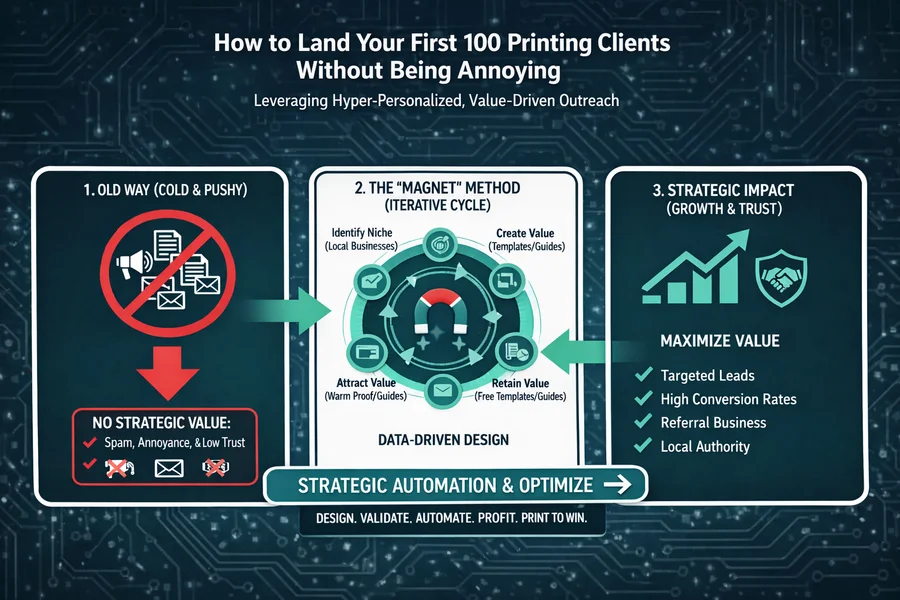
For a lean startup in the custom apparel world, every resource—time, capital, and mental energy—is precious. You cannot afford to waste weeks on outreach that falls flat or, worse, damages your brand’s reputation before you’ve even printed your first dozen shirts. Traditional "spray and pray" sales tactics are the antithesis of lean; they are wasteful, inefficient, and increasingly ignored in a world saturated with digital noise.
The lean startup approach to client acquisition isn't about volume; it’s a strategic experiment. Your goal is to systematically test low-cost, high-touch methods to discover what resonates with your specific market. You aren't blasting thousands of generic messages. You are running a series of smart, measurable outreach "sprints" designed to teach you exactly how to talk to your customers.
The Lean Outreach Mindset: Treat Every Channel as an Experiment
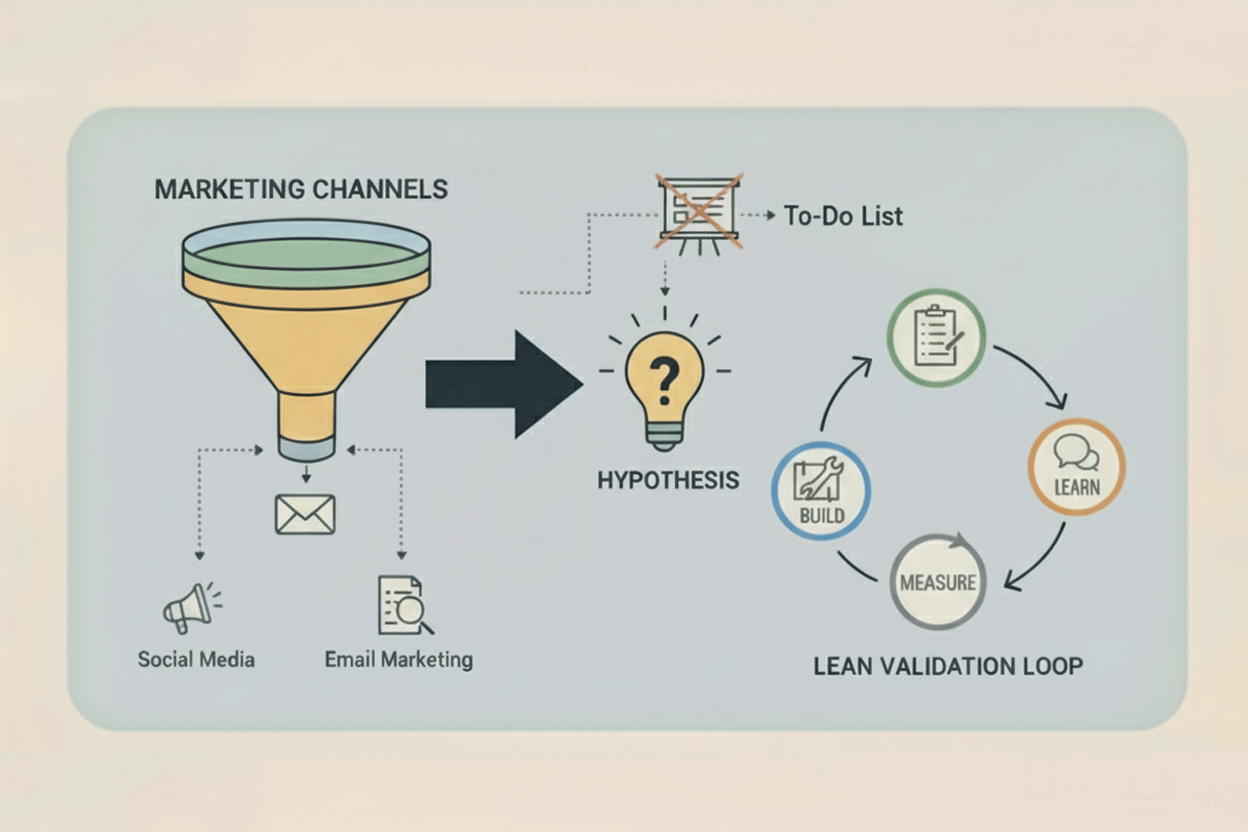
Before you send a single message or pick up the phone, you must shift your mindset. In the lean framework, you are not "selling" yet—you are gathering validated learning. Every interaction is a probe into the market to see where the pain points lie. This disciplined approach prevents you from sinking months of effort into a strategy that was never going to work. You fail fast, learn quickly, and move on to the next iteration.
- The Hypothesis: "Local craft brewery managers are frustrated by long lead times and want a partner who can handle small, high-frequency 'drop' runs." This is your educated guess about a customer's specific problem and their desire for a particular solution.
- The Experiment: Send 20 highly personalized emails to head brewers in a 30-mile radius. This is the practical test of your hypothesis. Personalization is key to getting genuine feedback.
- The Metric: Not just "sales," but engagement rate. Did they ask about your turnaround time? Did they mention their current provider?
- The Learning: If 15 people reply saying, "We actually print everything in-house," your hypothesis is wrong. You’ve learned that the 'outsourced' pain point doesn't exist for this segment. Pivot and try a different niche. This is where you analyze the results of your experiment to inform your next steps.
Your Outreach Toolkit: Ranked by Lean Principles
For a bootstrapped printing business, you must prioritize methods that offer the highest potential for learning and trust-building for the lowest capital outlay. This means focusing on activities that provide the most information about your market and customers with minimal financial investment.
Comparison of Lean Outreach Methods
|
Outreach Method |
Lean Effort/Cost |
Learning Potential |
Lean Recommendation |
|---|---|---|---|
|
"Just Send Pricing" |
Very Low |
Minimal |
Avoid. This is pure waste. It provides zero learning and frames you as a commodity. |
|
Cold Text / DM |
Low |
Negative |
Do Not Use. Violates digital boundaries. The "fast failure" here can permanently burn a local lead. |
|
Cold Call |
Moderate |
High |
Use Strategically. High-touch and immediate. A 5-minute call teaches you more than 100 ignored emails. |
|
Cold Email |
Moderate |
High |
Primary Lab. Excellent for A/B testing subject lines and value propositions at scale. |
|
Warm Referral |
High (Setup) |
Maximum |
The Gold Standard. Invest in building a simple referral loop early to maximize trust. |
The Build-Measure-Learn Loop for Printing
The core of the Lean Startup methodology is the Build-Measure-Learn feedback loop. This iterative process is crucial for any startup aiming to find its product-market fit efficiently. Here is how to apply it to your first 100 clients.
In the same way you wouldn't build a complex app without testing a prototype, don't write a 5-paragraph sales letter. Your first message is a testable prototype. Its only goal is to start a conversation. This means focusing on getting a response, not on closing a deal immediately. Think of it as a first date—you're trying to see if there's chemistry, not planning the wedding.
- The Personalized Hook: Show you spent 120 seconds looking at their business. This small investment of time demonstrates genuine interest and helps you stand out from generic outreach. It shows you've done your homework and understand their context. For example, you might say, "I saw your team at the Downtown Farmers Market—those vintage-style logos really stood out, but I noticed the print on the black tees seemed to be cracking." This specific observation makes your message relevant and positions you as someone who pays attention to detail.
- The Value Prop: Focus on the outcome, not the ink. People don't buy ink; they buy solutions to their problems. Instead of listing your printing capabilities, explain how you solve their business challenges. "We help local brands maintain premium retail quality so their merch actually sells, rather than sitting in a box." This statement highlights the benefit – increased sales and better brand perception – which is far more compelling than technical printing details.
- The Low-Lift CTA: Make it effortless to respond. You want to lower the barrier to entry for engagement. A complex question or a request for a lengthy meeting can be intimidating. Instead, offer something easy and valuable. "Would it be helpful if I sent over a 1-page guide on how to choose fabrics that prevent print cracking?" This is a soft ask that provides immediate value and opens the door for further conversation without demanding significant commitment from the prospect.
Vanity metrics like "Total Emails Sent" will kill your startup. They provide a false sense of productivity but don't tell you if you're actually making progress. Instead, track Conversation Rate. This metric tells you how many people are actually engaging with your outreach and providing feedback, which is essential for learning.
If you send 50 emails and get 5 replies, you have a 10% Conversation Rate. This is a crucial data point. If those 5 replies all say "We're happy with our current guy," your message is reaching people, but your value proposition isn't strong enough to cause a switch. This is a clear signal to iterate on your offer. You haven't failed; you've learned that your current approach isn't resonating, and you now know what to change.
After a batch of 50-100 outreaches, sit down with the data. Look for patterns. This is where the real learning happens. Don't just look at who replied; understand why they replied or didn't. This analysis is key to refining your strategy.
- Channel Wins: Did LinkedIn messages to CrossFit owners get a 20% reply rate while cold calls got 0%? This tells you where your target audience is most receptive and where to focus your limited resources. Move your resources to LinkedIn. If a particular channel consistently yields better engagement, double down on it.
- Objection Patterns: If everyone says, "Your prices are high," don't just lower them. This is a superficial response to a deeper issue. Learn why they perceive them as high. Are they comparing your premium screen printing to cheap heat transfers? Your "learning" is that you need to better communicate the durability and perceived value of your method. You need to educate your prospects on what makes your pricing justified.
High-Touch Strategies for High-Value Gains
To get to 100 clients quickly, you need to bridge the gap between being a "random guy with a printer" and a "trusted partner." This transition requires building relationships and demonstrating value beyond just the product itself. High-touch strategies are essential for cultivating that trust and perceived value.
The "Sample Box" Sprint
Identify 10 "dream" clients. These are businesses or organizations that align with your ideal customer profile and whose branding you admire. Focus on those whose needs you can genuinely meet and whose success would be a strong testament to your capabilities. This targeted approach ensures your efforts are focused on the most promising opportunities.
Print a high-quality sample of their logo on a premium garment. This isn't just about showcasing your printing skills; it's about creating a tangible representation of their brand that they can see and feel. Use a garment that speaks to quality and durability, mirroring the results you aim to deliver. This physical product serves as your Minimum Viable Product for this specific client, demonstrating your understanding of their brand and your commitment to quality.
Drop it off or mail it with a handwritten note: "I thought your branding deserved a canvas this good. If you ever need a backup for a rush job, I'm just down the street." This personal touch is critical. It transforms a transactional interaction into a relationship-building opportunity. The note clearly communicates your value proposition—quality and reliability—and offers a low-pressure call to action. The Learning: This tests if your quality is the "hook." If they don't respond to a free shirt with their own logo, quality isn't their primary pain point—it's likely price or convenience. This feedback is invaluable for understanding client priorities.
The Content-First Approach
Lean outreach can also be indirect. Instead of actively pushing your services, you can attract clients by providing value and demonstrating expertise. Join local Facebook groups for small business owners or niche forums (like r/SCREENPRINTING or local "Shop Small" groups). These online communities are fertile ground for building authority and generating inbound leads.
- Don't post: "I sell shirts, DM me." This is overly direct and often ignored because it offers no immediate value to the reader. It feels like spam and doesn't build trust.
- Do post: "I just figured out a way to make neon inks pop on dark polyester. If anyone's struggling with their sports team uniforms looking dull, happy to share the technique." This positions you as an expert, leading to "inbound" experiments where the customer comes to you. By sharing valuable knowledge freely, you attract people who are experiencing a specific problem you can solve, making them much warmer leads.
The Instant Turn-Offs: How to Fail "The Wrong Way"
- The Feature Dump: Prospects don't care that you have a MHM S-Type Xtreme AC-driven press. They care that their staff looks professional and the shirts don't shrink in the first wash. Sell the hole, not the drill. This means translating technical specifications into tangible benefits for the customer. Focus on the problem you solve or the outcome you deliver, not the tools you use.
- The Generic Blast: Using "Dear Business Owner" or "To whom it may concern" tells the prospect you are lazy. If you are lazy with your email, they assume you will be lazy with their registration and pantone matching. Personalization is not a luxury; it's a necessity. It shows respect for the prospect's time and business, signaling that you are capable of paying attention to detail.
-
The "Guilt-Trip" Follow-Up: Never send: "I see you read my last email and didn't reply..." This is the fastest way to get blocked. It's pushy and annoying. Instead, provide a "Value-Add" follow-up: "Hey, I just finished a project for a local gym similar to yours and we found a new moisture-wicking fabric they loved. Thought you might want to see the specs." This type of follow-up continues to offer value and keeps your business top-of-mind without being intrusive. It shows you're still thinking about their needs and have something useful to share.
Your 30-Day Lean Outreach Action Plan
To hit that 100-client milestone, you need a repeatable engine. This isn't about a single lucky break; it's about building a system that consistently brings in new customers. Follow this roadmap to build that engine.
Pick two distinct niches (e.g., Local Landscapers and Boutique Coffee Shops). These should be groups of businesses that likely have similar needs and pain points in custom apparel. Develop a unique hypothesis for each. For instance, consider what kind of apparel or printing challenges each group might face.
- Landscapers: They need durability and high-visibility. Their work is physically demanding and often outdoors, requiring tough, easily visible apparel for safety and branding.
- Coffee Shops: They need aesthetic appeal and employee comfort. Their uniforms are part of their brand image and customer experience, so style and comfort are key.
Send 25 personalized emails to each group. This is your initial experiment for each niche. Use a simple spreadsheet to track critical data points. This structured approach ensures you capture meaningful insights from your outreach efforts.
- Date Sent
- Channel (Email/LinkedIn)
- Reply (Yes/No/Not Now)
- The "Aha!" Moment (What did they actually say?)
Review your spreadsheet data from the first sprint. If the landscapers ignored you but the coffee shops asked for a price list, it's a strong signal to adjust your strategy. Stop calling landscapers for now and focus on what's working. Spend Week 3 refining your coffee shop pitch. Test a new variable: Does offering a "Starter Pack" (12 shirts + 12 hats) work better than a per-item price list? This iterative refinement based on data is the essence of lean methodology.
Now that you have a "proven" message and a "proven" niche, it's time to increase your volume. This is where you move from generating initial interest to landing those first 100 clients. Because you’ve done the lean legwork, you aren't guessing—you’re executing on a validated strategy. You're investing your time and resources where they're most likely to yield results, accelerating your growth.
Conclusion: Building the Engine
Landing your first 100 printing clients isn't about having the loudest voice in the room; it’s about having the most relevant one. By treating your outreach as a series of small, intelligent experiments, you remove the ego from the sales process. A "no" isn't a rejection; it's a data point that helps you refine your product-market fit. Each interaction, whether positive or negative, provides valuable information that guides your next steps.
The Lean Startup approach to client acquisition isn't about volume; it’s a strategic experiment.
You aren't just selling shirts; you are building a replicable, scalable engine for growth. Every conversation is a brick in the foundation of a business that understands its customers better than the "big guys" ever could. This deep understanding allows you to serve your clients more effectively and build lasting relationships. The lean approach ensures that your growth is sustainable and driven by genuine customer needs, not just aggressive sales tactics.

No comments yet
Be the first to share your thoughts on this article!