
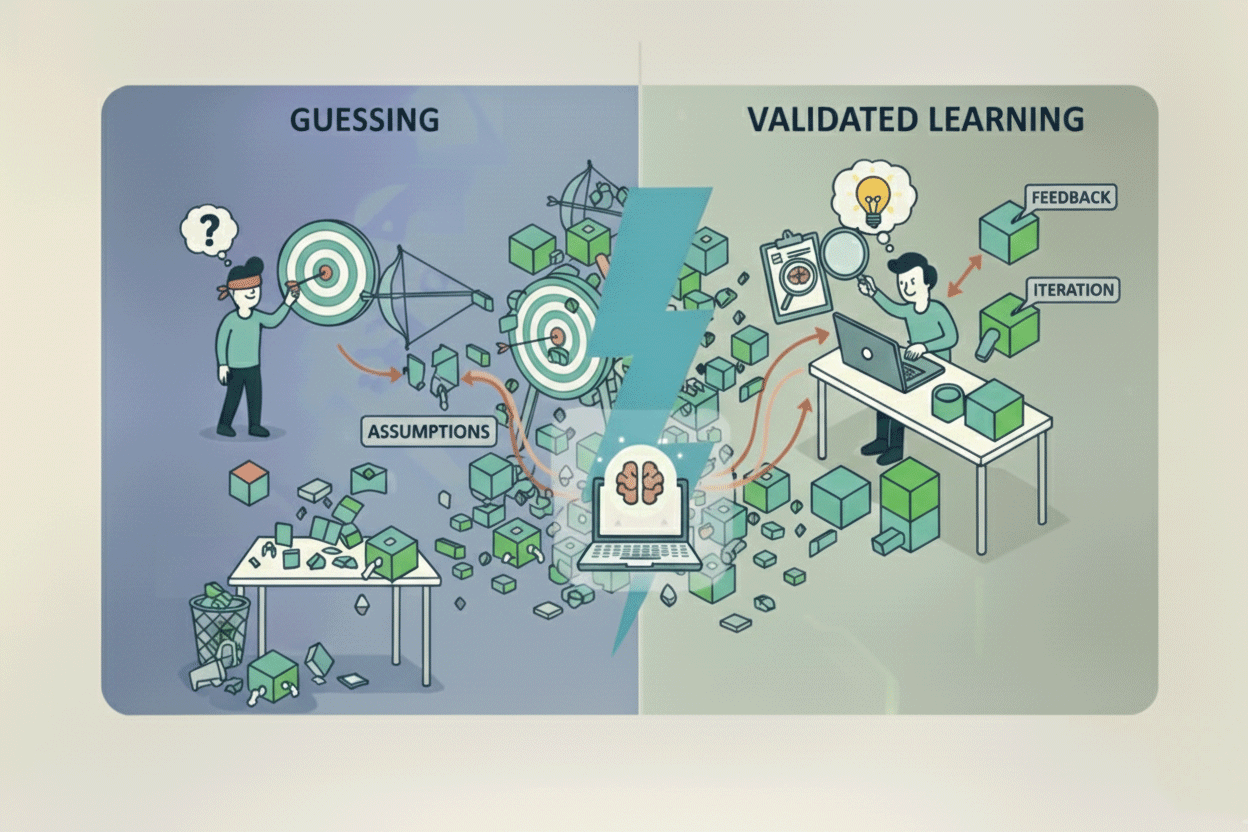
Imagine this: You spend three months coding a sophisticated AI-powered content generator. It summarizes meetings, writes blog posts, and even suggests SEO keywords using the latest RAG (Retrieval-Augmented Generation) techniques. You launch it to your network with a proud LinkedIn post... and wait. Crickets. No signups, no buzz, no stripe notifications.
Dejected, you finally hop on a call with five potential customers. You realize within minutes that they don't actually have a "meeting summary" problem. Their real pain? They are drowning in lead qualification and don't have time to even attend the meetings your tool summarizes.
But here is the good news: You can avoid this trap. In this post—the first in our Lean AI Systems series—I’ll walk you through the Lean Canvas, a strategic one-pager designed for solopreneurs. We are going to use it to validate your AI idea in just 7 days by using a "Strategic Filter" approach to eliminate guesswork and ensure you are building something people will actually pay for.
Why Lean Startup + AI Is Your Secret Weapon
The core of the Lean Startup methodology is the Build–Measure–Learn loop. For AI builders, this is a superpower that most people misuse. Because AI allows you to prototype a "thin slice" of a system in hours using orchestration tools like LangChain, n8n, or Gumloop, the "Build" phase has become dangerously easy.
The "Lean AI" twist is to frame AI as a customer effort reducer, not the star of the show. Your customers do not care about your vector database, your embedding model, or your 128k context window. They care about two things: saving time or making money.
The Lean Canvas: Your 7-Day Validation Blueprint
The Lean Canvas is a living document that summarizes your business model into nine key blocks. For a solopreneur, it replaces the 40-page business plan that no one reads. Let’s break down how to fill this out with an AI-native mindset.
1. Problem & Customer Segments (Days 1–2)
You cannot solve "productivity." You must solve a specific person's specific nightmare. Start narrow. Instead of "marketers," try "solo SaaS founders running LinkedIn ads who spend 10+ hours a week manually checking lead quality."
- Reddit Pipelines: Don't just browse Reddit; automate it. Use Gumloop to scrape subreddits like r/SaaS or r/Entrepreneur. Look for phrases like "How do I," "I hate it when," or "Is there a tool for."
- Bardeen.ai: Use this browser extension to scrape LinkedIn profiles of people who comment on competitor posts. What are they complaining about? What "workarounds" are they using? (Workarounds are the biggest indicator of a market opportunity).
2. The Unique Value Proposition (Day 3)
Your UVP shouldn't mention AI. It should mention the result.
- Bad: "An AI-powered lead scorer using GPT-4o."
- Good: "Qualify 100 leads in 5 minutes and stop wasting time on tire-kickers."
3. The AI Solution Hypothesis (The "Thin Slice")
Describe your solution in its most skeletal form. In the Lean AI framework, we use an AI-Driven Project Charter to rigidly limit your MVP to a maximum of three features. If it doesn't contribute to the primary "effort reduction" goal, it doesn't get built.
The Action Statement: Complete this sentence: "This product exists so that [User Persona] can [Measurable Outcome] instead of [The Current Painful Reality]."
4. Unfair Advantage
In the AI world, "having a better prompt" is not an unfair advantage. Prompts can be reverse-engineered in minutes. Your advantage is usually:
- Proprietary Data: Access to a specific dataset others don't have.
- Workflow Integration: Being the "glue" in a specific niche (e.g., the only tool that connects this CRM to that specific AI agent).
- Domain Expertise: You know the industry better than the Silicon Valley devs building "general" tools.
The 7-Day Action Plan: From Canvas to Signals
Validation isn't a philosophy; it’s a sprint. Here is your tactical calendar:
Your goal is to find "The Gap." Use your Reddit and LinkedIn scrapers to gather 50–100 data points. Look for the "Emotional Velocity" of the problem. If people are angry or losing money, you're on the right track.
Fill out your Lean Canvas. Use PivotBuddy at LeanPivot.ai to "poke holes" in your canvas. Ask the AI: "What is the most likely reason this business fails in 3 months?" The answer will point you to your "Riskiest Assumption."
Identify your "Leap of Faith" assumptions. For AI products, these are usually:
- Technical Feasibility: Can the AI actually do this accurately enough?
- Data Privacy: Will users actually give an AI access to their sensitive lead data?
- Willingness to Pay: Is the time saved worth at least $50/month?
This is the make-or-break step. You need to talk to 5–10 humans. Rule #1: Do not tell them your idea yet. If you tell them the idea, they will lie to be nice.
Instead, ask about their past:
Tell me about the last time you had to qualify leads manually.- "How long did it take?"
- "What tools did you try to use to speed it up?"
How much did those tools cost, and why did you stop using them?Log every quote verbatim in your Lean Vault. If 80% of people mention the same pain point, you have a "Green Light."
Pricing for the 2026 AI Economy
One of the biggest mistakes AI solopreneurs make is pricing like a traditional SaaS. In 2026, GPU and token costs are volatile. If you offer "Unlimited AI" for $19/month, one power user can turn your profit margin into a deficit overnight.
Pricing Model |
Best Use Case |
The "Lean" Benefit |
|---|---|---|
| Pure Usage | Developer Tools / APIs | You never lose money on a transaction. Revenue scales with costs. |
| Hybrid (Base + Usage) | B2B / Business Apps | Provides predictable monthly revenue (MRR) while protecting you from "heavy" AI users. |
| Outcome-Based | Agentic / "Done-for-you" | The "Holy Grail." Don't charge for the software; charge for the result (e.g., $5 per qualified lead). |
Day 8: The "Pivot or Persevere" Decision
By Day 8, you must be unsentimental. You are not a developer right now; you are a scientist. You have three choices:
The data is clear. People have the pain, they’ve tried workarounds, and they’ve agreed to a pilot price. Move to Module 2 and start building your modular AI stack.
During your interviews, you realized that your "all-in-one" tool was too much, but everyone was obsessed with one tiny feature.
- Example: You wanted to build an AI Agency Manager, but everyone just wanted the AI Invoice matching feature. Pivot: Kill the manager, build the Invoice tool.
The problem exists, but the people you talked to don't have the budget.
- Example: Solo founders love your tool but can't pay more than $10. Pivot: Take the same tech to Mid-Market Sales Teams who have a budget of $500/month for the same problem.
A tweak is not a pivot. A pivot is a change in strategy. If the fundamental problem doesn't exist, no amount of "vibe coding" will save the product.
Your Next Move: The LeanQuest
Don't let this be another blog post you read and forget.
- Download the Lean Canvas template.
- Go to LeanPivot.ai and engage PivotBuddy.
- Start your first "LeanQuest": Ask the AI to help you identify three hyper-specific customer segments for your current idea.
Validation is the difference between a "Project" and a "Product." Projects are fun hobbies; Products generate revenue. Which one are you building?
Tomorrow, in Module 2, we’ll move from Strategy to Systems. I'll show you how to build a modular AI stack using LangChain and n8n that allows you to swap out models and backends in minutes when you need to pivot.
See you in the next module.


No comments yet
Be the first to share your thoughts on this article!