

Here is the hard truth that every founder must face, especially those transitioning from a senior corporate role after a layoff: Your idea, in its current form, is probably wrong. It feels like a brilliant spark of genius in the vacuum of your home office. In that quiet space between turning in your laptop and receiving your final paycheck, it’s easy to convince yourself that you have found the "gap in the market" that everyone else missed. But until that idea collides with the reality of a paying customer, it is merely a high-stakes guess. For the professional-turned-solopreneur, the greatest risk isn't that you won't be able to build the product; it’s that you will spend six months and your entire severance package building something that nobody actually wants.
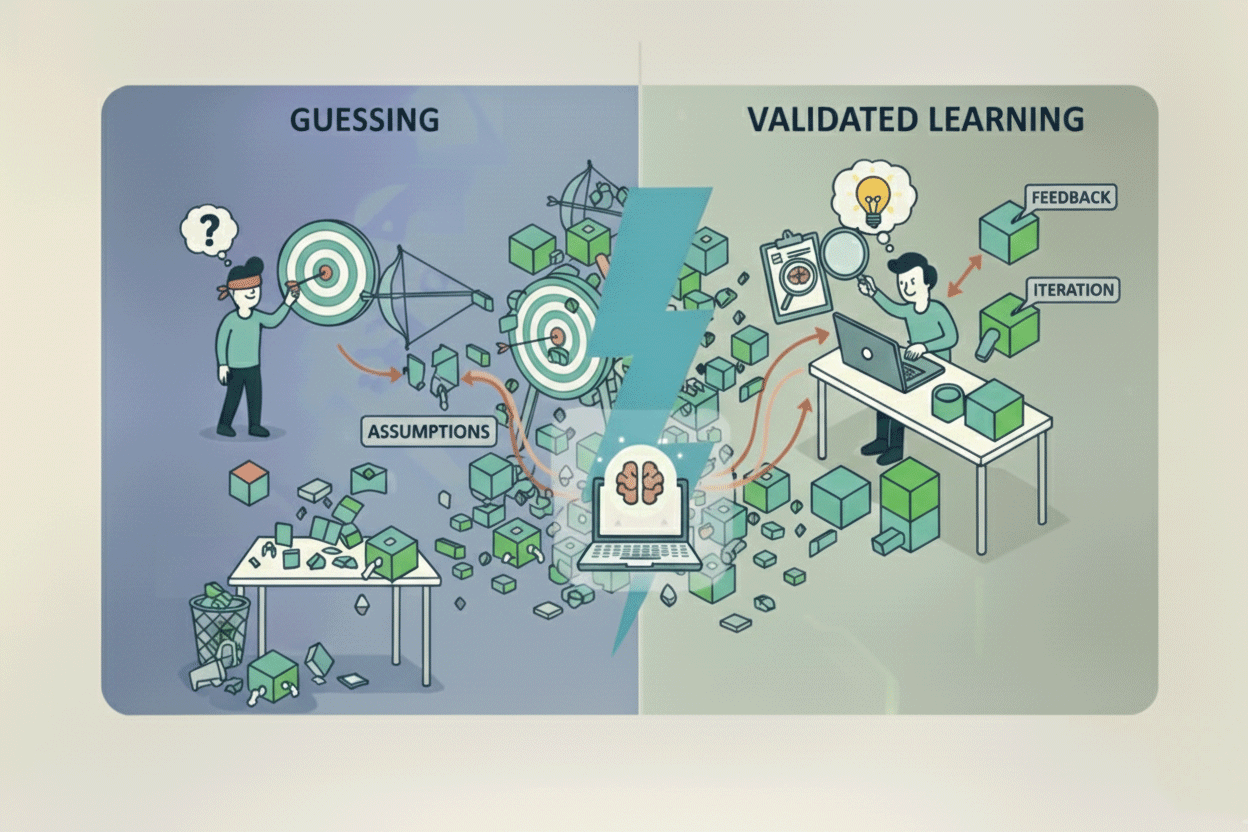
In the wake of a career disruption, the temptation to "build-to-prove" is overwhelming. You likely feel a subconscious need to validate your professional worth by creating a feature-rich, polished platform—a monument to the skills your former employer supposedly "lost." But in the world of lean startups, this is a dangerous path toward burnout and bankruptcy. This is why the MEASURE phase of the lean startup cycle is your most critical survival tool. It is the disciplined process of startup validation—moving beyond the intoxicating high of inspiration and into the world of data-driven decisions. For bootstrapped founders, measurement is the only way to protect your remaining runway and ensure your pivot is heading toward a real market opportunity rather than a dead end.
The Core Arguments for Startup Validation
Most startups fail because of a "Product/Market Mismatch." Founders often fall in love with their solution before they fully understand the problem. In the corporate world, you might have had the luxury of "vanity projects" or long-term R&D cycles funded by someone else's balance sheet. As a solopreneur, the MEASURE phase forces you to step outside of your own head and into the shoes of your users. This isn't just about collecting numbers; it’s about a fundamental shift in bootstrapping strategies—investing the absolute minimum to get the maximum amount of "validated learning."
For an expert-led business or a fractional consultancy, validation focuses on three core arguments that will define your success or failure. If you cannot prove these three things with data, you do not have a business; you have a hobby.
- The Problem exists and is "Painful": Is the problem you’re solving a "Vitamin" (a nice-to-have improvement) or a "Painkiller" (an urgent, must-have relief)? Measurement tells you the difference. A painkiller solves a problem that is currently costing the user time, money, or sleep.
- The Solution is "Viable": Will people actually use the specific workflow or service you’ve designed? Often, users agree a problem exists but find the proposed solution too complex, too expensive, or too disruptive to their current habits.
- The Market is "Willing to Pay": This is the hardest truth of all. Interest is free; commitment has a price tag. Validation requires finding the point where a user will exchange value (time, data, or money) for your solution. If people sign up for your free newsletter but refuse to pay $10 for the tool, you haven't validated a business—you've validated a content channel.
Deep Dive: Lean Startup Metrics for Early-Stage Growth
As a bootstrapped founder, you must distinguish between vanity metrics and actionable metrics. Vanity metrics, like total social media followers, LinkedIn likes, or general website hits, make you feel good but don't inform your next move. They give you a false sense of security while your runway evaporates. Actionable metrics, however, tell you exactly what is working and what needs to be scrapped.
1. Measuring Problem/Solution Fit (The Pre-Build Stage)
Before you build a single feature, you should be measuring the market’s hunger. Use these lean startup metrics to gauge initial startup validation:
- Landing Page Conversion Rate (LPCR): If 100 people visit your page describing your idea, and only 2 sign up for the waitlist, your messaging is failing. A healthy early conversion rate for a high-pain problem is typically 10% or higher. If it's below 5%, your problem isn't painful enough, or your audience is wrong.
- Engagement with Content: Are visitors reading your "Problem Deep-Dive" blog posts? Track "Time on Page." If they stay for 3+ minutes, they are looking for a solution. If they leave in 10 seconds, the headline was a clickbait hook that didn't deliver value.
- Survey Completion Depth: If people are willing to answer a 10-question survey about their struggles, the pain is real. If they drop off after the first question, the problem isn't significant enough for them to spend 60 seconds describing it.
2. Measuring Product/Market Fit (The Post-Launch Stage)
Once you have a functional MVP, your focus shifts toward retention. You are no longer measuring "interest"; you are measuring "attachment."
- The Sean Ellis Test: Ask your early users: "How would you feel if you could no longer use this product?" If 40% or more say "Very Disappointed," you have found Product/Market fit. If most say "Somewhat Disappointed" or "Not Disappointed," you are a Vitamin, and you will be the first subscription they cancel when their budget gets tight.
- Activation Rate: What percentage of people who sign up actually complete the "aha! moment" (e.g., sending their first invoice, creating their first report)? If they sign up but never use it, your onboarding is a barrier.
- Churn Rate: For subscription models, this is the ultimate indicator of a "leaky bucket." If you lose 20% of your users every month, you are spending your effort on acquisition rather than value. Churn is often a symptom of building features for yourself rather than the user.
- Customer Acquisition Cost (CAC) vs. Lifetime Value (LTV): Even in the early stages, you must measure how much it costs (in ads or time) to get a user compared to the revenue they bring. If your CAC is higher than your LTV, your bootstrapping strategy is unsustainable and requires an immediate pivot.
Actionable Advice: Implementing a Data-Driven Feedback Loop
You don't need a team of analysts or a $5,000 subscription to an analytics suite to make data-driven decisions. You need a structured experiment. Follow this 5-step path to validate your next move with surgical precision:
Bootstrapping Strategies for High-Impact Measurement
Effective measurement doesn't require expensive tools; it requires a bootstrapping mindset that prioritizes truth over comfort. Here is how to gather deep insights on a shoestring budget while protecting your emotional health:
- The "Concierge" Validation: Before writing a single line of backend code, perform the service manually for a few clients. If you're building a reporting tool, generate the reports by hand in Excel. Measure how much time it takes you and how much the client values the result. If they won't pay for the manual service, they definitely won't pay for the software. This is the ultimate "low-cost" validation.
- User Interview Archetypes: Don't just talk to "anyone." Create three "Customer Archetypes" based on your industry experience and interview five people from each. Measure the consistency of their pain points. If 12 out of 15 people use the exact same words to describe their frustration, you have found your marketing copy and your validated market need.
- The "Magic Button" Test: Add a button to your dashboard for a feature you haven't built yet (e.g., "Export to PDF"). Track how many people click it. When they do, show a polite message saying, "We're currently perfecting this feature! Would you like to be a beta tester?" This measures real-world demand without any development overhead.
- The "Fake Door" Landing Page: Create a landing page that looks like a finished product. Have a "Pricing" section with a "Buy Now" button. When they click, tell them you're in private beta and invite them to the waitlist. This measures "Willingness to Pay" much more accurately than a survey ever will.
The Importance of "Cohort Analysis" for Solopreneurs
As you move through the MEASURE phase, you will notice that your early users behave differently than later ones. This is where cohort analysis becomes vital. By grouping users by the month they joined, you can see if your improvements to the product are actually working. If the "January Cohort" stayed for one month but the "March Cohort" is staying for three, you have proof that your iterations are adding real value. For a founder coming out of a layoff, this upward trend is the most powerful psychological fuel available.
Without cohort data, you might see your total user count rising and think you're successful, while in reality, you're losing old users as fast as you're gaining new ones. This "treadmill effect" is a silent killer of lean startups. Data-driven decisions allow you to stop the leak before you run out of water.
Conclusion: The Emotional Reward of Data
A layoff can leave you feeling like your professional judgment is being questioned. It creates a sense of "un-belonging" that can lead to making desperate, ego-driven business choices. The MEASURE phase is how you reclaim your confidence. When you make data-driven decisions, you are no longer relying on luck, the whims of a corporate supervisor, or the approval of an HR department. You are relying on the market's objective truth.
The "Hard Truth" about startup ideas is that they are cheap and abundant. It is the validation of those ideas—through lean startup metrics and disciplined bootstrapping strategies—that creates real, enduring value. Embrace the numbers, listen to the silence of a low conversion rate, and celebrate the small, authentic signals of user interest. You are no longer just an "idea person" or a "displaced worker"; you are a founder building a business on the bedrock of reality. Every failed experiment is a gift that saves you from a failed company.
"If you cannot measure it, you cannot improve it. But in a lean startup, if you do not measure it, you cannot survive it. Let the data be the light that guides your pivot."
The journey from layoff to launch is paved with data points. Don't be afraid to look at them. They aren't judging your past; they are informing your future.



No comments yet
Be the first to share your thoughts on this article!