

You’ve made the leap. The steady paycheck is gone, replaced by the exhilarating, often terrifying, freedom of building something from scratch. For solopreneurs and early-stage founders, especially those bootstrapping, the biggest challenge isn't always coming up with an idea—it’s proving that idea has legs before running out of runway. How do you know if you're on the right track before you pour all your limited time, energy, and capital into a concept that might ultimately fall flat? This is where the “Measure” phase of the Lean Startup cycle becomes your most reliable companion. It is about converting vague gut feelings into concrete evidence, transforming your domain expertise and passion into actionable data that tells you exactly where to steer your business next.
Think of it this way: your expertise inventory—everything you know, the skills you possess, and the insights you’ve gathered over your career—is your foundation. But to build a sustainable business, you must constantly verify the structural integrity of your venture as it goes up. Measurement isn't an elite luxury reserved for multinational enterprises with massive analytics budgets and dedicated data science departments. It is the fundamental, day-to-day engine that validates or invalidates your assumptions as a bootstrapped founder. Without it, you are flying blind in an incredibly unforgiving sky.
The Psychology of the Bootstrapped Founder: Why We Resist Data
Before diving into the mechanics of tracking, it is vital to address a common psychological barrier: why so many solopreneurs resist measurement. When you build something yourself, the product or service becomes an extension of your identity. Getting objective data on its performance can feel like a direct evaluation of your personal worth. If the data shows that users are abandoning your signup flow or that nobody is clicking your primary call-to-action, it hurts.
As a bootstrapper, this emotional hurdle is compounded by the "Build It and They Will Come" fallacy. It is incredibly tempting to hide in your IDE, your writing software, or your design tool, convincing yourself that you just need to add *one more feature* or write *one more post* before your audience magically discovers you. This is a form of productive procrastination. Shifting your mindset from "builder" to "scientific validator" means accepting that a "no" from the market is not a personal failure—it is simply data pointing you toward a viable pivot. The faster you collect that data, the less runway you waste.
The Metrics That Matter (Before You Even Think About Scaling)
When you're starting out, the sheer volume of potential metrics can easily lead to analysis paralysis. You do not need a complex dashboard tracking a hundred different parameters. You need a handful of high-signal metrics that reveal whether your core assumptions about your customers and your solution are true. For a bootstrapped solopreneur, focus almost entirely on metrics that directly demonstrate customer engagement and high-intent behaviors.
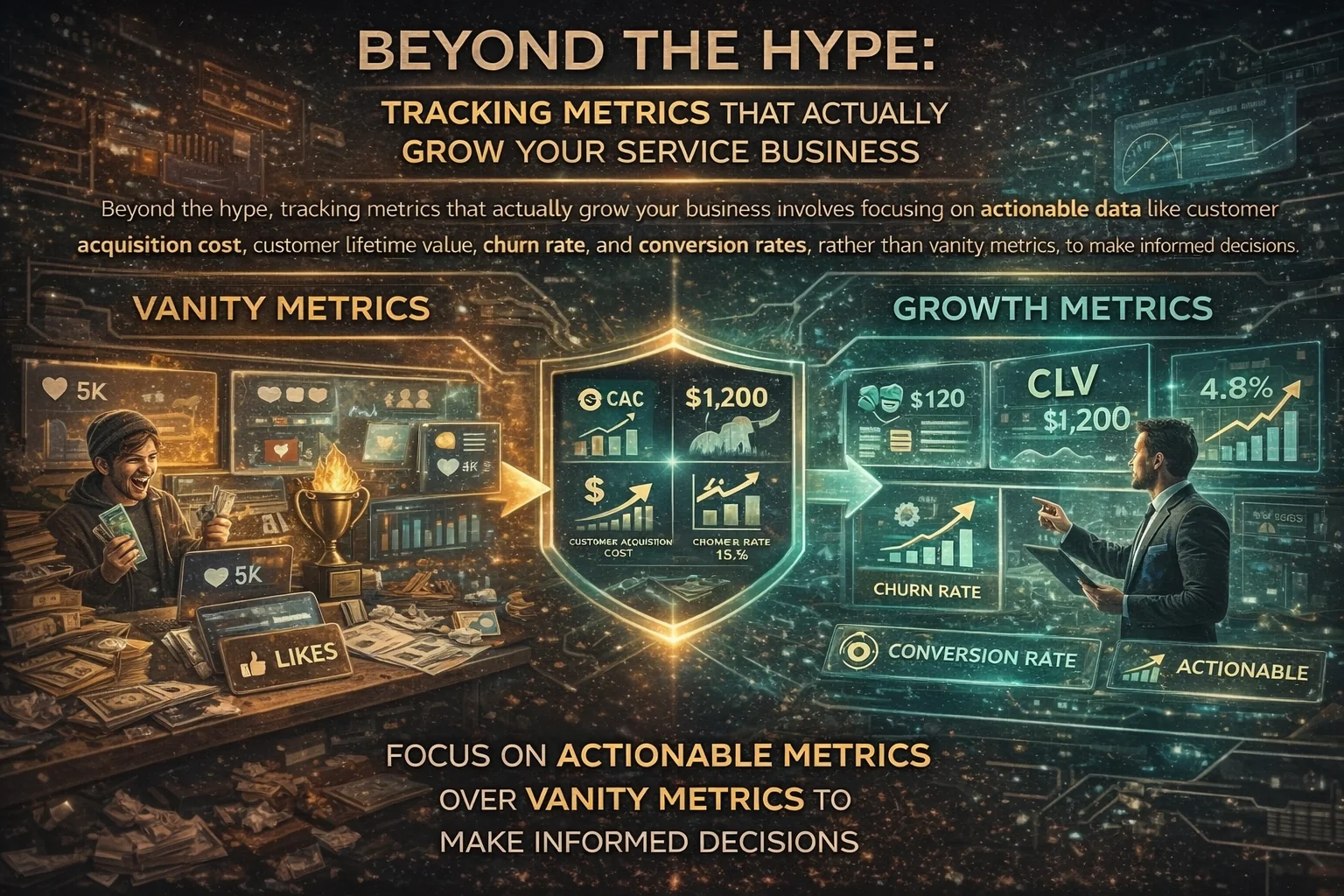
- Customer Acquisition Cost (CAC) – Your Bootstrapped Edition: In traditional VC-backed startups, CAC is calculated by dividing total marketing spend by the number of acquired customers. But when you are bootstrapping, your primary currency isn’t venture capital—it’s your own time (sweat equity).
To calculate your true bootstrapped CAC, you must assign an opportunity cost to your hours. If you value your time at $50/hour, and you spend 10 hours writing a detailed guest blog post that eventually yields 2 paying clients, your acquisition effort cost you $500 in time. Your bootstrapped CAC is $250. If your product only costs $20, this acquisition model is fundamentally unsustainable. Tracking the precise correlation between your time investments, tool costs, and customer generation prevents you from endlessly executing low-ROI marketing tasks.
- Conversion Rate (The Micro vs. Macro View): This is the ultimate health indicator for your digital storefront. Instead of looking at a single conversion rate, break it down into two distinct phases:
- Micro-conversions: Small actions that indicate strong interest but not immediate purchase (e.g., subscribing to your newsletter, reading a full case study, downloading a free calculator, or spending more than 2 minutes on your landing page).
- Macro-conversions: The ultimate goal of your funnel (e.g., submitting a paid consulting application, starting a trial, or completing a checkout).
A high micro-conversion rate paired with a terrible macro-conversion rate suggests that your content and value proposition are highly engaging, but your product structure, pricing model, or checkout friction is turning buyers away at the final hurdle.
- Customer Lifetime Value (CLV) – The Early-Stage Estimator: Predicting long-term CLV is notoriously difficult when your business is only months old. However, you can monitor early indicators of lifetime value. Focus on retention intervals: Are newsletter subscribers remaining active after 30, 60, or 90 days? Are early clients renewing their contracts, or is your business suffering from "leaky bucket" syndrome, where you constantly have to find new customers just to stay afloat? A sustainable bootstrapped business model relies heavily on repeat business, low churn, and organic word-of-mouth referrals.
- High-Signal Engagement Metrics: This goes beyond basic page views. You must define what "active and engaged" looks like for your specific business. If you run an agency, it could be the percentage of clients who respond to onboarding steps within 24 hours. For a software-as-a-service (SaaS) tool, it might be the percentage of users who log in at least three times a week. For an info-product, it could be the course completion rate. Identify the specific behavior that proves your customer is deriving real value from your offering, and measure how many of them reach that point.
Actionable Tip: Define Your "Aha!" Moment
Before setting up any tracking scripts, clearly write down what success looks like for your very first users. What is the exact "Aha!" moment where they experience the core value of your product? For example, for a project management tool, the "Aha!" moment isn't completing sign-up—it's when a user successfully creates their first project and invites a team member. Your early tracking should be hyper-focused on measuring how quickly and frequently new users reach this specific milestone.
The Vanity Metrics Trap: What to Actively Ignore
As a solopreneur working in isolation, it is incredibly easy to fall prey to vanity metrics. These are data points that make you feel good, look impressive on social media, but have absolutely zero correlation to your business's financial viability. Examples include:
- Raw Page Views: A blog post that goes viral on a social aggregator might bring in 20,000 visitors in a afternoon. But if those visitors have a bounce rate of 99% and zero of them sign up for your newsletter or buy your product, that traffic is meaningless noise that can actually distort your conversion analytics.
- Social Media Followers & Likes: Having thousands of followers on X, LinkedIn, or Instagram is useless if they do not interact with your commercial offers. A founder with 300 highly engaged email subscribers who trust their expertise will almost always out-monetize a founder with 10,000 passive social media followers.
- Cumulative Signups: Never track "total registered accounts" as your primary metric of growth. If 90% of those accounts are dormant and have never logged back in after day one, your active user base is flatlining despite a growing cumulative chart.
Building Your Measurement Framework: Simple, Not Complicated
You don't need a formal education in data analytics or statistics to build a highly effective measurement framework. In fact, a simple, logical structure is far easier to maintain and act upon than a complicated business intelligence dashboard.
Start by breaking down your business model into basic hypotheses, and assign targeted metrics to validate each one. Below is a blueprint showing how to translate basic business assumptions into actionable Key Performance Indicators (KPIs):
- Step 1: Your Core Assumption Hypothesis: Every business venture is built on a series of nested assumptions. Identify the primary assumption that needs validation right now.
Example: "Independent course creators need an automated email formatting tool, and they are willing to pay $19/month for it."
- Step 2: Assigning Core KPIs: Based on that assumption, identify the minimum metrics required to prove or disprove it. Avoid the temptation to measure everything. Stick to 1 or 2 metrics per hypothesis.
- Assumption: "Course creators need an automated email formatting tool."
- Primary KPI: The percentage of landing page visitors who click "Try for Free" (Interest/Desire).
- Secondary KPI: The percentage of trial users who paste their first draft and run the formatter within 48 hours of registering (Onboarding success).
- Assumption: "They are willing to pay $19/month."
- Primary KPI: The conversion rate from free trial accounts to active, paid subscriptions at the end of the trial period (Monetization viability).
- Secondary KPI: The average churn rate of paying users in month two and three (Customer retention).
- Assumption: "Course creators need an automated email formatting tool."
- Step 3: The "One Metric That Matters" (OMTM) Mindset: While you have several sub-metrics, you must establish a single, overarching North Star metric that defines your current stage of business. Your OMTM changes as your venture matures:
- Empathy/Validation Stage: Your OMTM is the number of qualitative customer development interviews completed per week.
- Sticky Stage: Your OMTM is user retention (e.g., percentage of users returning to your tool week-over-week).
- Virality/Growth Stage: Your OMTM is the customer referral rate or organic word-of-mouth signups.
- Revenue Stage: Your OMTM is Monthly Recurring Revenue (MRR) or profit margins.
By forcing yourself to focus on just one primary metric at a time, you align your daily activities and prevent precious time from being scattered across competing priorities.
Analytics Setup and Data Collection: Low-Cost, High-Impact Tools
Setting up your measurement infrastructure does not require writing complex data pipeline scripts or paying hundreds of dollars a month for enterprise tools. In fact, you can run a highly detailed validation operation using completely free or extremely low-cost tools.
1. Website Analytics: The Foundation
You must understand how people are arriving at your site and what they do when they get there. You have two main routes here:
- Google Analytics (GA4): The industry standard. It is completely free and exceptionally powerful, though it has a steeper learning curve than previous versions. Focus on setting up custom **Events** rather than just tracking page views. Create events for clicking outbound social links, downloading PDFs, or initiating checkouts.
- Privacy-First, Simple Alternatives: If Google Analytics feels overwhelming or you want to respect user privacy without complex cookie banners, tools like Plausible or Fathom (which cost a few dollars a month) provide incredibly clean, single-page dashboards showing exactly where your traffic comes from and which pages convert, without any administrative overhead.
2. Customer Interaction Tracking: The Power of Spreadsheets
For early-stage bootstrapped founders, a meticulously maintained spreadsheet is often more powerful than a complex enterprise CRM. Create a simple pipeline sheet to track leads and early conversions. Here is a structure you can build in Google Sheets or Airtable:
| Contact Name | Lead Source | Current Status | Key Pain Point Identified | Interaction Date | Conversion Event |
|---|---|---|---|---|---|
| Jane Doe | LinkedIn Outreach | Active Client | Formatting emails takes her 2 hours/week | 2026-06-15 | Purchased Annual Plan |
| John Smith | Organic Search | In Trial | Wants to easily schedule newsletters | 2026-06-28 | Registered Free Trial |
This layout forces you to document the specific qualitative problems your early users face. This is data in its most valuable form, showing you the exact words they use to describe their frustrations so you can integrate them directly into your copywriting.
3. Qualitative Feedback Systems
Quantitative data tells you *what* is happening, but qualitative data tells you *why*. Do not rely on web traffic numbers alone. Set up direct feedback collection points:
- The Sean Ellis Product/Market Fit Survey: This is a simple, single-question survey sent to users who have experienced your product at least once. Ask them:
"How would you feel if you could no longer use this product?"
Provide three options: a) Very disappointed, b) Somewhat disappointed, or c) Not disappointed. If 40% or more of your respondents select "Very disappointed," you have achieved a strong signal of product/market fit and are ready to start investing in customer acquisition channels.
- Frictionless Feedback Forms: Embed a simple, single-field feedback box at the bottom of your product or client portal asking, "What is one thing we could improve?" Tools like Google Forms or Tally (which has an incredibly generous free tier) make this seamless.
4. Behavioral Heatmaps and Session Replays
Tools like Microsoft Clarity (completely free) or Hotjar are absolute game-changers for identifying hidden UX bugs. By watching anonymized recordings of actual users navigating your site, you can instantly see where they get confused, where they experience "rage clicks" (repeatedly clicking an unclickable element), or where they stop reading your sales page and bounce. This qualitative visibility takes the guesswork entirely out of your landing page optimization.
Practical Tip: Start with What You Can See
Do not spend days configuring custom telemetry pipelines, tracking APIs, or complex event networks before you have your first 100 visitors. Focus entirely on setting up basic, clean page tracking, a simple goal completion event for your signup page, and a behavioral recording tool. You can scale the complexity of your analytics setup as your active user base expands.
Data-Driven Decisions: The Bootstrapper's Edge
Collecting beautiful charts is useless if you do not use them to drive business decisions. The true power of a lean, bootstrapped operational model is your speed of execution. Unlike corporate executives who must navigate layers of bureaucracy to make a simple change, you can look at your data on a Friday afternoon and implement a major pivot by Monday morning. This is your ultimate competitive advantage.
Understanding the Law of Small Numbers
One major trap bootstrapped founders fall into is trying to apply corporate statistical standards to early-stage data. If you have 50 visitors to your website, and you run an A/B test on your landing page headline where Version A gets 2 conversions and Version B gets 4 conversions, that is not a statistically significant result. Do not spend weeks waiting for a classic A/B test to reach a 95% confidence interval when your traffic is low.
Instead, focus on **radical iterations** rather than micro-optimizations. If your conversion rate is low, do not waste time testing a red button versus a green button. Test a completely different value proposition, a dramatic price change, or an entirely different target audience. When you change something major, the difference in user response will be obvious even within a small sample size.
Knowing When to Pivot vs. Persevere
Your metrics are your ultimate compass for making the hardest decision in entrepreneurship: whether to double down on your current path, adjust your strategy (pivot), or close the chapter and move on to a different concept. Let the data guide you through this matrix:
- Scenario A: High traffic, low micro-conversions.
The Diagnosis: Your marketing or search positioning is successfully getting attention, but your landing page is failing to build trust or communicate your value proposition clearly.
The Action: Redesign your header, clarify your messaging, and simplify your primary call-to-action.
- Scenario B: High micro-conversions, low macro-conversions.
The Diagnosis: People are highly interested in the problem you solve, but they do not trust your specific solution, find your onboarding process too complicated, or believe your price is too high.
The Action: Introduce a free tier or interactive sandbox, offer a money-back guarantee, or run a limited discount promotion to test price sensitivity.
- Scenario C: High signups, but zero engagement and extremely high churn.
The Diagnosis: Your marketing is excellent at making promises, but your actual product or service fails to deliver on those promises. You are suffering from a lack of product-market alignment.
The Action: Stop marketing immediately. Reach out directly to churned users for interviews, identify where the product fell short, and rebuild the core value loop before acquiring more traffic.
Conclusion: The Data-Driven Compass
Your journey as a bootstrapped solopreneur is a thrilling, unpredictable ride. But relying solely on intuition, gut feelings, and hope is a recipe for burnout and empty bank accounts. By implementing a lightweight, disciplined measurement framework from day one, you arm yourself with the clarity required to navigate early uncertainty.
Remember, data is not a bureaucratic hurdle designed to slow you down. It is your compass. It tells you when you are heading toward a cliff and when you are on the path to true growth. By letting evidence dictate your priorities, you ensure that every hour of sweat equity you invest is building toward a sustainable, profitable venture that truly serves your customers and stands the test of time.




No comments yet
Be the first to share your thoughts on this article!