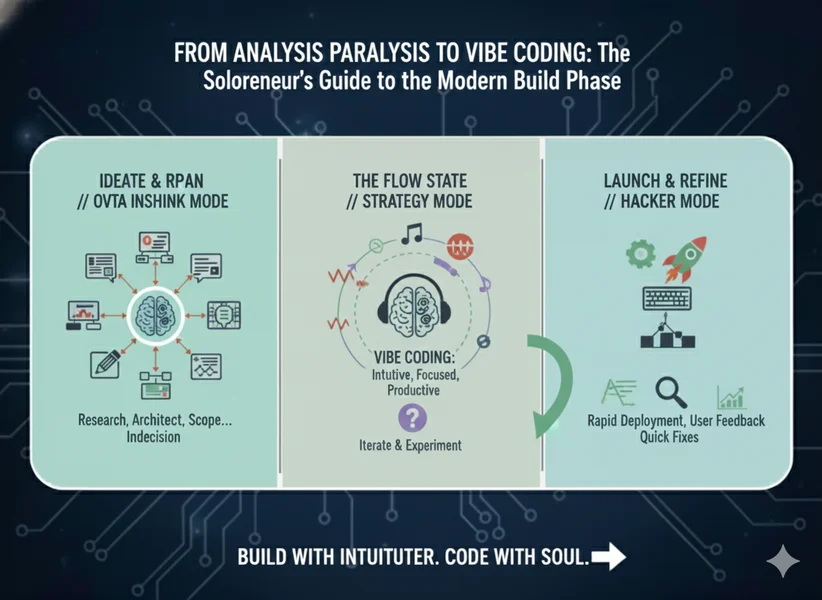
For decades, the path from "idea" to "product" was gated by a massive technical bottleneck. Solopreneurs often spent months—or even years—stuck in a state of "analysis paralysis," over-planning architectures and agonizing over tech stacks before writing a single line of code. In the high-stakes world of early-stage startups, this delay is often fatal. The most common way to fail is "building a cathedral"—the act of over-building an intricate, heavy solution before validating that anyone actually wants it.
However, a tectonic shift occurred in early 2025. Coined by computer scientist Andrej Karpathy, the term "Vibe Coding" describes a new paradigm where developers act as orchestrators of intent rather than manual writers of syntax. This approach, when paired with the rigor of the Lean Startup methodology, allows a single founder to sketch a Product Requirements Document (PRD) in the morning and push a verified release by dinner.
The Philosophy of Vibe Coding
Vibe coding is not simply "AI-assisted programming." It is a fundamental shift in how software is conceived and executed. In traditional development, the human is responsible for the "how"—the loops, the logic, and the memory management. In vibe coding, the human provides the "vibes"—the high-level judgment, preferences, and intuition—while Large Language Models (LLMs) handle the technical execution.
Giving In to the Vibes
As Karpathy famously noted, vibe coding involves fully giving in to the vibes, embracing exponentials, and forgetting that the code even exists. For the solopreneur, this means:
- Software for One: Creating hyper-personalized tools that address specific, immediate needs without the overhead of enterprise-scale maintenance.
- Intent-Driven Development: Describing the desired outcome in plain language (e.g., "Add a login page that supports Google OAuth and redirects to a user dashboard") and letting the AI generate the implementation.
- Iterative Prompting: Recognizing that the first result may not be perfect and using further natural language instructions to refine the application.
However, "giving in to the vibes" is not an excuse for sloppiness. Critics argue that naive vibe coding—accepting AI suggestions without review—can lead to security vulnerabilities and a total loss of understanding of the codebase. To succeed, the solopreneur must transition from a "coder" to an "orchestrator," cultivating the craft of writing crisp, precise specifications.
The 5-Step Vibe Coding Workflow
To move from paralysis to production, the LeanPivot framework mandates a structured 5-step workflow. This process ensures that the speed of vibe coding is grounded in the reality of a valid product requirement.
The Tech Stack Showdown – Supabase vs. Convex
A central decision in the modern "Build Phase" is the choice of a Backend-as-a-Service (BaaS). For the solopreneur, the debate typically centers on two powerhouses: Supabase and Convex.
Supabase: The Relational Standard
Supabase is the "open-source alternative to Firebase," built on top of PostgreSQL. It is the ideal choice for founders who value:
- Standardization: Using industry-standard SQL and Row Level Security (RLS) ensures that the project remains portable and avoids vendor lock-in.
- Complex Relations: Because it is built on Postgres, it handles deep, structured data and complex analytics queries more efficiently than document-based systems.
- Extensibility: Supabase offers Edge Functions for low-latency global code and a massive ecosystem of existing Postgres tools.
Convex: The Reactive Innovator
Convex represents a newer paradigm: the "reactive database." It is a transactional document store where every query is a subscription by default. Convex is the "vibe coder’s" dream for several reasons:
- Automatic Sync: When data changes in the backend, the client-side UI updates automatically via WebSockets. No manual sync logic or state management libraries like Redux are required.
- End-to-End Type Safety: Convex offers native TypeScript integration, meaning the backend logic and frontend queries share the same types without a separate code-generation step.
- Developer Experience (DX): By handling scaling, caching, and validation automatically, Convex allows the developer to focus purely on business logic rather than database tuning.
Feature | Supabase | Convex |
|---|---|---|
Core Tech | PostgreSQL | Reactive Document Store |
Real-time | Opt-in via Subscriptions | Native/Automatic |
Type Safety | Generated via CLI | Native End-to-End |
Lock-in | Low (Open Source) | Medium (Managed Platform) |
Speed-to-Market Infrastructure
A successful Build Phase is not just about the database. It is about the "Glue" that holds the product together. The LeanPivot framework emphasizes tools that provide "production-grade" features in minutes.
Auth in 10 Minutes: Clerk
Authentication is traditionally one of the most error-prone parts of a build. Between maintaining session state, protecting API routes, and handling JWTs, it can swallow weeks of development. Clerk has become the gold standard for vibe coding because it deeply integrates into frameworks like Next.js, handling both server and client contexts automatically. By wrapping an app in a <ClerkProvider> and adding a simple middleware.ts file, a founder can enable social logins (Google, GitHub), multi-factor authentication, and organization management in under 10 minutes.
Visual UI to Clean Code: FlutterFlow
For mobile-first solopreneurs, FlutterFlow allows for visual construction of UIs while maintaining a professional design system. Crucially, FlutterFlow allows users to export clean, human-readable Dart code, avoiding the "black box" problem of traditional no-code tools. This allows a founder to build the "Vibe" visually but maintain the ability to customize or host the code on any server later.
Avoiding the "Pivot Killer"
While vibe coding emphasizes speed, the framework warns that "technical debt is the ultimate Pivot Killer." When code is generated quickly with minimal review, it can become fragile. If the code is not updated or maintained properly, it becomes "outdated" and difficult to understand, making future updates a nightmare.
Technical debt is the ultimate Pivot Killer.
The Discipline of VibeOps
To combat this, the framework advocates for VibeOps—the intersection of vibe coding and operational discipline. This includes:
- Transparent Changelogs: Maintaining a clear record of changes so the AI (and the human) can track the project's evolution.
- Automated Status Pages: Using tools like Better Stack to provide second-by-second timelines of application health, ensuring that "speed to market" doesn't mean "constant downtime."
- Small, Verified Changes: Instead of asking an AI to build a 1,000-line program in one prompt, the orchestrator asks for one function at a time, verifying it with tests before proceeding.
Conclusion: The Solo Unicorn Era
The Build Phase of 2026 is no longer about who can type the fastest or who knows the most obscure framework syntax. It is about who can best translate business problems into rigorous specifications and verify the results with data.
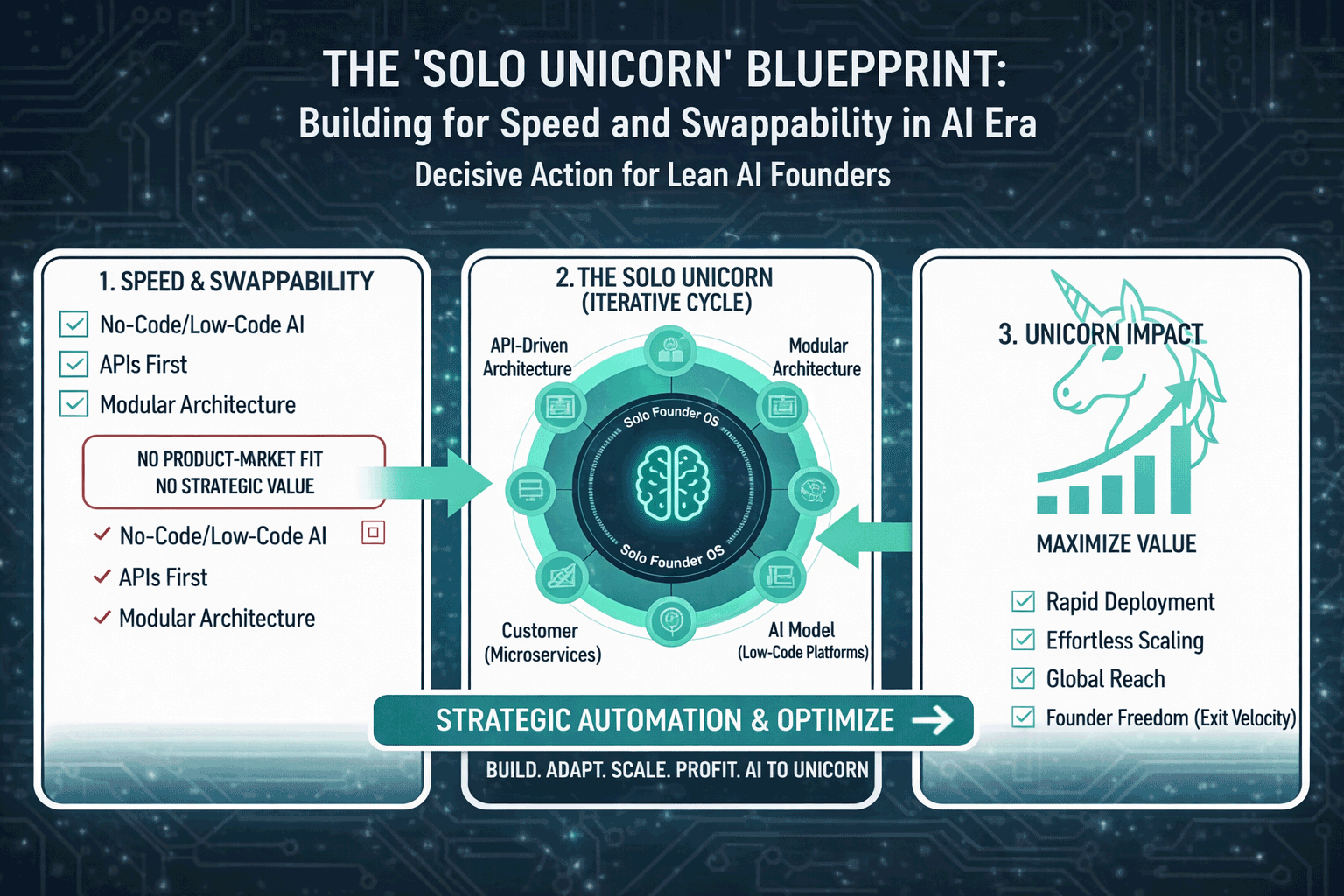
By mastering the "Solo Unicorn Stack"—Next.js for performance, Clerk for security, and Supabase or Convex for data—the solopreneur can finally break the cycle of analysis paralysis. The goal of the Build Phase is not to build a finished product; it is to build a Minimum Viable Business ($0 stack: Notion, Super.so, Gumroad) in 48 hours to start collecting the real data that leads to growth. In the era of vibe coding, the only thing stopping you from shipping is the clarity of your intent.

No comments yet
Be the first to share your thoughts on this article!