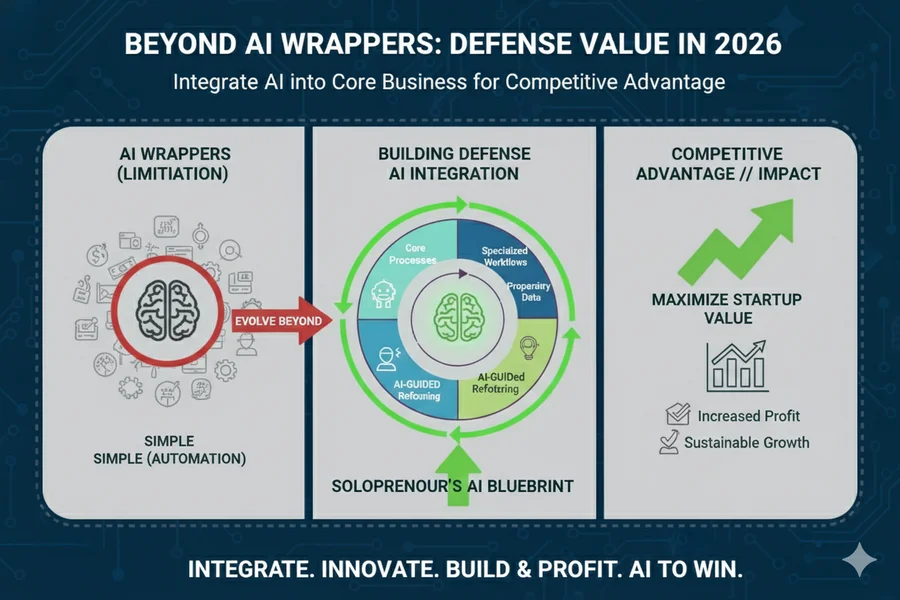
In late 2022 and throughout 2023, you could build a million-dollar business by wrapping OpenAI's GPT-3 API in a polished interface. These "wrappers"—PDF summarizers, LinkedIn post generators, generic AI copywriters—thrived by being first to market, bridging the gap between raw command lines and non-technical users. They were the low-hanging fruit of a technological revolution.
But in 2026, the wrapper will be a commodity. The landscape is littered with startups that learned too late that a CSS framework and a system prompt don't constitute a moat. When underlying models evolve, they don't just improve—they absorb the features of wrappers built on top of them. If your value proposition is "I make GPT-5 easier to use for real estate agents," you're one product update away from obsolescence. In the age of AI, this "Sherlocking" happens at light speed.
To survive as a solopreneur today, you must move beyond the wrapper. You must build something defensible, complex, and genuinely valuable. You must build an AI Superagent.
The Wrapper Trap: Why "Easy to Build" Means "Easy to Kill"
For solopreneurs, "easy to build" usually signals "easy to replicate." If you can launch your business in an afternoon using no-code tools, so can ten thousand others who watched the same YouTube tutorial.
Most AI startups focus exclusively on output: take a user's prompt, send it to an LLM, display the result. This linear, stateless transaction is fundamentally flawed for three reasons:
- Zero moat. Your competition isn't just other startups—it's the LLM providers themselves. When OpenAI launches Custom GPTs or Anthropic introduces Artifacts, thousands of wrappers become obsolete overnight. You're competing on marketing spend, not product value.
- Model fragility. Wrappers are vulnerable to model drift. When underlying models update for safety or efficiency, your carefully tuned prompts may break. Without controlling the workflow, you have no way to fix it beyond starting over.
- Low retention. Users quickly realize they're paying $20/month for a middleman they don't need. Once they grasp basic prompting, they go directly to ChatGPT, Claude, or Gemini for the same results at no cost.
The path forward isn't building these fragile layers—it's building agentic systems that don't just discuss work but execute it with precision no human-driven chat can match.
What Is an AI Superagent?
To understand Superagents, we must reframe our relationship with AI. A wrapper is a tool, like a hammer—it requires human direction, correction, and constant oversight. A Superagent is an employee, like a carpenter. You don't instruct a carpenter on hammer technique; you provide blueprints, and they determine the steps, gather materials, and build the house.
A wrapper is a tool; a Superagent is an employee.
Technically, an AI Superagent is an autonomous system operating in an agentic loop. Instead of one-way processing (Input → Output), Superagents follow a recursive cycle: Observe → Plan → Act → Evaluate → Repeat.
This system rests on four pillars that distinguish it from 2023's chatbots.
1. Autonomy and Self-Correction
Wrappers take prompts and return answers. If those answers are hallucinated or incorrect, users must catch and fix them. Agents, however, critique themselves. They use chain-of-thought reasoning to review their work, identify missed requirements, and iterate until completion.
This shifts systems from probabilistic (might be right) to deterministic (workflow ensures correctness). A Superagent might use one model to generate a draft and a second, more skeptical model to audit it against constraints. If the auditor rejects it, the agent revises—without users ever seeing the failure.
2. Tool Use: The Agent's Limbs
A brain without limbs can only think. Superagents access tools—APIs, databases, software interfaces. They browse the live web for current pricing, write and execute Python code for complex calculations, send emails via SendGrid, update Notion databases, or trigger Vercel deployments.
By connecting LLMs to the Software 2.0 stack, you transform writers into operators. Instead of "Here's a marketing plan," you get "I researched your competitors, drafted three ad variants, uploaded them to Meta Ads Manager, and set alerts to report ROI in 48 hours."
3. Long-Term Memory: Persistent Context
Wrappers are stateless—they forget everything when sessions end. Superagents use vector databases (employing Retrieval-Augmented Generation) to maintain persistent memory.
They remember clients' brand voices, past preferences, key stakeholders, and business constraints. They don't just know "how to write"—they know "how you write." This creates compound value: the more the system is used, the more specialized it becomes, building a data moat no generic LLM can replicate.
4. Planning and Recursive Decomposition
This is the agent's executive function. When given a high-level goal—"Organize a webinar for 500 people"—Superagents don't just draft invitations. They decompose goals into sub-tasks:
- Research trending topics in the target industry
- Cross-reference the founder's calendar for availability
- Create a landing page in Webflow
- Set up Zoom links and automated reminder sequences
- Draft and schedule social media promotion
Superagents manage task dependencies. If research fails to identify a trending topic, the agent adjusts its plan before proceeding.
The Economics of Superagency: The 10x Solopreneur
This is the ultimate path for lean solopreneurs because, for the first time in history, cognitive labor has near-zero marginal cost.
In traditional freelancing, revenue is tied to hours. Doubling revenue meant doubling staff or caffeine intake—both recipes for burnout.
In the world of Superagency, you're no longer selling time. You're selling results produced by a digital workforce that operates 24/7, never demands raises, and performs with perfect consistency.
Consider the evolution:
From Creator to Director: Your New Role
As an AI solopreneur, your role is transforming. You're no longer the one doing the work—you're the systems architect who designs logic, sets constraints, and orchestrates agents.
Success requires new skills:
- Instruction engineering. Beyond prompting—building multi-step chains where one output becomes structured input for the next.
- Orchestration. Knowing which models suit which tasks. Don't use $50/million token reasoning models for typo fixes; use fast, cheap models for grunt work and save heavy models like o1 for high-level planning.
- Edge case management. Identifying where AI might hallucinate and building human-in-the-loop checkpoints. Design systems where AI handles 95% of work and only alerts you to unresolvable ambiguities.
The 2026 Solopreneur Stack
Building Superagents requires more than chat interfaces. Our proven stack includes:
- The Brain (LLMs): A mix of OpenAI, Gemini, Anthropic, and Llama models. Remain model-agnostic.
- The Limbs (Automation): Tools like Make.com, N8N, or Zapier connect your AI to 6,000+ apps.
- The Memory (Vector DBs): Pinecone or structured Airtable databases store persistent data and brand guidelines.
- The Interface: Custom dashboards using Softr or Bubble let clients see work being done, not just chat history.
First Steps: Thinking in Agency
Stop looking for "AI ideas." Start identifying inefficient workflows.
Find tasks in your business requiring five or more manual steps. For example: "I read transcripts, summarize them, extract action items, email the team, and add items to Trello."
A wrapper summarizes the transcript.
A Superagent completes all five steps while you sleep.
Your prompt today: examine your to-do list. Which items are processes rather than single tasks? Which involves moving data between silos? Those processes are the foundation of your first AI business.
What's Next?
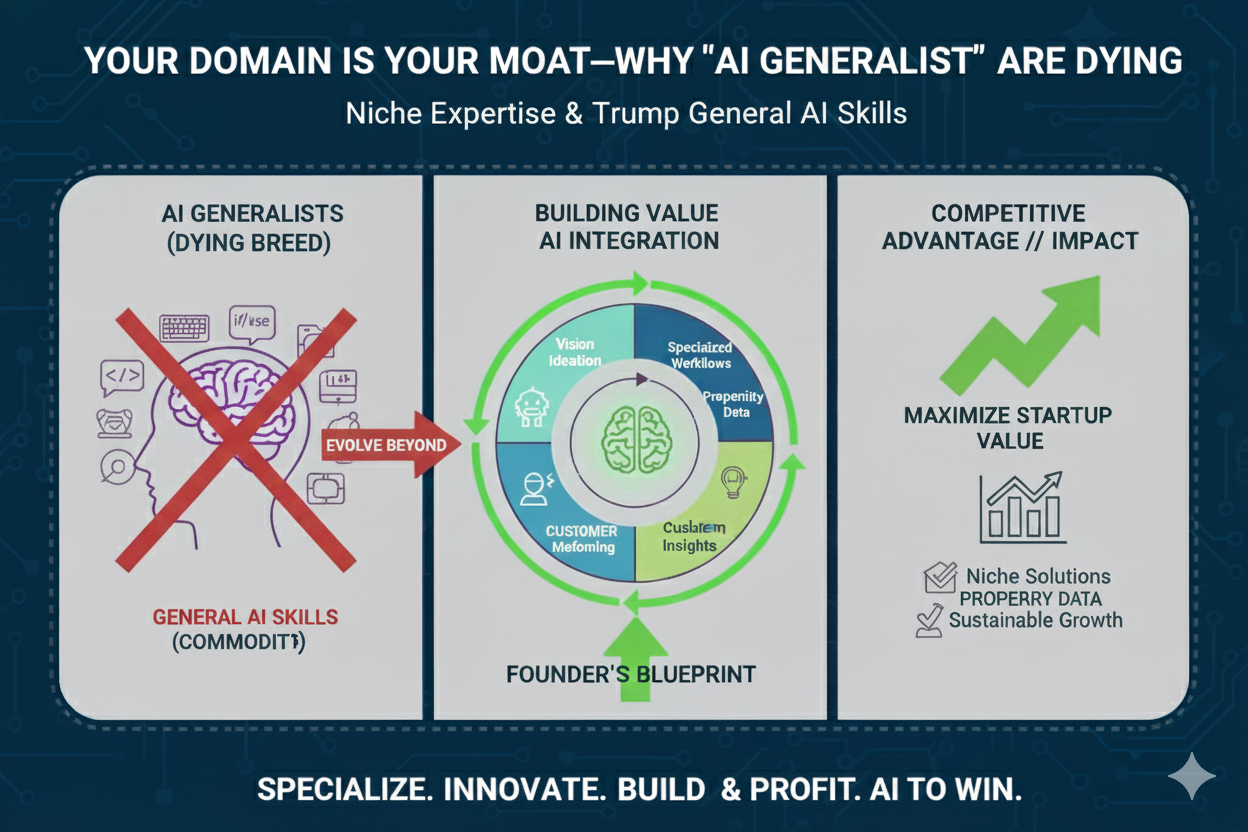
In our next post, Your Domain is Your Moat, we'll explore why being a "techie person" is actually a disadvantage in the AI age. We'll examine why your "boring" past career—expertise in insurance claims, contract law, specialty plumbing logistics, or healthcare compliance—is your most powerful secret weapon. That deep, nuanced knowledge lets you spot high-value, "invisible" AI opportunities that generalist Silicon Valley crowds will never conceptualize, let alone solve effectively.
Stop chasing hype. Start building systems that solve expensive, specific problems.

No comments yet
Be the first to share your thoughts on this article!