
In the first part of this series, we looked at the Build phase. This is the exciting, fast-paced part where tools like "Vibe Coding" let you turn an idea into a real product in just a few days. But in the world of startups in 2026, there is a new danger. Because it is so easy and cheap to build things, it is very easy to build the wrong thing. If you are driving at 100 miles per hour but you don't have a steering wheel, you aren't going to win the race. You are just going to crash faster.
In the Lean Startup method, speed only matters if you are learning. We call this Learning Velocity. To make sure you are actually making progress, you have to move away from old-school accounting and toward something called Innovation Accounting. This is a system built specifically for people who are dealing with a lot of "maybe" and "I think." This guide is your manual for building a Founder's Dashboard. Think of it as your GPS. it ensures that every hour you spend building is actually moving you toward a real business, not just a "vibe."
The Muda Filter: How a Dashboard Saves Your Life
Muda is a Japanese word that simply means "waste." For a solo founder in 2026, waste is the biggest enemy you have. Most people think "runway" means how much money you have in the bank. For a solopreneur, runway is actually how much Energy and Focus you have left. The Founder's Dashboard acts as a filter to catch four specific types of waste before they kill your startup:
- Strategic Muda (The Wrong Direction): This is when you try to sell a solution to a group of people who don't actually care about the problem. You are building a high-tech bridge to a deserted island. No matter how good the bridge is, no one will use it.
- Digital Muda (The Over-Builder): This happens when you spend weeks building complex features—like a fancy "Profile Settings" page or "Dark Mode" buttons—before you've even proven that people want to use your app a second time. You are building a castle before you know if anyone wants to live in the neighborhood.
- Prompt Muda (Argue-with-the-Robot): This is a new type of waste for 2026. It's when you spend three hours trying to get an AI agent to perfectly align a button or use a specific word in a feature that only 1% of your users will ever see. It is "polishing the chrome on a car that has no engine."
- Emotional Muda (The Dopamine Trap): This is the drain on your brain from checking your phone for "likes," retweets, and comments. If those people aren't clicking your "Buy" button, their likes are just noise. It is called "Success Theater," and it makes you feel like you're winning when you're actually standing still.
By building a dashboard early, you stop being a dreamer and start being an Auditable Founder. This means you can look at your business and know exactly why it is growing or why it is failing. In the fast-moving Vibe Era, data is the only thing that keeps your ego from driving your business off a cliff.
Pillar 1: The Vibe Economy – Putting a Number on Feelings
We’ve talked about how modern customers don't just buy a tool; they "hire" a product because of how it makes them feel or what it says about them. This is the Vibe Economy. A "vibe" isn't an excuse to be lazy with your thinking. It is a real business factor that you can measure. To build a brand that lasts, you have to find a way to turn "feelings" into "data points."
Let's look at how successful brands measure their "vibe" to predict their future success:
Example: Liquid Death (The Cool Water Company)
On paper, they sell water in a can. That's a boring commodity. In reality, they sell a "heavy-metal, rebellious" lifestyle. They don't just track how many cans they sell. To see if their "vibe" is working, they track UGC (User-Generated Content) Velocity.
- The Metric: Mention-to-Purchase Ratio.
- Why it matters: If 1 out of every 10 customers posts a photo of the can on social media without being asked, the "vibe" is doing the work of an expensive marketing team. If that number goes down, the brand is becoming "just water," and they will eventually have to lower their prices to compete.
Example: Notion (The Second Brain Vibe)
Notion sells the feeling of being an organized, productive person. Users don't say "I'm using a database"; they say "I'm building my system." They track Template Virality to see if people are adopting the "Notion lifestyle."
- The Metric: External Template Clones per Active User.
- Why it matters: When a user creates a workspace and shares it as a template, they are acting as a salesperson for the brand. High template clones mean people aren't just using the tool; they are identifying with it.
In the Vibe Economy, your most important goal is Community Gravity. You measure this by seeing if people use your specific words in private Discord or Slack groups when you aren't around. If the market starts using your language to talk about their problems, you have found Language-Market Fit.
Pillar 2: The Validation Logic Engine (VLE)
The VLE is your "Startup Scorecard." It prevents the biggest mistake founders make: having a perfect technical solution for a problem that no one is willing to pay for. It forces you to look at your business as a 4x4 grid. Your goal is to move from "Discover" (guessing) to "Deliver" (scaling) as fast as possible.
| The Dimension | Discover (The Guess) | Define (The Test) | Develop (The MVP) | Deliver (The Scale) |
|---|---|---|---|---|
| The Problem | "I think they are hurting." | People click an ad about the pain. | User finishes a manual task for you. | More than 40% of people come back. |
| The Solution | "Maybe this app helps." | 100+ people join a waitlist. | User finds value in under 2 minutes. | People tell their friends about it. |
| The Customer | "Probably freelancers." | You found where they hang out. | You interviewed 5 strangers. | It is cheap to find new ones. |
| The Value | "They'll pay $10." | People say they'd be sad if it left. | First person swipes their credit card. | People keep paying every month. |
The VLE grid shows you when your business is Out of Balance. If your "Solution" is in the "Develop" stage (you've spent weeks coding) but your "Problem" row is still in "Discover" (you haven't actually proven that the pain exists), you are generating massive Muda. You are building a solution for a problem that might not be real. The grid tells you to stop writing code and start talking to people. A balanced grid is the sign of a smart founder.
✅ Pro Tip: Every Friday, do a "Vertical Audit." Look at your grid. If any row is two steps ahead of the others, stop working on that row. You need to pull the rest of the business up to match your code.
Pillar 3: Sanity vs. Vanity – The Monday Morning Test
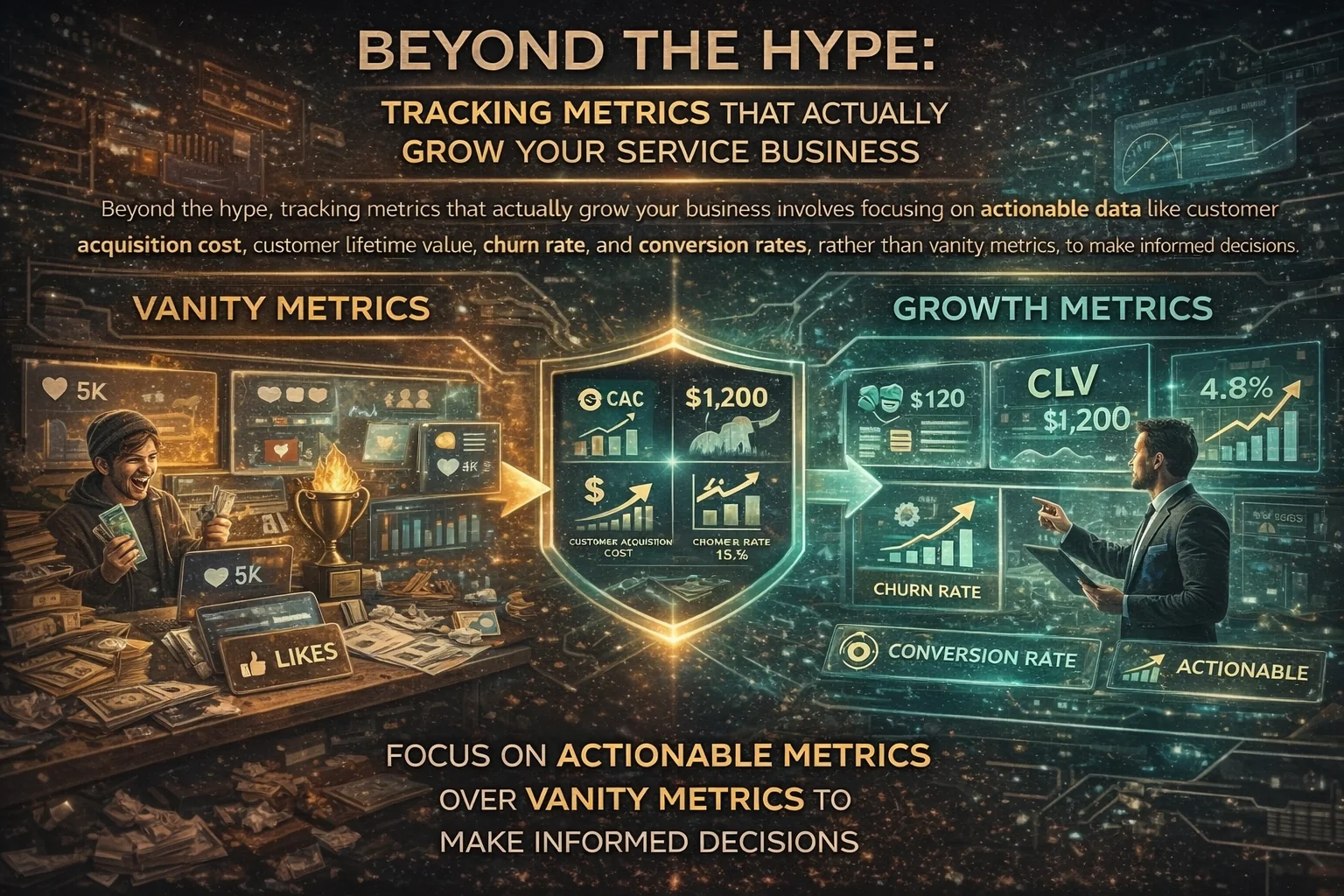
To keep your dashboard from becoming a distraction, every number on it must pass the Monday Morning Decision Test. Ask yourself: "If this number changes by 20% by Monday morning, will I change my plan or my product?" If the answer is "no," that number is just noise. It's an "empty calorie" for your ego.
| Vanity (The Ego Trap) | Sanity (The Real Truth) | The Decision You Must Make |
|---|---|---|
| Total Number of Users | User Retention | If low, stop growing and fix the features. |
| Number of "Followers" | Language Echo Score | If zero, rewrite your copy; no one "gets" you. |
| Total Page Views | Save-to-View Ratio | If low, your content is entertaining but useless. |
| Number of Features Built | Time to Aha! (TTA) | If > 60 seconds, make the app simpler. |
| App Downloads | Revenue Per User | If flat, your pricing is probably wrong. |
| Size of Email List | Email Click Rate | If < 2%, your list is full of bored "tourists." |
The reason people love vanity metrics is because they give you a "Dopamine Hit." Seeing a big number makes you feel like a CEO. But a solopreneur's health is measured by Leverage. Your goal is to keep your "Team Size" at one while pushing your "Revenue Per Employee" toward a million dollars. You can't do that if you are chasing "Likes."
Language Echo: How to Know if You're Famous or Just Loud
We’ve mentioned Language Echo as a sign of authority. In 2026, we measure it using a simple 3-Level scale. This is how you know if you are winning the battle for the customer's mind. It's the move from "Your Idea" to "The New Standard."
Language Echo happens when your audience starts using your specific words to describe their own world. It is the ultimate sign that you are building a "Cognitive Moat."
The Weekly Echo Audit
You don't need a robot to do this (though it helps). Spend 30 minutes every Friday afternoon doing a "Pulse Audit":
Specific Tools: Use SparkToro to find the phrases your audience is currently using. If their vocabulary starts to look like yours over a 90-day period, you are building a "Cognitive Moat." Features can be copied by AI in seconds; a concept that lives in a customer's brain is almost impossible to steal.
The Evidence Ladder: Stop Lying to Yourself
As a founder, your brain is a "lying machine." It is wired to find any tiny bit of proof that you are a genius and ignore any signal that you are failing. To stay safe, you must use the Evidence Ladder. This prevents you from making huge life changes based on a single "good job" from a friend.
- Step 1 (Anecdotal): A friend says, "Cool idea!" (Action: Ignore it. Friends lie to be nice).
- Step 2 (Weak): 50 people signed up for a "Coming Soon" page after seeing a TikTok. (Action: This proves "Interest," but it doesn't prove "Value").
- Step 3 (Moderate): 5 people spent 30 minutes on a Zoom call telling you about their pain. (Action: You now have permission to build a small MVP).
- Step 4 (Strong): Users are inviting their coworkers to your app. They are risking their reputation for you. (Action: You have found a real fit. Keep going).
- Step 5 (Definitive): A stranger who doesn't know you gave you their credit card number. (Action: You have a business. Scale it now).
⚠️ Important: Never build a feature that takes more than two days to code unless you have at least Step 3 evidence that it is a "must-have" for your users.
Agentic Telemetry: Hearing Your App's Heartbeat
A dashboard is useless if the data is missing or wrong. When you build, your most important technical job is Telemetry. This just means "wiring the app for sound." Every click should be recorded. In 2026, we use Agentic Telemetry—using AI to watch the data for us.
- Event Tracking: Use tools like PostHog to track the "Magic Moment." If you built an AI writing tool, the "Magic Moment" isn't when they log in; it's when they click "Download" on their first story. Track how long it takes them to get there.
- Friction Audit: Feed your user session recordings (from tools like Hotjar) into an AI agent. Ask: "Where did the user look confused or pause for too long?" This will find "UI Muda" that your charts will never show.
- Lightweight Traffic: Use Plausible to see where your users are coming from. If a specific LinkedIn post sent you 10 people who stayed for 10 minutes, that post is a "Winning Habit" you should repeat.
Summary: Your Weekly Audit of the Truth
The Founder's Dashboard is the only way to survive the confusion of the "Vibe Era." It turns "I think" into "I know." It makes sure that every hour you spend in front of your computer is an hour spent building a real, sustainable business. Measurement isn't something that stops you from building; measurement is the steering wheel that makes your building count.
By focusing on Language Echo, tracking your speed via the VLE grid, and being ruthless with Sanity Metrics, you have built a system for truth. But data is only useful if you make a choice. You must be brave enough to look at your dashboard and decide to change your course, even if it means deleting your favorite piece of code.
✅ Pro Tip: Every Monday at 9:00 AM, do a "Muda Audit." Ask: "What did I do last week that didn't move a Sanity Metric or get me to a higher step on the Evidence Ladder?" If you find waste, kill that project and get your focus back.
Next Post: LEARN – How to take this data and make the hardest decision in a founder's life: Mastering the "Pivot vs. Persevere" choice. We will look at the "Pivot Compass" and how to turn your insights into repeatable habits that make money.




No comments yet
Be the first to share your thoughts on this article!