If you are an early-stage founder or a solopreneur navigating the chaotic waters of April 2026, you are likely suffering from a modern burnout: Agent Paralysis. Every morning, the landscape shifts. A new "fully autonomous" framework drops on GitHub, promising the moon. You see viral demos of GPT-5.x Thinking and Gemini 3.x Pro agents coding entire SaaS platforms from a single prompt, booking multi-city flights via native browser executors, and managing complex executive calendars. It looks like magic. It feels like the future.
Driven by FOMO, you spend your entire weekend setting up a massive, multi-container orchestration stack. You debug Docker images, configure vector databases for hybrid RAG, and struggle with OAuth tokens until 3:00 AM. By Sunday night, you sit back and realize the sobering truth: you haven’t actually automated a single task that makes you money. You’ve built a cathedral in a desert where no one lives.
In the Lean Startup world, we call this Architecture Cosplay. You’re playing the role of a CTO at a Series C scale-up before you’ve found a single user who cares about your existence. You are optimizing for Extended Thinking time and rate-limit handling before you have validated the soul of your business.
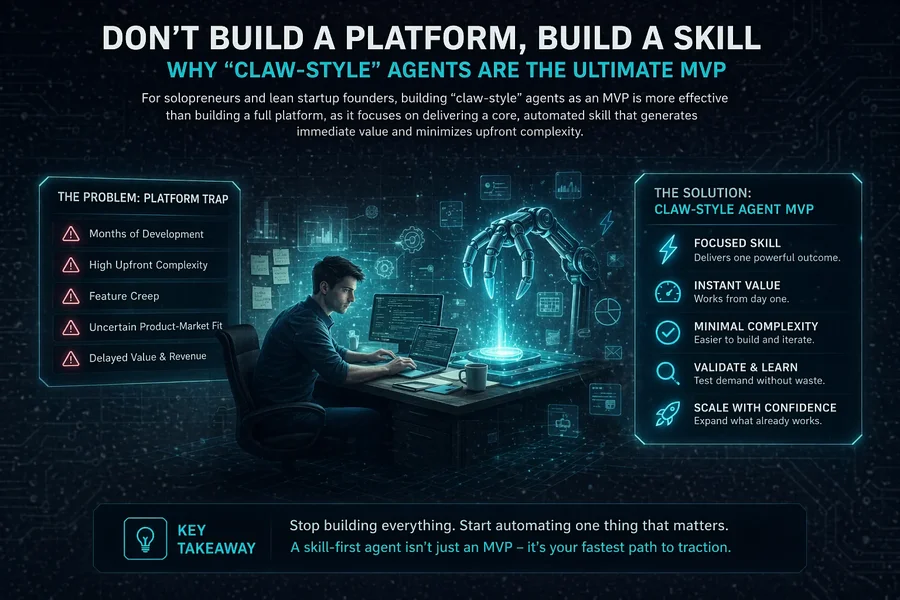
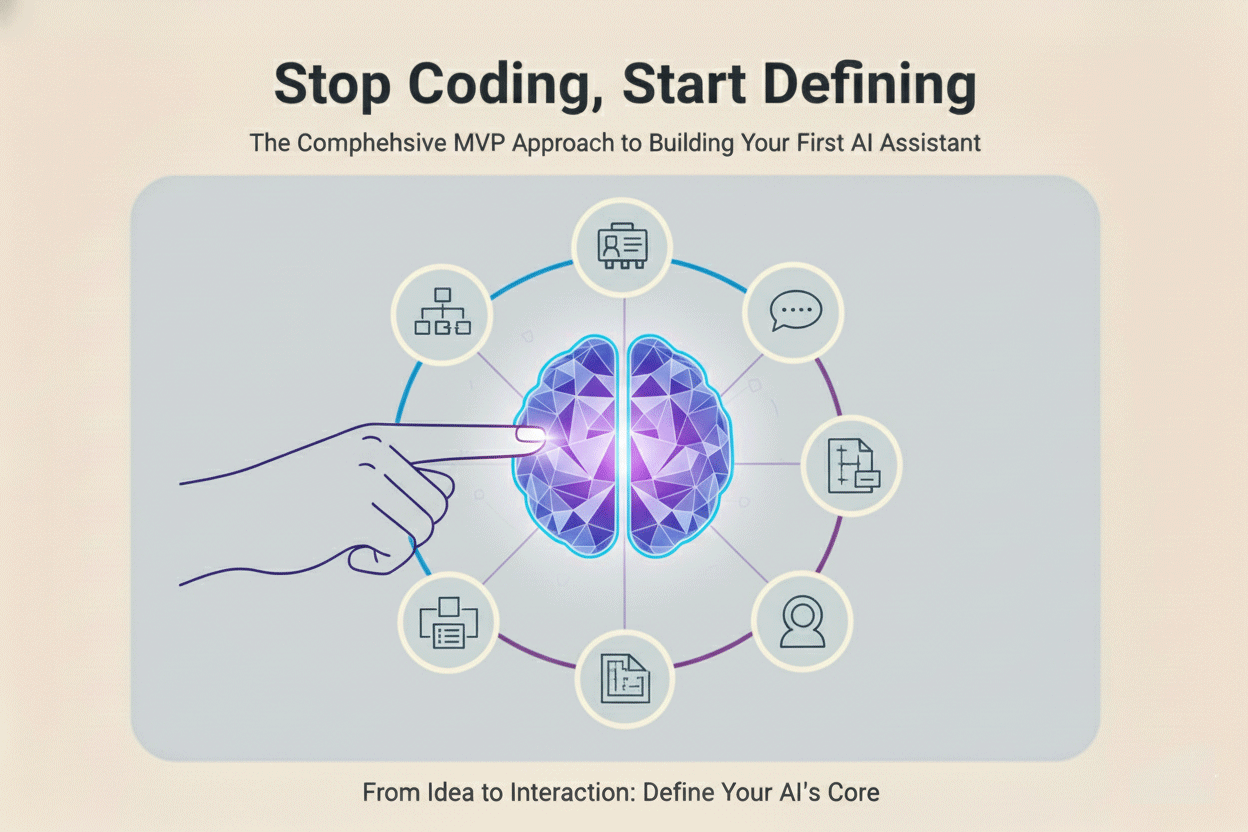
The "Claw" family of agents—starting from the foundational OpenClaw—offers a way out of this trap. By focusing strictly on the Build phase of the Build-Measure-Learn loop, we can use these variants to create "Minimum Viable Agents" (MVAs). These are not platforms; they are tools designed to survive the first contact with reality.
The goal of an early-stage founder isn't to build a platform. It’s to build a Skill.
The Pivot from "General" to "Vertical"
The primary reason founders fail with AI agents in 2026 is the "Jarvis Fallacy." They want a generalist. They want a single instance of GPT-5.x or Claude 4.x Opus that can handle customer support, outbound sales, and technical debugging simultaneously. While modern LLMs are multimodal reasoning powerhouses, reliable automation is strictly vertical.
In a Lean Startup, "anything" is the enemy of "learning." If your agent is designed to do everything, how do you diagnose a failure? When a customer is unhappy, was the failure in the model’s contemplation phase, a flaky API integration, or a poorly defined system instruction? If you can’t isolate the variable, you can’t iterate. And if you can’t iterate, you’re dead in the water.
The Claw architecture is built on the Skill Pattern. A skill is a thin, vertical slice of functionality. It is the tactical equivalent of a "Feature" in a traditional MVP. It does exactly one thing with high reliability:
- "File a Linear ticket based on this specific Slack thread structure."
- "Monitor this competitor's social feed and alert me when they mention a specific feature."
- "Draft a technical response to this GitHub issue using DeepSeek-V3 or Llama 4 for localized, high-speed code auditing."
By building a Skill instead of a Platform, you reduce your technical debt to almost zero. You aren't building an engine; you're building a spark plug. If the skill doesn't provide value, you delete the folder and move on. You haven't wasted weeks on infrastructure that you’ll be too emotionally attached to "kill" later.
Choosing Your "Experiment Engine"
The first step in the Build phase is picking the right variant. In April 2026, the model is a commodity; the variant is your Constraint. Lean founders love constraints because they force simplicity and prioritize speed-to-market.
Here is how to pick your "Claw" based on the specific learning objective of your current sprint:
The "I Need Leverage" Strategy: OpenClaw
If you are a solopreneur trying to "clone yourself" to handle the administrative rot that eats 40% of your day, start with OpenClaw. This is the Swiss Army Knife of the ecosystem.
- The Build: OpenClaw has the largest library of pre-built "Lego" skills. You aren't writing low-level orchestration; you are configuring YAML files and connecting existing blocks.
- The Learning: Your goal is to find High-ROI Workflows. If you connect OpenClaw to your email and it triages 50% of your spam or schedules 3 meetings using Mistral Small 3 via Ollama without you touching it, you’ve validated that "Agentic Triage" is a viable path for your business.
The "I Need Performance" Strategy: ZeroClaw or Nanobot
If you are building a product where the AI needs to live on the edge—like a smart home device or a specialized hardware tool—you cannot afford the overhead of a massive Python environment or a 40GB Docker container.
- The Build: ZeroClaw (built in Rust) or Nanobot (Mini-Python). These are stripped-down, lightning-fast, and remarkably stable. They don't have the "bells and whistles" of OpenClaw, and that’s the point.
- The Learning: Your goal is to prove Technical Feasibility. Can a local Gemma 4 or Phi-4 model from Hugging Face respond in under 300ms on a Raspberry Pi? If yes, you have a hardware product. If no, you pivot your architecture before you waste $50k on a manufacturing prototype.
The "I Need Context" Strategy: VisionClaw or DroidClaw
If your startup is mobile-first or deals with the physical world, your "Build" phase needs to focus on Input/Output friction. Text-only agents often fail here because they lack situational awareness.
- The Build: Use VisionClaw to process real-time multimodal streams or DroidClaw to intercept Android notifications and system states.
- The Learning: You are testing User Adoption. Will a user actually wear augmented reality glasses if a Llama-4-Vision model running locally via Ollama can "see" their environment and help them troubleshoot in real-time? You don't need a cloud cluster to test this; you just need a specialized Claw running on a local device.
The "Thin Slice" Workflow: How to Build Your First Skill
Stop thinking about "Agents" as autonomous beings and start thinking about them as "Loops." A successful MVA Build follows a ruthless three-step process designed to get you to the "Measure" phase in under four hours.
Avoiding the "Prompt Engineering" Rabbit Hole
A major trap in the Build phase is "Prompt Perfectionism." Founders spend 20 hours perfecting a 500-line prompt and 0 hours building the integration logic. This is a mistake. A "perfect prompt" in an unstable environment is useless.
Focus your engineering effort on the Glue:
- Build a "Good Enough" prompt that handles the 80% case.
- Build a "Robust" integration that handles API timeouts, rate limits, and 2026-era Extended Thinking latency.
If your agent can’t reliably post to your CRM because the API connection is flaky, it doesn't matter how "smart" the LLM is. The Claw pattern encourages you to treat the LLM as a modular, swappable component. If the prompt isn't working with GPT-5.x, you should be able to swap the model to a local Llama 4 variant via OllamaClaw in under 60 seconds. The "Build" is the Skill logic, not the Model weights.
Summary: Your Weekend Build Challenge
If you’re a founder, your mission this weekend isn't to "learn AI." That's too broad. Your mission is to solve one specific business problem using the Claw architecture. This is a test of your ability to build a Minimum Viable Agent.
By Monday morning, you won't just have a "cool demo" to show off on social media. You’ll have the first real data point in your Measure phase. You’ll know exactly how much time you saved, where the agent hallucinated, and whether this "Skill" has the potential to become a standalone product or if it’s just a helpful internal tool.
Don't build a platform. Build a skill. The Claw family is here to help you move faster, fail cheaper, and learn more than your competitors who are still stuck in Architecture Cosplay.
What's Next?
Now that you've built your first MVA, how do you know if it's actually "profitable" for your time? Data without context is just noise. In the next post, we’ll look at the Measure phase: How to instrument your Claw to track real-world ROI and identify the exact moment an experiment becomes a business.
In the 2026 economy, the founders who win are not the ones with the largest GPU clusters, but the ones with the tightest Build-Measure-Learn loops. Start small. Build a Claw.



No comments yet
Be the first to share your thoughts on this article!