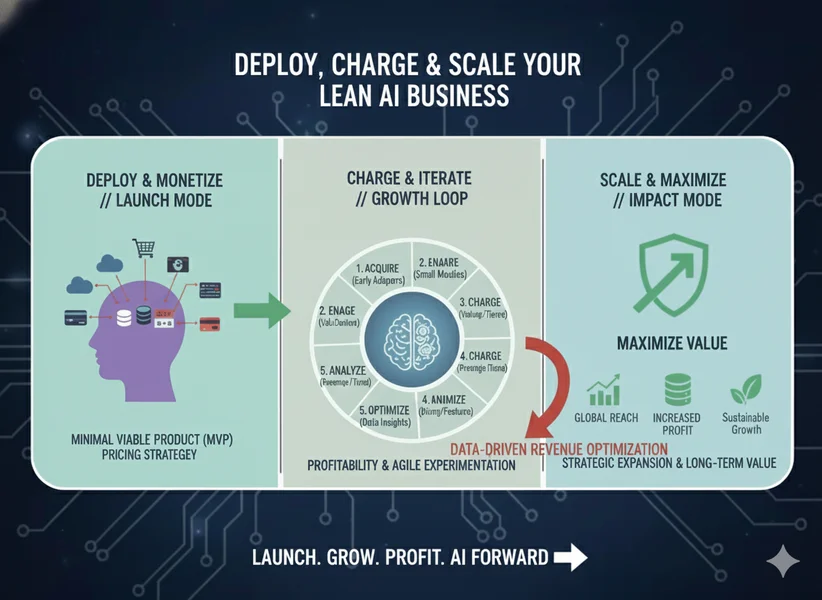
Your pilots are converting. Your experiments are optimizing. The "Growth Radar" or "Content Flywheel" you vibed into existence just a few weeks ago has likely reached a critical threshold—an 80% Net Promoter Score (NPS), a sustainable profit margin per run, and a 70% user retention rate. Your early clients are signaling the ultimate validation: they are telling you the tool "pays for itself 10x."
You find yourself at a pivotal junction, likely sitting between $3,000 and $5,000 in Monthly Recurring Revenue (MRR). For many, this is the "Valley of Death" for solopreneurs. You have a product that works, but you are still the primary engine of delivery.
Enter the final boss: Complexity.
As you scale, the "happy path" you built in your prototype will be tested. A single high-volume client might spike to 1,000 requests per day, instantly crashing a basic Streamlit app or exceeding your API rate limits. Burnout looms as you struggle to juggle delivery, technical support, and sales.
This post is about graduating. We are moving from "cool experiment" to "Lean AI Empire." We will cover the transition to high-availability hosting, client-proof guardrails, and the pricing models that protect your margins in a deflationary token market.
1. The Lean Production Stack: Reliable, Not Fancy
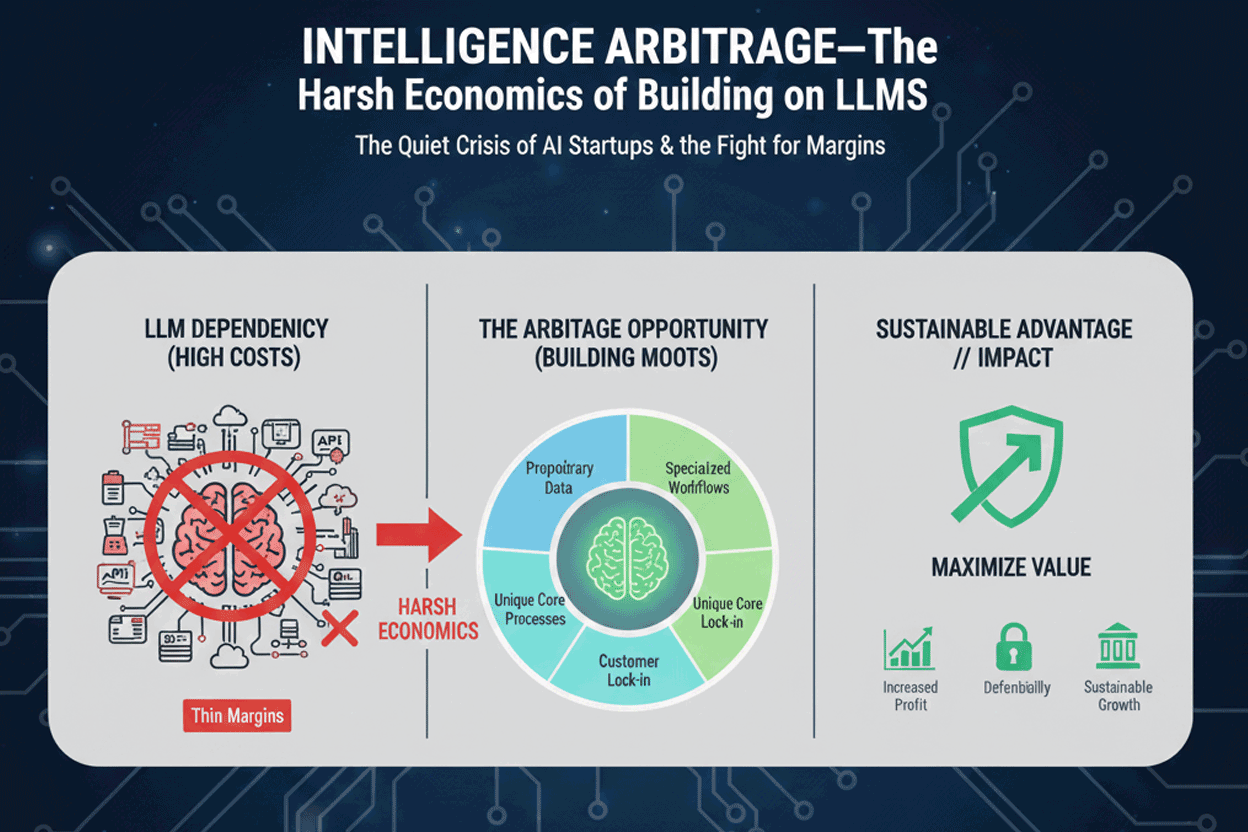
In 2026, "production-ready" for a solopreneur does not mean building a massive Kubernetes cluster. It means shifting from notebook-style experiments to reproducible pipelines with deep observability. While you used tools like Gumloop for rapid logic assembly in Post 2, scaling requires a stack that reliably turns data into prediction-driven features without you needing to babysit the console.
The 5-Layer Production Blueprint
Layer | Production-Grade Standard | Why it Works for Solos |
|---|---|---|
UI/API | Vercel / Next.js | Pairs AI generation with professional components for "prompt to production" speed. |
Gateway | Portkey / LiteLLM | Provides automatic fallbacks and load balancing across 1,600+ models with minimal overhead. |
Models | Model Routing | Routes simple tasks to cheap models (GPT-4o-mini) to maintain high profit margins. |
Observability | Langfuse / Helicone | Tracks cost attribution per user and identifies active vs. dormant segments. |
Security | Centralized Secrets | Manages API keys and PII data in accordance with SOC 2 and GDPR standards. |
To calculate your true business health at this stage, you must track your Gross AI Margin ($M_g$):
$$M_g = \frac{\text{Revenue} - \text{Token Costs}}{\text{Revenue}} \times 100$$
A healthy Lean AI business should aim for $M_g \ge 75\%$. If your margin is lower, you are likely over-using expensive frontier models for tasks that a "Mini" model could handle.
2. Step 1: Harden for Production (Days 1–3)
Building a functional model is only 20% of the work; the remaining 80% is operationalization. To protect your business from "The Hallucination Floor"—the baseline error rate inherent in LLMs—you must implement automated quality evaluations.
The Guardrail Protocol
As a solo founder, you cannot manually check every output. You need automated "bouncers" at the door of your database.
3. Step 2: Pricing & Packaging Mastery (Days 4–5)
The traditional SaaS playbook of "per-seat" pricing is being upended. In 2026, the market is shifting toward Hybrid Pricing to account for the Token Paradox: the phenomenon where token costs drop significantly, but total usage explodes as founders throw 100x more "horsepower" at complex problems.
If your AI tool allows one user to do the work of five people, charging a flat "per seat" price is a strategic mistake—you are capturing none of the value you've created.
If your AI tool allows one user to do the work of five people, charging a flat "per seat" price is a strategic mistake—you are capturing none of the value you've created.
The Lean AI Pricing Ladder
Tier | Strategy | Value Proposition |
|---|---|---|
Starter | Base Subscription | Predictable recurring revenue covering platform overhead. |
Pro | Consumption-Based | Charges per resolution or credit, ensuring revenue scales with your GPU/API costs. |
Elite | Outcome-Based | High-ticket fees tied to business impact, such as "per qualified meeting booked." |
Calculating the Value-Based Price ($P_v$)
Instead of cost-plus pricing, use this formula to find your floor:
$$P_v = (\text{Hours Saved} \times \text{Hourly Rate}) \times 0.20$$
If you save a founder 10 hours a week at a $100/hr internal rate, your tool is worth $200/week ($800/mo). If you are charging $20/mo, you are leaving 97% of your value on the table.
4. Step 3: Scaling Without Breaking (Days 6–7)
By 2026, AI-native startups are expected to outperform traditional SaaS by 300% in "Revenue per Employee." A $10M ARR AI startup might only require 15 people. As a solopreneur, your "employees" are autonomous agents.
Operational Scaling via Agentic Workflows
To scale from $5k to $20k MRR without hiring, you must automate your own back-office.
- The SDR Agent: Use an AI agent to handle your outbound research and initial LinkedIn outreach based on your Lean Canvas personas.
- The Support Agent: Implement a RAG-based chatbot that has access to your Lean Vault and previous Slack conversations. It should resolve 80% of user "How-to" questions.
- The Data Flywheel: This is your "defensive moat." Design your UX so that every user interaction—every edit they make to an AI response, every "thumbs up"—naturally captures data that improves your underlying prompts or fine-tuning datasets. Competitors can clone your features, but they cannot clone your historical data flywheel.
5. Capstone Case Study: Brandon’s Lean Empire
Brandon used the Lean Canvas methodology to transition his "AI Validation Coach" from a side project to a sustainable business.
The Pivot:
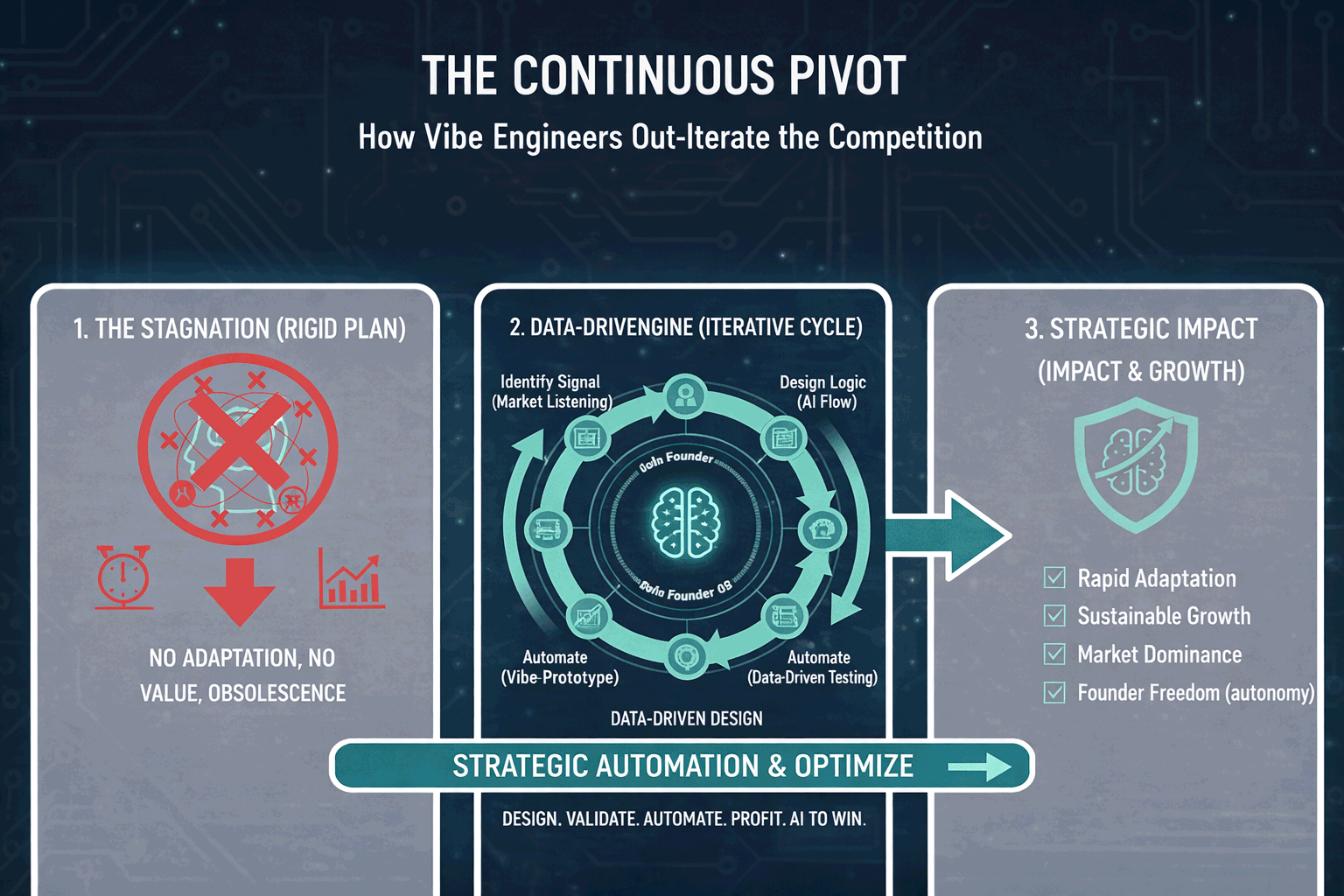
His initial broad tool for "all founders" had high traffic but zero conversions. By analyzing his experiment logs in his Lean Vault, Brandon noticed that the highest engagement came from a very specific niche: local florists trying to automate their marketing. He executed a "Zoom-In Pivot," making the florist niche his entire market.
The Production Scale:
Brandon realized that during holiday seasons (Valentine's Day, Mother's Day), his traffic spiked 400%. He implemented Portkey for automatic model fallbacks and Langfuse for cost attribution to ensure he wasn't losing money on high-volume accounts.
The Result:
By moving from seat-based pricing to a hybrid model—$197/mo base + $1 per "Qualified Lead" generated—he reached $12,000 MRR in four months. Because he automated his onboarding and support, he maintains an 85% gross margin and spends less than 10 hours a week on operations.
6. Your Production Launch: Go Live Today
Vibe the production prompt to move your code to a Vercel-backed API. It is time to stop "testing" and start "running." Onboard your first "Pro" client today using a usage-based credit system.
Final Vibe Coding Prompt (The Production API)
Paste this into Cursor to wrap your logic for a professional deployment:
Create a FastAPI backend optimized for Vercel deployment. Integrate LiteLLM for model routing with a fallback from 'gpt-4o' to 'claude-3-5-sonnet'. Implement a middleware that redacts PII from all incoming requests. Add an endpoint that logs the 'Cost per Resolution' to my Supabase 'experiments' table. Ensure all AI responses are validated against a Pydantic schema to prevent UI-breaking JSON errors.Series Complete: The Evidence-Based Empire
You have moved from a vague idea to a validated, production-grade AI business. You didn't do it by following "vibes" or chasing every new model release. You did it by sticking to the Lean Canvas, running time-boxed experiments, and building modular systems that can pivot as fast as the market moves.
The journey to building an evidence-based AI empire starts now. The tools are essentially free, the models are getting smarter, and the world is full of unsolved problems.
Stop guessing, and start building.

No comments yet
Be the first to share your thoughts on this article!