
Your first pilot lands. That $997 "AI Growth Radar" offer you packaged in Module 3? Your client raves about the scored leads, pays on time, and even refers a colleague. Momentum is building. You feel like you’ve cracked the code.
But here is the critical pivot point where most solopreneurs fail: One win does not make a business; it makes a fluke. What if the next ten clients find the outreach lines robotic? What if your token costs explode by $400\%$ because you’re scaling a poorly optimized prompt? Or worse, what if your model starts "hallucinating" lead data, and you don't notice until a client cancels?
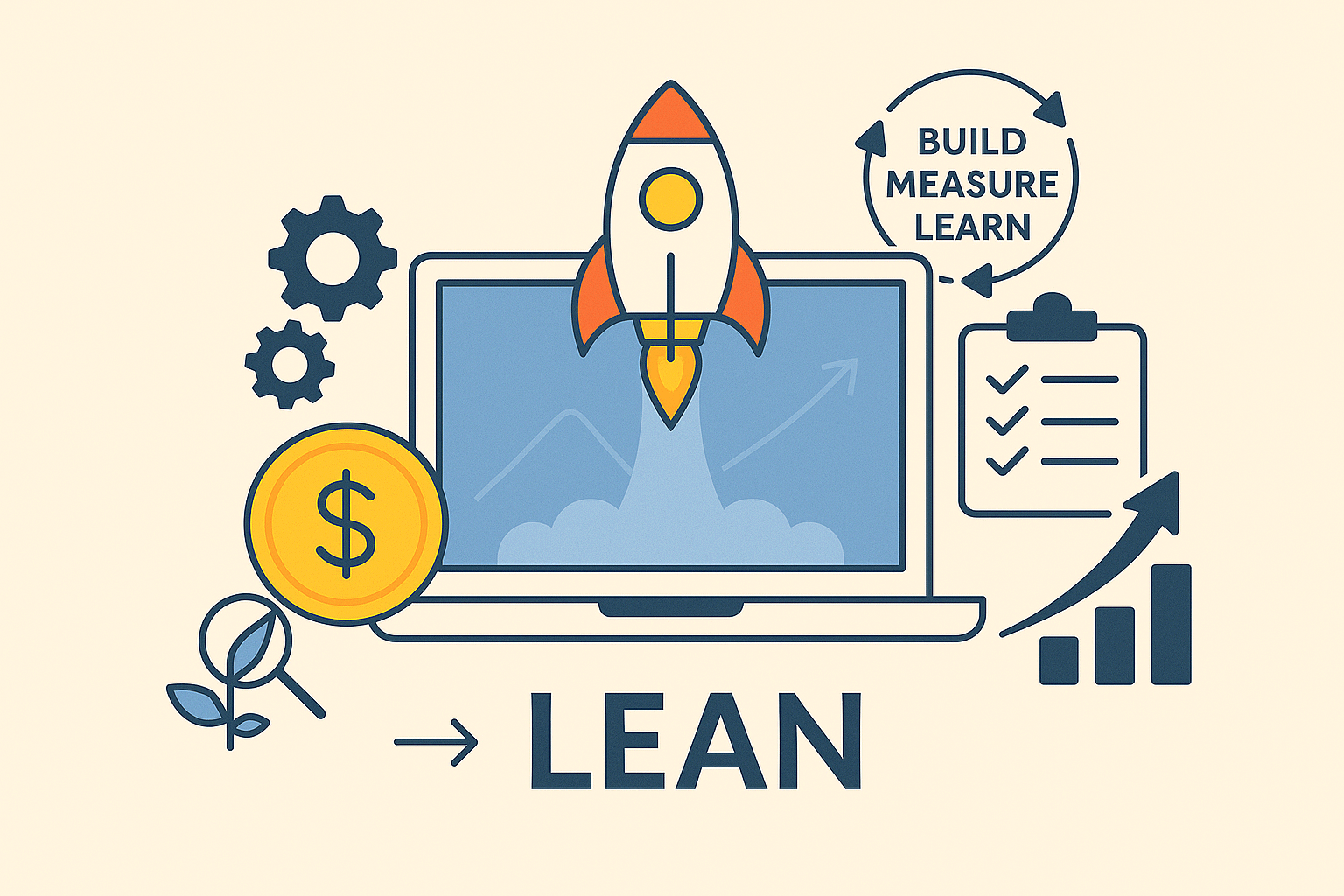
In the AI era, you cannot afford to "set it and forget it." You need the Build–Measure–Learn (BML) loop—the Lean Startup heartbeat that turns lucky hits into repeatable, scalable revenue. Because a simple prompt tweak can constitute a new "Minimum Viable Product," your speed of learning is limited only by your ability to track the right data and act on it ruthlessly.
In this post, we’ll adapt the BML loop for AI systems. We’ll dive into the metrics that actually matter, "Vibe Coding" prompts for your own observability dashboard, and a decision framework to help you navigate the "Decision Spectrum."
The AI Build–Measure–Learn: The Accelerated Loop
In the traditional startup world, the "Build" phase of the loop usually took weeks or months of engineering. In the AI world, the "Build" phase is often just a text edit. If you change a system instruction from "Be professional" to "Be a witty growth hacker," you have technically built a new product variant.
Because the "Build" phase is now nearly instantaneous, the bottleneck has shifted. The most successful AI founders aren't the best coders; they are the best learners.
Why AI Founders Need the Loop
- The Hallucination Floor: Even the best-tuned systems have a baseline hallucination rate. You need to know if a change in your RAG (Retrieval-Augmented Generation) pipeline is pushing that number up or down.
- Margin Drift: High-performance models are deflationary over time, but your usage can be "lumpy." One complex customer query could cost you $\$0.01$ or $\$1.00$. Without measuring "Cost per Resolution," you are flying blind into a margin graveyard.
- The Lean Vault: Use systems like LeanPivot.ai to maintain what we call a "DNA Repository." Every failed prompt and every "thumbs down" from a user is a piece of data. If you don't log it, you are doomed to repeat the same technical mistakes in your next project.
Your AI Experiment Metrics Dashboard
Forget vanity metrics like "page views" or "total signups." For an AI-native product, you need "Sanity Metrics" that prove the AI is actually performing the job it was "hired" to do.
The Core AI Metrics
- Faithfulness ($F$): This measures if the AI’s claims are actually grounded in the context you provided it.
$$F = \frac{\text{Number of Claims Grounded in Context}}{\text{Total Claims Made}}$$
Target: $> 85\%$ - Cost per Resolution ($C_r$): The total token spend (input + output) to solve one customer task.
Target: $<\$0.50$ (depending on your niche) - P95 Latency: The response speed for your slowest $5\%$ of users. In 2026, users will abandon a chat or voice interface if the "thinking" time exceeds a few seconds.
Target: < 2 \text{ seconds for RAG; } < 500\text{ms for voice.} - RAG Relevance: A measure of how well the retrieved data chunks actually match the user’s intent.
Vibe Dashboard Prompt for Cursor
You don't need to build a complex monitoring suite from scratch. You can "vibe code" a Streamlit dashboard in minutes. Paste this into Cursor or Claude:
"Build a Streamlit dashboard that connects to my Supabase logs. Create four interactive charts:
- A time-series of average token cost per run ($C_r$).
- A bar chart of 'Thumbs Up/Down' feedback categorized by prompt version (A vs B).
- A distribution of P95 latency across different models.
- A table showing the Faithfulness Score calculated from my 'LLM-as-a-Judge' logs.
Ensure I can toggle between 'GPT-4o-mini' and 'Claude 3.5 Sonnet' to compare which one provides better ROI. Use Tailwind-style CSS for a clean, dark-mode aesthetic."
The 7-Day Experiment Playbook
Stop "tweaking" and start experimenting. A proper AI experiment follows a strict 7-day cadence.
Case Study: Jordan’s 3-Week Optimization Sprint
Jordan’s "AI Growth Radar" (from Module 3) was a hit, but users complained the research felt "robotic." Here is how Jordan used BML to fix it without a complete rewrite.
- Week 1 (The Prompt Experiment): Jordan added three "few-shot" examples of human-written outreach. He measured a $15\%$ increase in user "Acceptance" of the generated lines. Result: Persevere.
- Week 2 (The Model Swap): Jordan switched from GPT-4o to Claude 3.5 Sonnet for creative writing tasks via Portkey. The quality jumped significantly ($+22\%$ NPS), but the cost per run spiked by $40\%$. Result: Pivot to Hybrid.
- Week 3 (The Hybrid Routing): Jordan used LiteLLM to implement "Conditional Routing." Simple lead scoring went to the cheap GPT-4o-mini, while the final personalized writing went to Claude.
- The Outcome: Costs stabilized, and profit per resolution hit $\$0.65$. Latency dropped because simple tasks were handled by faster models.
By using Helicone for one-line proxy logging, Jordan saw exactly where the money was going. He wasn't guessing; he was engineering a profit margin.
Common Pitfalls to Avoid
1. The "Tweak" Trap
Making tiny, incremental changes—like adjusting a button color or changing one word in a 1,000-word prompt—without a hypothesis is just "fiddling." If you don't have a predicted outcome and a metric to track it, you aren't experimenting; you're just busy.
2. Ignoring Latency
3. The "Vibe" Validation
Your Next Move: Set Up Your "Sanity Suite"
Don't wait until you have 100 users to start measuring.
Tomorrow: Module 5 – Deploy, Charge, and Scale Your Lean AI Empire. We’ll look at how to move from $1,000 in revenue to $10,000 and beyond by automating your own delivery and setting up "Guardrails" that let you sleep while the AI works.
The loop is your lifeblood. See you in the next module.


No comments yet
Be the first to share your thoughts on this article!