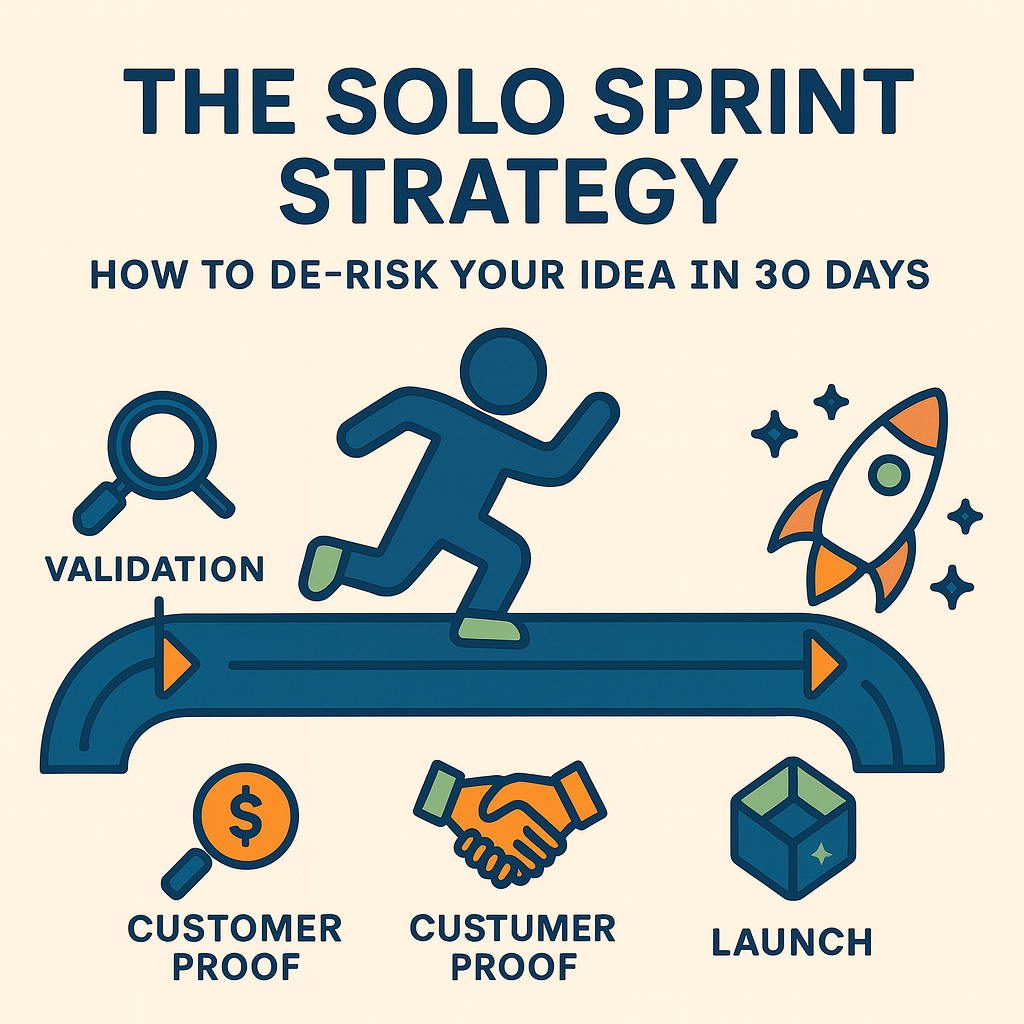
If Week 1 of the Solo Sprint was about strategic validation, Week 2 was about surgical focus (see The Solo Sprint Strategy – How to De-Risk Your Idea in 30 Days). You’ve confirmed the market pain, locked down your value proposition, and, most importantly, you’ve applied the MoSCoW method to ruthlessly cut any feature that isn't a Must-have.
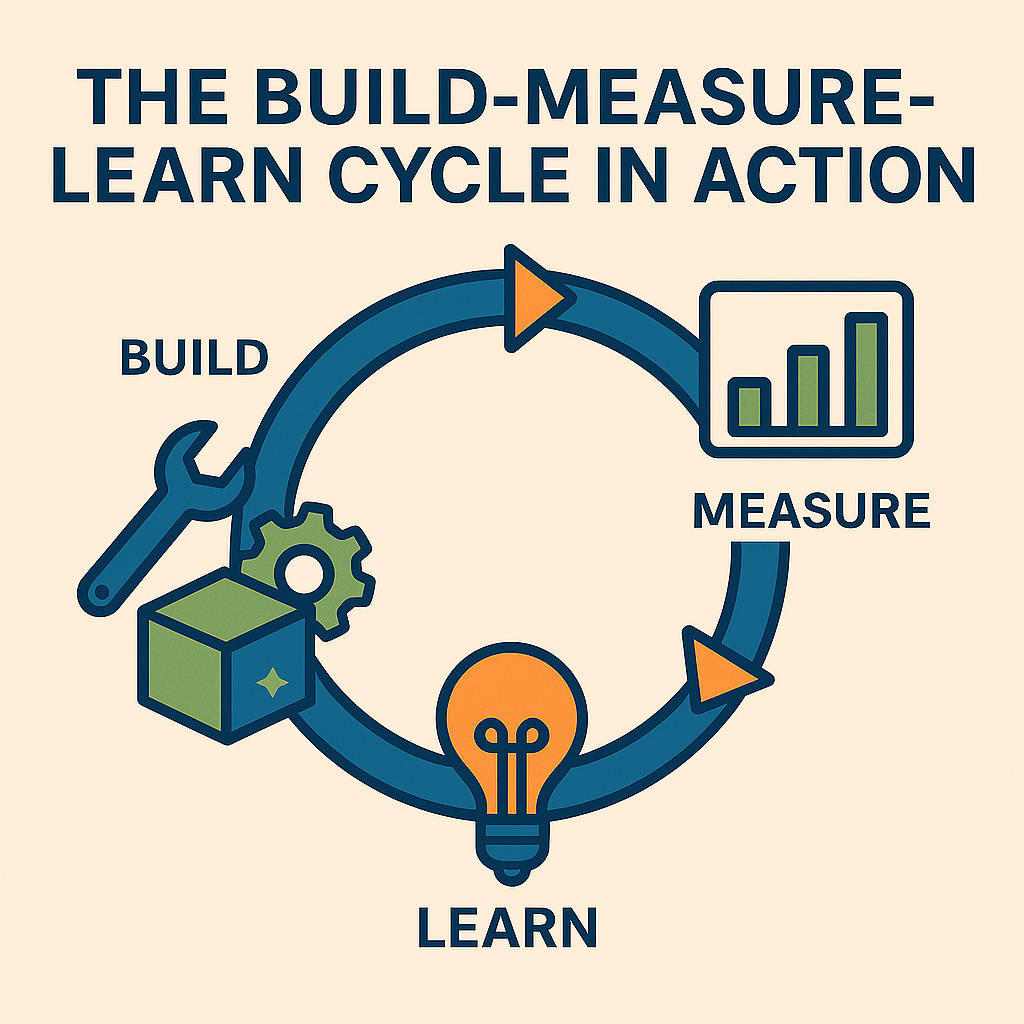
Now, the second half of the Solo Sprint focuses on execution and the essential "Learn" phase of the Lean Startup cycle. Your initial validation proved that the problem exists; now, in Weeks 3 and 4, you must prove your solution works and that the market will pay for it.
Week 3: The Lean Build—From Plan to Product
1. The No-Code/AI MVP Stack: Your Instant Dev Team
Building an MVP in 7 days or less is only possible by leveraging a no-code stack. This allows you to build a functional, testable product without writing any custom software, instantly transforming you from a founder into a system architect. You don't need to know Python; you need to know how to connect tools.
- Front-End/App Builder: Use visual platforms like Softr, Webflow, or Bubble to create the user interface (UI) and basic web application logic flows. These tools allow you to visually drag-and-drop your MVP into existence, linking pages and components without writing a line of code.
- Data/Back-End: Use a flexible database tool like Airtable or Google Sheets as the back-end. This is simple, cheap, and easily managed by one person.
- Logic Automation (The Glue): This is the magic. An orchestration tool like Make.com or Zapier connects your front-end, your data, and your AI tools to handle the core logic and automation.
Scenario Example: A user clicks a button on your app (Front-End) Make.com reads the data from Airtable (Data) Make.com sends that data to an AI model for analysis (AI) Make.com then delivers the result back to the user via email or a dashboard (Front-End/Logic).
This stack allows you to move from plan to product in days, not months, which is the cornerstone of the Solo Sprint’s speed advantage. Your goal is not perfection; it's functionality and testability.
2. Managing the Build: The 30-Day Action Plan
Building under pressure requires a highly structured approach. You need a guide that breaks the build down into tiny, manageable tasks.
- Use a Project Management Dashboard: Tools like Asana, Trello, or ClickUp are non-negotiable. Your entire build should be mapped out, with tasks no larger than a half-day's work. This prevents the "I need to build the whole platform" paralysis and replaces it with "I need to connect the user sign-up form to the database."
- The Single-Day Goal: Every morning, you must know the single "Must-have" task you will complete by the end of the day, ensuring you maintain a clear dashboard of progress. For the non-technical founder, the biggest challenge is not the complexity of the task, but the discipline to stick to the planned scope.
3. Creating Launch Assets: The Landing Page as a Final Hypothesis Check
The "build" is not just the product; it includes the assets required for launch. Your launch-ready landing page is your final, beautiful check on the value proposition defined in Week 2.
- Clarity is King: The copy on your landing page must be clear, benefit-focused, and directly address the ICP’s pain points. A confused mind never buys. Use the customer’s own language from your Week 1 interviews to make them feel understood.
- The Power of the Call to Value: Your button text should not be a generic "Sign Up." Use a compelling Call to Value that reflects the core benefit: "Get Your Custom Plan Now," "Start Saving 5 Hours a Week," or "Access Exclusive Beta."
- AI for Copy Generation: Use a tool like Copy.ai or a Generative AI prompt to generate high-converting headlines and benefit-focused body copy. Feed the AI your pain points and the single unique benefit of your MVP, and ask it to instantly write 10-20 variations. This saves hours of staring at a blank screen and provides multiple options for A/B testing later.
4. Designing the Onboarding Experiment
A critical component of the MVP is an effective onboarding experience that guides the user to the product's core value with minimal friction. This onboarding flow is itself a miniature experiment.
- Time-to-Value (TTV) is the Only Metric: Your goal is to measure and minimize how many clicks, fields, or seconds it takes for a user to reach the core feature that solves their problem. If TTV is too high, your user will churn before they even realize your product is valuable.
- Track Friction Points: Use simple heat mapping or analytics tools to track where users drop off during the onboarding sequence. Every single drop-off point is a friction point—a signal that your flow is too complex, your copy is confusing, or your design is intimidating. Fix these before you launch widely.
Week 4: Launch & Learn—The Continuous Feedback Loop
Week 4 marks the culmination of the sprint with a launch that is intentionally focused on learning and iteration. This is where the "Measure" and "Learn" phases of the cycle dominate.
1. The Soft Launch Playbook: Learning Over Traffic
The Solo Sprint reframes "launching" as a soft launch—a strategic experiment. This approach involves releasing a beta version to a select group of targeted customers. The goal is not to attract a massive audience but to get a "small group really excited," thereby minimizing risk.
- Targeted Beta Group: Target the 10-20 people you interviewed in Week 1, or a closed community of early-adopter contacts. This is a controlled environment designed for honest, insightful feedback, not massive sales.
- Clear, Measurable Goals (KPIs): Your launch goals are not revenue-based yet. They are metric-based, derived from the hypothesis you created. Use a "KPI Dashboard Blueprint" prompt to select 5-10 key metrics to track from day one. These must be Actionable Metrics that lead to a clear decision (pivot or persevere). Key examples include:
Activation Rate: The percentage of users who complete the core onboarding step.
Retention Rate: The percentage of users who return after Day 1 and Day 7.
Core Value Usage Frequency: How often the user engages with the "Must-have" feature (e.g., creating a report, analyzing a file).
- Risk Mitigation: A small, controlled launch minimizes the risk of a public flop, which is especially important for a single founder who cannot handle a flood of support tickets or negative press that could sink the brand before it starts.
2. Establishing the Continuous Feedback Loop: The OODA Model
A successful lean startup's longevity is defined by its ability to adapt quickly via a continuous feedback loop. The mental model you must adopt is the OODA Loop (Observe, Orient, Decide, Act). This model emphasizes agility and helps you outpace larger, slower competitors.
Observe: Collect all raw data—analytics, crash reports, customer support messages, and surveys.
Orient: Analyze and interpret the data within the context of your original hypothesis. Ask: Did the results confirm my assumption? If retention is low, is it a product problem or a messaging problem?
Decide: This is the most critical phase. Based on the analysis, you must prioritize one insight and decide on the next experiment. If the data shows users dropping off after the first five minutes, your decision is to streamline onboarding (a product decision). If they aren't using the product at all, the decision might be to refine the value proposition (a marketing decision).
Act: Implement the decision (i.e., fix the onboarding flow or change the landing page copy) and immediately loop back to Observe the new results.
This fast cycle is what accelerates validated learning and keeps you in front of the competition.
3. The AI-Automated Feedback Engine
The Solo Sprint uses AI to automate the repetitive parts of the feedback loop, freeing the founder to focus on the high-impact Decision and Act phases.
- Automated Collection & Analysis: Use a no-code tool like Make.com to orchestrate the loop. You can connect your survey tool (e.g., Typeform) and your analytics data to an AI agent. This agent can be prompted to:
Perform Sentiment Analysis: Quickly categorize positive, negative, and neutral open-ended responses.
Summarize Churn Reasons: Look at cancellation notes and summarize the top three reasons users left.
Prioritize Insights: Instantly generate a prioritized feature backlog based on the frequency and severity of customer complaints.
The validated learning from the soft launch informs the next iteration. Based on early data, the founder can either pivot (if the initial hypothesis is disproven) or persevere (if the hypothesis is proven and can be refined). This efficient execution of the "Learn" phase is what separates a viable business from a failed one.
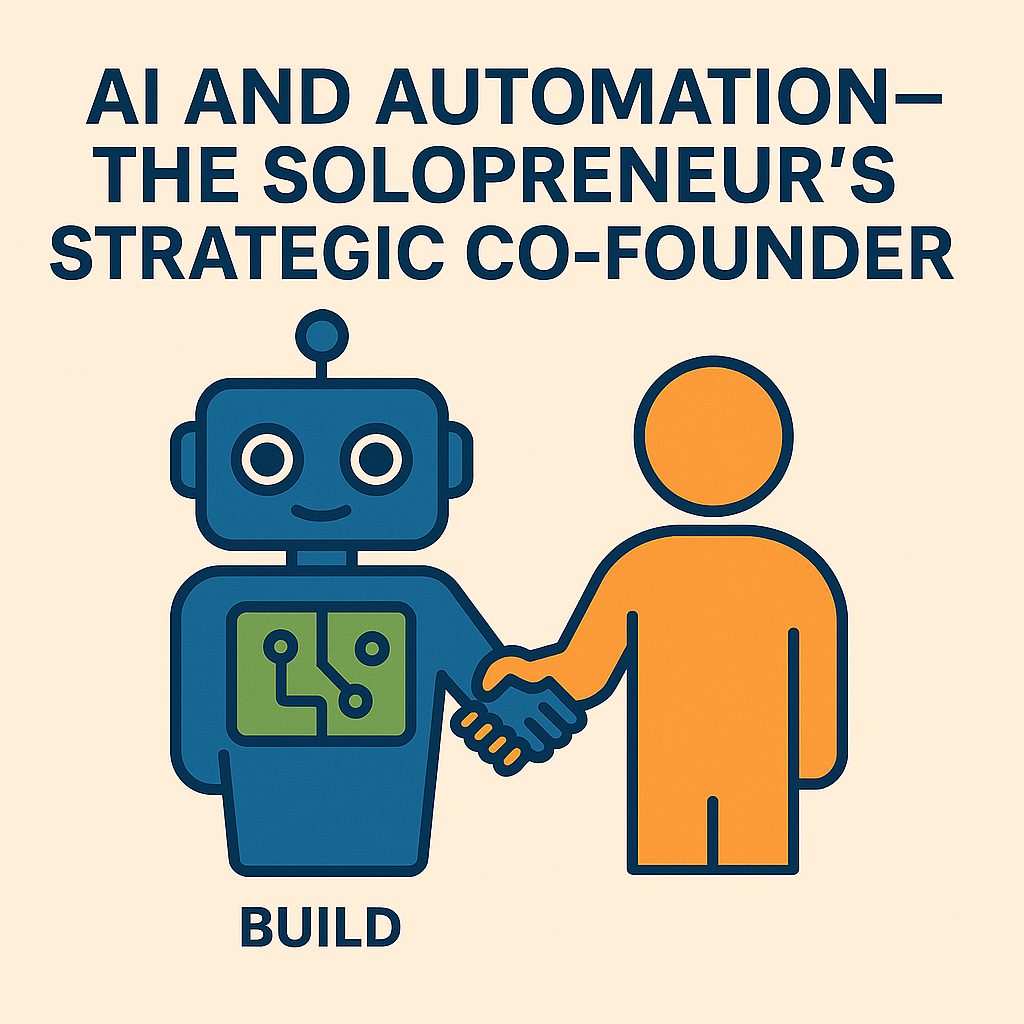
Now that the execution and learning phases are complete, are you ready to see how AI becomes your full-time, strategic co-founder in Blog Post 3?



No comments yet
Be the first to share your thoughts on this article!