
If you hang around founders long enough, you notice a specific physiological shift. The moment someone says, “We’re finally building,” their energy spikes. The pupils dilate, the caffeine intake triples, and the paralyzing ambiguity of the "idea phase" feels like it’s finally over. Calendars fill with sprint planning, JIRA tickets multiply like digital Hydra heads, and the roadmap expands into a multi-month vision of features, edge cases, and aesthetic polish.
But here is the uncomfortable truth that keeps seasoned investors and second-time founders up at night: Most early-stage startups don’t die because they can’t build. They die because they build too much of the wrong thing before they know what is true.
In a world where AI-assisted coding, no-code platforms, and sophisticated boilerplate templates make shipping easier than ever, the real danger to your runway isn’t being too slow. It’s being too certain, too early. We have reached a point in the evolution of technology where the cost of output has plummeted, but the cost of miscalculation remains as high as ever. It is time to fundamentally rethink what “Build” actually means in the context of a high-growth startup.
The "Just Ship It" Trap in the Age of AI
“Just ship it” used to be the ultimate antidote to corporate analysis paralysis. It was a battle cry against the "waterfall" methodology and the endless over-planning of the 1990s. In the 2010s, shipping was a filter for competence. If you could ship, you were already ahead of 90% of the dreamers sitting in coffee shops talking about their "App Idea."
Today, in the era of Generative AI and ubiquitous LLMs, that same mantra has quietly become a trap. Because today, the friction of creation has vanished. You can:
- Spin up a high-fidelity, conversion-optimized landing page in sixty minutes using AI site builders.
- Generate a full, reactive UI with complex state management via tools like Cursor or v0 in an afternoon.
- Ship a functional v1 product in weeks instead of months, bypassing the traditional "hard labor" of engineering.
On the surface, this looks like a massive competitive advantage. But it also means you can move very quickly in the wrong direction while feeling productive the entire time. We are seeing a new phenomenon: the "High-Velocity Pivot" where founders ship four different products in four months, none of which have a foundation in customer reality. Shipping more features does not mean you are making more progress. It often just means you are stacking more untested assumptions into your codebase, your burn rate, and your own psychology. Every commit feels like momentum, but if that build isn't grounded in evidence, you aren't compounding value—you are compounding risk. You are essentially building a faster car to drive off a cliff you haven't seen yet.
💡 Key Insight: Shipping more features does not mean you are making more progress. It often just means you are stacking more untested assumptions into your codebase, your burn rate, and your psychology.
The Real Job of “Build” is to Create a Probe
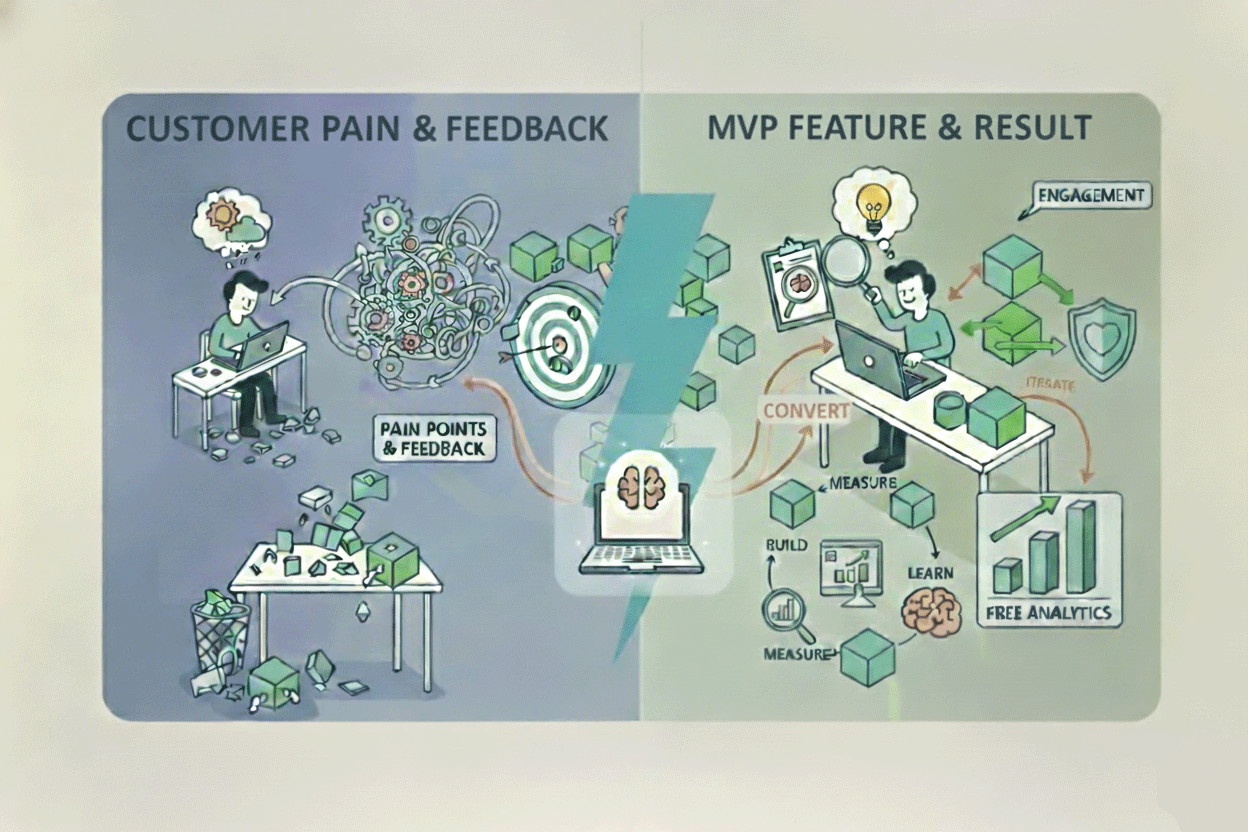
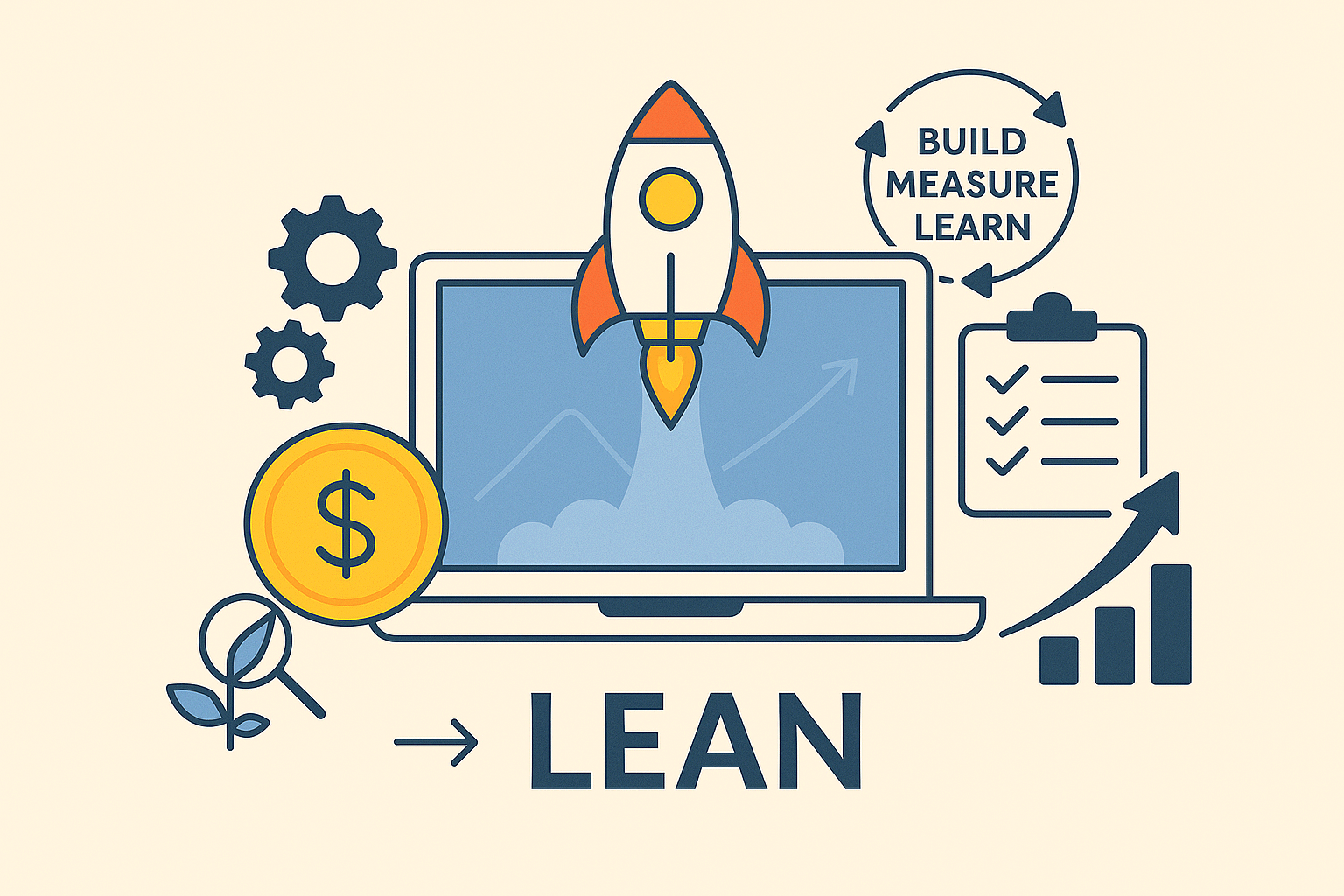
In the classic Eric Ries loop—Build, Measure, Learn—most founders interpret "Build" as an engineering task: "Create a product, then see how people respond." They treat the product as the destination, the prize at the end of the race. Another perspective is to “Create the simplest thing that will expose a behavior you can learn from.”
Your job is not to build a product. Your job is to build probes into reality. In physics, a probe is an instrument launched into an unknown environment to send back data. It isn't intended to stay there forever; it’s intended to survive long enough to transmit the truth back to the home base. A startup probe doesn't exist to impress a VC or look "clean" on Product Hunt. It exists to answer a singular, burning question about how the world actually works. This requires a fundamental shift in the founder's ego:
- From: “What features can we build to make this 'complete'?”
- To: “What do we need to learn right now, and what is the absolute smallest thing we can build to trigger that learning?”
Once you view "Build" as a learning expense rather than a value-add, much of what passes for startup "progress" reveals itself as expensive, high-fidelity guessing. You realize that a 20-feature roadmap is actually just 20 chances to be wrong, and you’d rather be wrong about one thing at a time for $500 than 20 things at once for $50,000. Real building isn't about construction; it's about interrogation.
The very best startup ideas tend to have three things in common: they're something the founders themselves want, that they themselves can build, and that few others realize are worth doing. — Paul Graham
The Paul Graham Warning: The Danger of Plausible Ideas
In his seminal essay, How to Get Startup Ideas, Y Combinator co-founder Paul Graham highlights a "doubly dangerous" trap for founders: the "plausible-sounding" bad idea. These are ideas that sound like they should exist—"Facebook for Pet Owners" or "A Marketplace for Local Artisans"—but for which there is no actual "pull" or urgent need from the market.
The danger is that because the idea is plausible, the founder feels justified in building a robust version of it. They spend months on the "Pet Social Graph" or the "Artisan Payment Gateway." By the time they realize no one is using it, they have built a monument to an assumption rather than a probe into reality. They are left with a "Product" that has no "Market," and no remaining capital to find one. They mistook a "good dinner party topic" for a "viable business model."
⚠️ Important: He had built a monument to an assumption rather than a probe into reality. Do not mistake architectural elegance for market resonance.
Before the MVP: Defining the Minimum Viable Question
The term "MVP" (Minimum Viable Product) has been co-opted and corrupted by the industry. It is now often used as an excuse to build a "slightly buggy" version of a full product. But even an MVP is downstream of something more vital: the Minimum Viable Question (MVQ).
If you don’t know exactly what question you are trying to answer, even a "lean" build is overbuilt. If you are building "to see what happens," you are gambling with your life's work. If you are building to answer an MVQ, you are conducting an experiment. An MVQ sounds like:
- "Will mid-market HR leads actually click a 'Request Demo' button if we promise to automate compliance audits via AI?"
- "Do users return to the dashboard a second time within 48 hours without being prompted by a push notification?"
- "Are customers willing to upload sensitive financial data to a prototype that looks this unpolished, or is trust our primary barrier?"
The question tells you what to build. If your question is about "willingness to pay," you don't build a complex dashboard; you build a high-converting pricing page with a "Buy Now" button that leads to a "Coming Soon" waitlist. That is a build. That is a probe. It provides a more honest signal than a hundred "I would totally buy that" comments from friends who don't want to hurt your feelings.
💡 Key Insight: The question tells you what to build. If you can't state the question, stop the sprint.
The Hierarchy of Building: Four Levels of Investigation
It is recommended founders move through a hierarchy of builds, earning the right to write production code only after the previous level has yielded a significant signal. We call this the "Learning Escalator."
Level 1: Building Systems of Observation (No Code)
- The Question: Is this problem real and painful, or am I hallucinating it based on my own biases?
- The Goal: To hear a potential customer describe the pain in their own words, using their own vocabulary, before you've contaminated them with your pitch.
Level 2: Building Artifacts (The Articulation)
- The Question: Does my specific angle on this problem resonate enough to create "pull"?
- The Goal: To see if someone says, "When can I have this?" or better yet, "Can I pay you to solve this for me manually right now?"
Level 3: Building Lightweight Systems (Concierge & No-Code)
- The Question: If I solve this problem manually, does the user value the outcome enough to change their daily behavior or open their wallet?
- The Goal: To prove that the "Job-to-be-Done" is high-priority enough to overcome the friction of a clunky UI.
Level 4: Building Product Slices (The Engineering Move)
- The Question: Can we deliver this value repeatedly, reliably, and profitably with software?
- The Goal: To generate Evidence of Retention. Do they come back when the novelty wears off?
Why Overbuilding is Emotionally Ruinous
There is a financial cost to overbuilding, but the emotional cost is what kills most founders. When you spend six months crafting a complex system, you stop being an objective scientist and you become the system's defense attorney.
The "Sunk Cost Fallacy" is a biological reality in the startup world. When you’ve spent $100k and 1,000 hours on a feature set, your brain treats that code as part of your identity. Consequently:
- You stop being able to "hear" that users don't care. You assume they just "need more onboarding" or "the UI needs a refresh."
- You start "explaining" the product to users during tests instead of listening to their silence. You become a salesperson when you should be a researcher.
- You treat negative evidence as a personal threat to your identity rather than a guide for your strategy.
When you build smaller, focused probes, you remain agile—not just in your code, but in your mind. You aren't married to a solution; you are obsessed with the problem. This emotional flexibility is a competitive advantage that no amount of venture capital can buy. It allows you to pivot when the signal says "no" without feeling like you are burning your life's work to the ground. It keeps you objective in a game that is designed to make you delusional.
💡 Key Insight: This emotional flexibility—the ability to detach your ego from the code—is a competitive advantage that no amount of venture capital can buy.
The "Build" Checklist
Before your next sprint, put every planned feature, update, or "improvement" through this three-point audit. If a feature doesn't pass all three, it’s not a build; it’s an indulgence.
Example: "Users will be willing to connect their primary bank account to see this automated tax analysis."
Example: "If fewer than 10% of invited users link an account within 24 hours of signing up, the value proposition is too weak to justify building the automated filing engine."
Example: Can we test this with a fake "Connect Bank" button that triggers a survey or a manual request for a PDF statement before we build the Plaid integration?
Closing: The Moat of Judgment
In 2026, execution—in the sense of typing code and deploying servers—is no longer the bottleneck. It is no longer a moat. Anyone with a GPT-5 subscription and a weekend can "build" a functional application. The founders who win are no longer the best "builders"; they are those who build exactly enough to know what is true.
The new "moat" is judgment. It is the ability to look at a beautiful roadmap and have the courage to delete 80% of it because it hasn't earned the right to exist yet. Your goal for this week shouldn't be to ship ten features or clear your JIRA backlog. It should be to reduce the uncertainty of your business model by 10%.
Build less. Learn more. Then—and only then—build again.


No comments yet
Be the first to share your thoughts on this article!